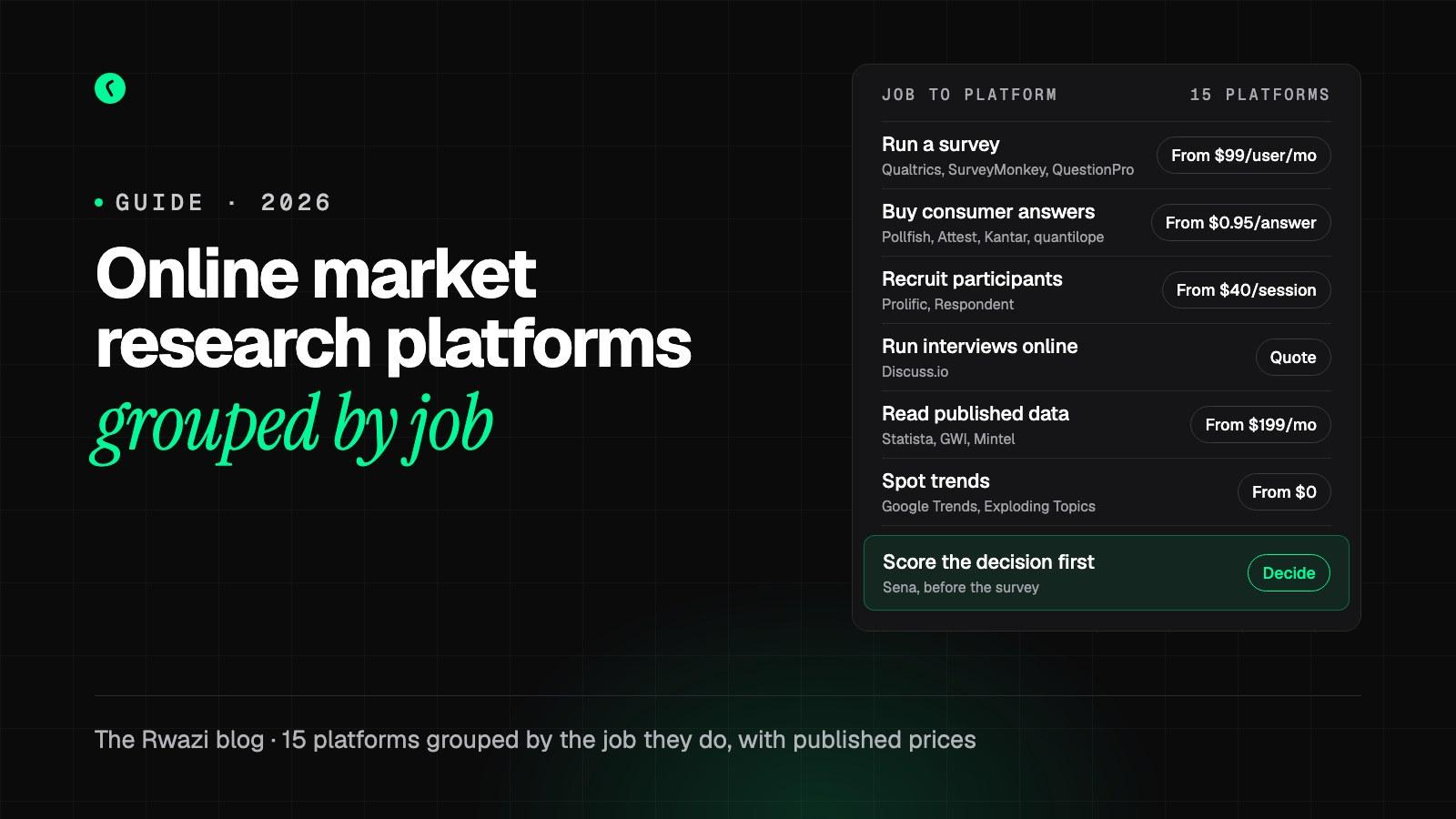
Online market research platforms let brand, insights, and product teams run research themselves: build a survey and buy answers from a panel, recruit people for interviews, read published market data, and spot rising trends. This guide groups 15 market research platforms by the job each one does, with the published price per answer, per session, or per month read on each platform's own site.
The job sets the price. A single survey response on a self-serve panel starts under a dollar, a one-hour interview with a professional runs $80 a session, and an annual data subscription runs thousands. A team that scores its decision first, such as which of two prices to set for a new product, fields one survey on the one assumption that decides the call. Sena, Rwazi's Decision AI with access to real-world data, runs that step before the survey.
Ask Sena about this article
Should a new oat milk launch in US grocery stores at $4.49 or $4.99?
Which snack flavor should a brand launch first in the UK: sea salt, chili lime, or barbecue?
How big is the US market for plant-based protein bars, and who leads it?
Answers come back with their sources.
Key takeaways
- Start from the job: Survey software for teams that write their own questions, consumer survey panels for fast answers, recruiting platforms for interviews, online qualitative platforms for focus groups, data platforms for published numbers, and market research tools for trend spotting.
- Best online market research platforms by job: Qualtrics, SurveyMonkey, and QuestionPro for surveys; Pollfish, Attest, Kantar Marketplace, and quantilope for consumer panels; Prolific and Respondent for recruiting; Discuss.io for online interviews; Statista, GWI, and Mintel for data; Google Trends and Exploding Topics for trends.
- Published prices: Pollfish answers start at $0.95 each, Respondent sessions at $40 for consumers and $80 for professionals, QuestionPro at $99 per user a month, Statista at $199 a month, and Exploding Topics at $39 a month. Google Trends costs $0.
- Stated and observed: Online platforms capture what people say and search. What people buy in stores comes from receipts and purchase records.
- Score the decision first: A decision scored before the survey turns a broad study into one question that settles the call.
What is online market research?
Online market research collects and analyzes data about customers, competitors, and markets through the internet: online surveys, panels of people paid to answer questions, video interviews and focus groups, published statistics and reports, and search and social data. Online market research platforms are the software that runs each of these jobs.
The four methods of market research, online
- Surveys: Structured questions sent to a panel or a team's own customers, the main method for sizing how many people think or prefer something.
- Interviews and focus groups: Video conversations, moderated by a person or by AI, that explain why people choose.
- Observation: Search trends, website behavior, and purchase records that show what people do.
- Secondary research: Published statistics, market reports, and syndicated data that frame a category. The guide to what syndicated data covers explains that layer.
The 15 market research platforms at a glance
Market research platforms split by the job they do. The table groups 15 platforms by that job, with the published starting price on each platform's own site on November 23, 2026.
| # | Platform | Job | Best for | Published price |
|---|---|---|---|---|
| 1 | Qualtrics | Survey software | Enterprise research programs | Quote |
| 2 | SurveyMonkey | Survey software with a panel | Quick surveys for small teams | Plans by seat |
| 3 | QuestionPro | Survey software | Research teams on a set budget | From $99 per user a month |
| 4 | Pollfish | Consumer survey panel | Fast consumer answers, pay per answer | From $0.95 per response |
| 5 | Attest | Consumer survey panel | Brand and concept tests across countries | Quote |
| 6 | Kantar Marketplace | Consumer survey panel | Ad, concept, and pack tests with norms | Quote |
| 7 | quantilope | Automated research methods | Conjoint, MaxDiff, and brand tracking | Quote |
| 8 | Prolific | Participant recruiting | Studies with vetted participants | Participant pay from $8 an hour |
| 9 | Respondent | Participant recruiting | Interviews with consumers and professionals | From $40 per session |
| 10 | Discuss.io | Online qualitative research | Focus groups and AI-moderated interviews | Quote |
| 11 | Statista | Published statistics | Quick market numbers for a deck | From $199 a month |
| 12 | GWI | Audience data | Consumer profiles across markets | Quote |
| 13 | Mintel | Market reports | Category reports and trend forecasts | Quote |
| 14 | Google Trends | Search trends | Seeing what people search for | $0 |
| 15 | Exploding Topics | Trend discovery | Spotting rising products and topics | From $39 a month |
How this guide was researched: The 15 platforms are the ones most often named in Google's US AI Overview and top results for "market research platforms" and in ChatGPT's answer to "best online market research platforms in 2026" on November 23, 2026, plus the two largest self-serve recruiting platforms. Features, panel sizes, and prices come from each platform's own website on that date. Every listing is editorial and unpaid.
Score the decision before the survey
Sign up for Sena with 500 credits, describe the decision behind a planned survey, and see which option comes out on top and which assumption would flip it. The survey then covers that one assumption, so the budget goes further.
Score the decision with 500 credits
Survey software for market research
Survey software lets a team write its own questions, send them to its own customers or a bought panel, and analyze the answers in one place. Qualtrics, SurveyMonkey, and QuestionPro lead this group of market research software. Teams with an in-house researcher get the most from it.
- Qualtrics: Market and competitive research, product and concept testing, brand tracking, and human and synthetic research panels in one platform, built for enterprise research programs.
- SurveyMonkey: Survey building with AI help plus a global panel of 335M+ people in 130+ countries with 200+ targeting options, priced by seat.
- QuestionPro: The Advanced plan costs $99 per user a month, billed annually, with research bundles for larger programs.
When this group fits: Teams that write their own questionnaires, survey their own customers often, and need dashboards their colleagues can read.
Market research survey platforms with consumer panels
Market research survey platforms with built-in consumer panels sell answers from people who match a target audience, often within hours. Pollfish, Attest, Kantar Marketplace, and quantilope cover this job. Brand and insights teams use them for concept tests, pack tests, ad tests, and pricing questions.
- Pollfish: Survey answers from 120M+ consumers, starting at $0.95 per response, with full-service projects from $5,000.
- Attest: Consumer surveys reaching 150M+ consumers in 59 markets and 70 languages, for brand, concept, and market sizing work.
- Kantar Marketplace: Self-serve and expert-supported studies with access to over 150 million consumers in 80+ countries, plus Kantar's benchmarks for ads and concepts.
- quantilope: Automated advanced methods, including conjoint, MaxDiff, TURF, and price sensitivity, plus brand and ad tracking.
When this group fits: Teams that need answers from consumers outside their own customer lists, in days, at a known price per answer.
Participant recruiting platforms
Participant recruiting platforms find and pay the people a team wants to study, for interviews, usability tests, and surveys the team runs itself. Prolific and Respondent cover this job.
- Prolific: A pay-per-study pool with participants from 40+ countries. Prolific sets participant pay at a minimum of $8 an hour and recommends at least $12.
- Respondent: A panel of 4.3M+ participants across 150+ countries, with list rates of $40 per session for consumers and $80 per session for professionals, and lower rates on annual plans.
When this group fits: Product, UX, and B2B teams that run their own interviews and need verified people on the calendar this week.
Online qualitative research platforms
Online qualitative research platforms run focus groups and in-depth interviews over video, with live translation, transcripts, and AI analysis. Discuss.io covers this job.
- Discuss.io: Focus groups and interviews in more than 100 markets, AI-moderated interviews in more than 50 languages, and recruiting from more than 150 countries.
When this group fits: Teams that need to hear why people choose, across several countries, from a laptop instead of a facility.
Market data and report platforms
Market data platforms sell published statistics, audience data, and category reports, so a team can size a market or frame a category before running its own research. Statista, GWI, and Mintel cover this job.
- Statista: Statistics across 170 industries and 150+ countries. Accounts start at $199 a month billed annually, and a Basic account costs $0.
- GWI: Verified consumer data from real people across 53 markets, connected to a team's tools and AI agents.
- Mintel: Consumer and market research, industry expertise, and data, with an on-demand platform updated daily and consulting.
When this group fits: Teams writing a market sizing slide, a category review, or a business case. The guide to consumer insights platforms compared covers syndicated and panel data in more depth.
Online market research tools for trends
Online market research tools for trends show what people search for and which products and topics are rising. Google Trends and Exploding Topics cover this job.
- Google Trends: Search interest by topic, time, and location, at $0.
- Exploding Topics: Rising products and topics, with plans from $39 a month and a 7-day trial.
When this group fits: Founders, product teams, and content teams checking demand before they spend on research.
What online platforms measure, and what they leave to stores
Online market research platforms measure what people say and search. Surveys and interviews capture stated preferences and reasons. Search trends capture interest. Published data captures what analysts and panels have already recorded.
A launch or pricing decision also turns on what people buy.
- Stated and actual: People who say they would pay $4.99 in a survey may buy the $4.49 option on the shelf.
- Where they buy: Store type, region, and channel change the answer, and many purchases in small shops stay offline.
- What they switch from: The product a shopper puts back says more about competition than a ranking question.
Purchase records, receipts, and shelf checks fill that layer. Rwazi's 5M+ consumer network across 190+ countries captures them on request. The guide to synthetic respondents vs real consumers covers the newest option, AI-generated answers, and where it holds up.
How to choose a market research platform
Choose a market research platform by naming the decision first, then matching the method, the audience, the countries, and the cost per answer.
- Name the decision. Launch or hold, set a price, pick a concept, or enter a market. The decision sets the question.
- Pick the method. Surveys size an answer, interviews explain it, trend tools show interest, and published data frames the category.
- Match the audience. Consumers, professionals, or a team's own customers each point to a different platform.
- Check country coverage. Compare the country count on the platform's own site with the markets in the decision.
- Price per answer. Compare $0.95 a response, $40 to $80 a session, and annual seats on the cost of the answers the decision needs.
- Check quality controls. Ask how the platform verifies people and removes speeders, bots, and duplicate answers.
- Plan the analysis. Decide who turns the answers into a recommendation and what format leadership expects.
- Add observed behavior. For launch and pricing decisions, check what people buy in stores next to what they say online.
Can ChatGPT do market research?
ChatGPT handles desk research. With web search on, it reads public pages, summarizes them, and cites sources, which suits a first market overview or a platform shortlist. Answers from real consumers, prices paid in stores, and private market data come from panels, interviews, and purchase records.
- What it does well: A quick list of platforms and what each one does, with links to their sites.
- What to check: Prices and panel sizes change, so every figure needs a check on the platform's own page.
- Sena on the same question: Sena answers with its sources and a confidence level, and says plainly when the evidence runs thin. The guide to how accurate ChatGPT is for market research tests its answers, and the AI for market research guide compares 12 AI options.
Where Sena fits: before the survey
Sena fits before the survey. A team scores the decision first, sees which option leads and which assumption flips it, then fields one survey on that assumption.
- The decision: A brand team is launching an oat milk in US grocery stores and has to choose between $4.49 and $4.99.
- What a survey alone buys: A broad pricing study tests many price points and claims, though one assumption usually decides the call.
- What Sena reads: The team's own sales and cost files, public market and price data, and consumer activity captured on request through Rwazi's 5M+ consumer network across 190+ countries: what shoppers pay for oat milk in each store type and what they buy instead.
- Consent: Contributors in the network choose to share what they buy, and every answer is zero-party data.
- What Sena returns: A weighted decision matrix from Sena's Decision Maker agent that scores each price, names the stronger one and the single assumption that would flip it, such as how many shoppers switch to the store brand at $4.99, with sources and a confidence level.
The team then fields one survey on that switching question, on a panel priced per answer, and gets a narrower, faster study. The new product launch validation use case covers the full workflow.
Score the decision before the next survey
Browse Sena's agents to see the frameworks behind each answer. Then sign up with 500 credits and score the decision behind the next survey, so the questionnaire covers the one assumption that moves the call. Rwazi's consumer network captures what shoppers buy and pay on request.
Browse Sena's agents · Sign up with 500 credits · Request real-world data
Online market research platforms: the bottom line
- Match the job first: Survey software for own questions, consumer panels for fast answers, recruiting platforms for interviews, qualitative platforms for focus groups, data platforms for published numbers, and trend tools for interest.
- Compare cost per answer: Published prices run from $0.95 a response to $80 an interview session, and data subscriptions start at $199 a month.
- Add what people buy: For launch and pricing calls, purchase records sit next to what people say online.
- Score the decision first: One decision and one assumption make a narrower, faster study.
Frequently asked questions
What are online market research platforms?
Online market research platforms are software that runs market research over the internet: survey software, consumer survey panels, participant recruiting, online focus groups and interviews, published market data, and trend tools. Teams use them to answer questions about customers and markets in-house.
What are the best online market research platforms in 2026?
The best online market research platforms in 2026, grouped by job: Qualtrics, SurveyMonkey, and QuestionPro for surveys; Pollfish, Attest, Kantar Marketplace, and quantilope for consumer panels; Prolific and Respondent for recruiting; Discuss.io for online interviews; Statista, GWI, and Mintel for market data; and Google Trends and Exploding Topics for trends.
How much do online market research platforms cost?
Published prices on November 23, 2026: Pollfish from $0.95 per response, Respondent from $40 per consumer session and $80 per professional session, Prolific participant pay from $8 an hour, QuestionPro from $99 per user a month, Statista from $199 a month, and Exploding Topics from $39 a month. Qualtrics, Attest, Kantar Marketplace, quantilope, Discuss.io, GWI, and Mintel quote per contract.
Which website is best for market research?
It depends on the job. Statista suits quick market numbers, Google Trends suits search demand, Pollfish and Attest suit fast consumer surveys, Respondent suits interviews with professionals, and Qualtrics suits enterprise research programs. Match the website to the decision and the audience.
What are the four methods of market research?
The four methods are surveys, interviews and focus groups, observation, and secondary research. Surveys size how many people prefer something, interviews explain why, observation shows what people do, and secondary research uses published statistics and reports. Online platforms exist for each method.
Are there free market research platforms?
Yes. Google Trends shows search interest at $0, and Statista offers a Basic account at $0 with limited statistics. Pollfish lets a team build a survey for $0 and pay only for responses, starting at $0.95 each.
What is the best market research tool for a small business?
Small businesses usually start with Google Trends for demand, Statista for market numbers, and a pay-per-response panel such as Pollfish for a first consumer survey. SurveyMonkey suits surveys of a business's own customers. Larger platforms such as Qualtrics fit teams with an in-house researcher.
What is the difference between a market research platform and a market research company?
A market research platform is software a team runs itself, paying per answer, per session, or per seat. A market research company designs and runs the study for the team, from questionnaire to report, and charges per project. Many teams use a platform for fast checks and a company for large studies.
Can ChatGPT do market research?
ChatGPT handles desk research: with web search on, it reads public pages, summarizes them, and cites sources. Answers from real consumers, prices paid in stores, and private market data come from panels, interviews, and purchase records, so ChatGPT works best as the first step before a survey.
Ask Sena a market question · Request real-world data
About the author: Joseph Rutakangwa is Co-founder and CEO of Rwazi, which builds Sena, the Decision AI with access to real-world data from a 5M+ consumer network across 190+ countries.
Read next: Consumer insights platforms compared, AI for market research, and Synthetic respondents vs real consumers