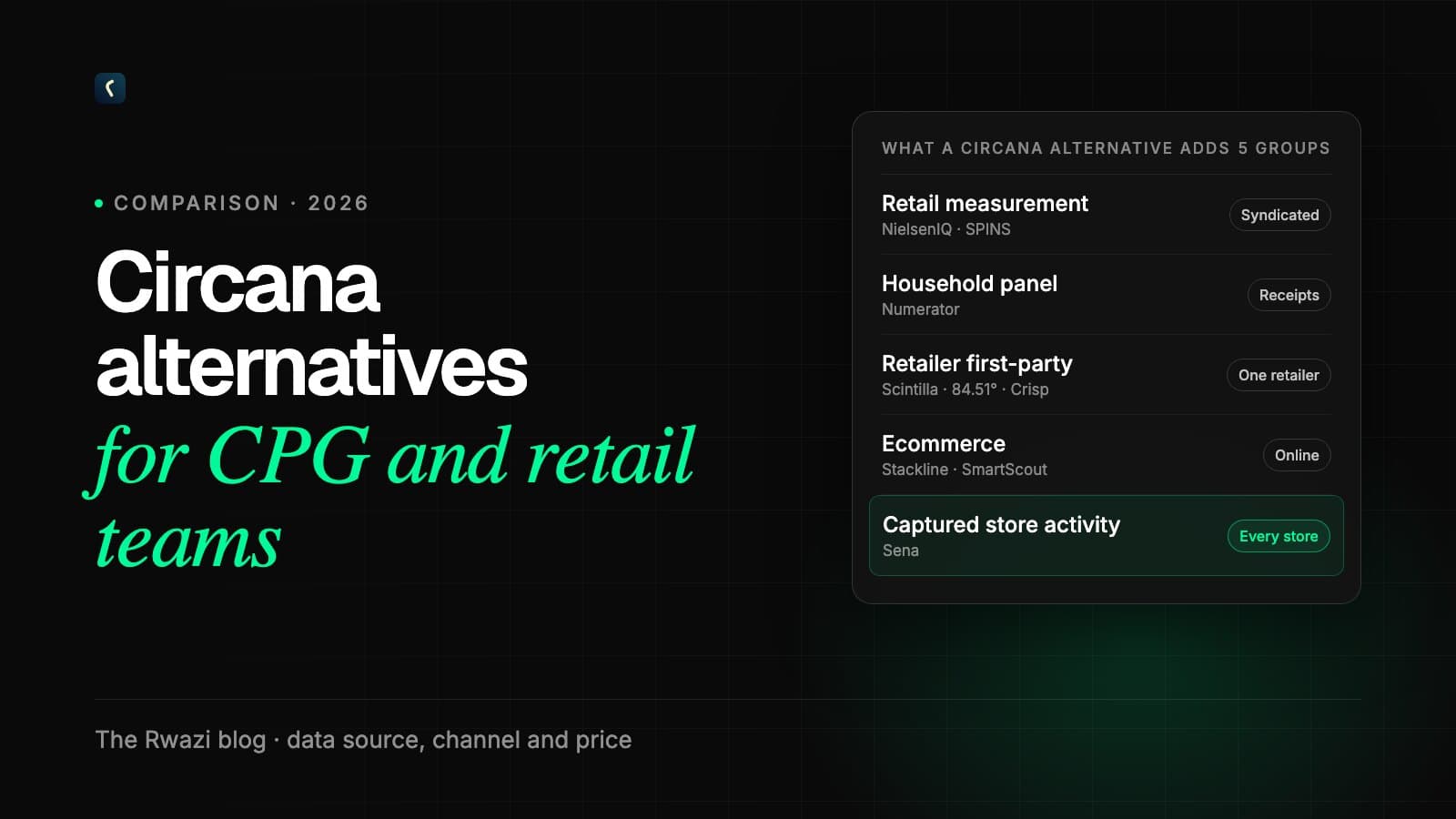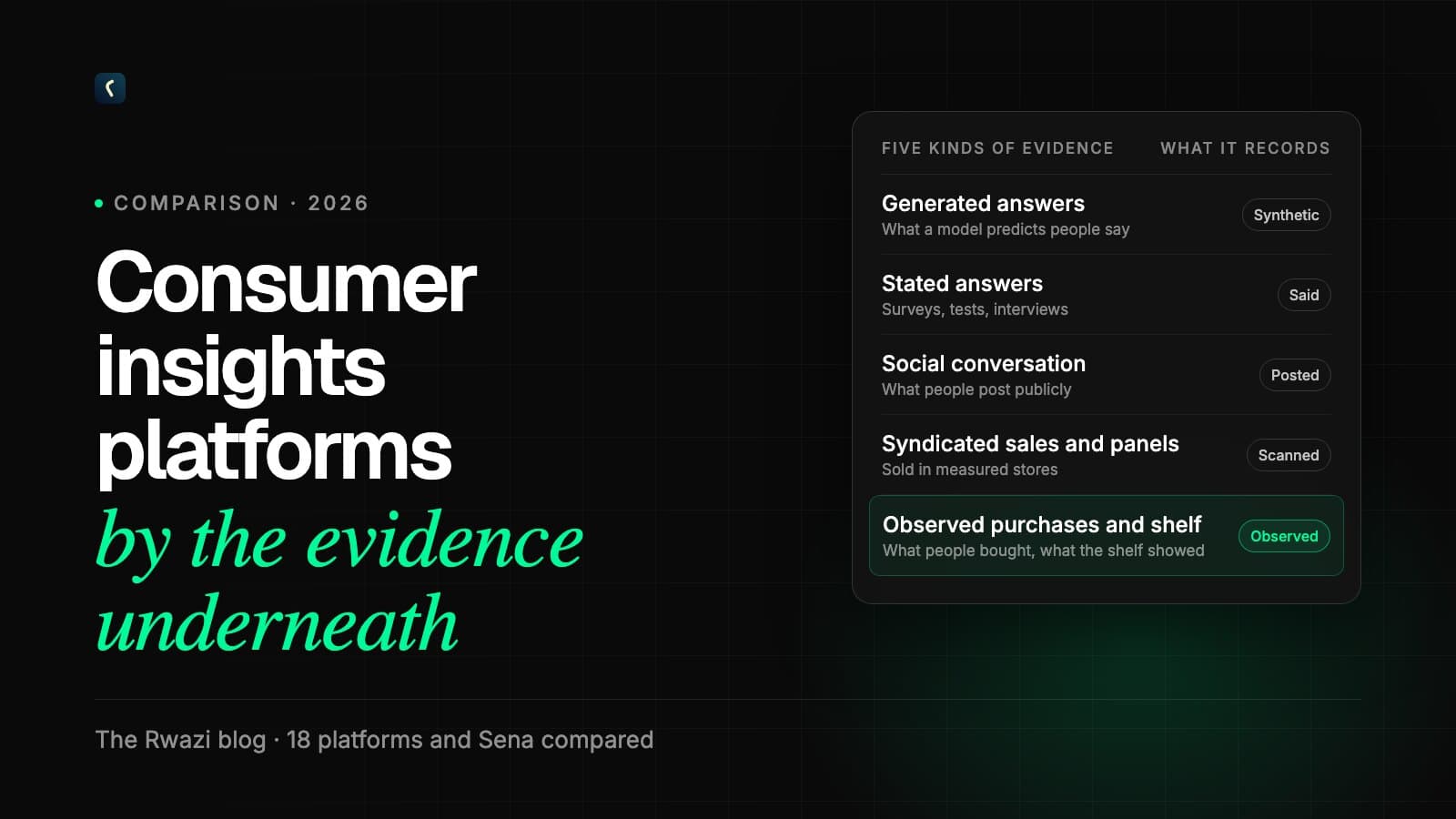
A consumer insights platform shows what consumers buy, think, and do ahead of product, brand, and pricing decisions. The leading options rest on five kinds of evidence: syndicated sales and panels (Circana, NielsenIQ, Numerator, SPINS); survey and concept tests (Zappi, quantilope, Attest, Qualtrics); AI-moderated interviews (GetWhy, Conveo); social and audience data (Brandwatch, GWI, YouGov); and captured activity.
Comparisons often rank these platforms on speed, live reporting, and AI features. The variable that decides whether a number survives a go or hold call is the evidence under it. This guide sorts 18 platforms by what each answer rests on and maps each kind of evidence to the decision stage it fits.
How we compared these platforms.
- Each platform is sorted by the evidence behind its answers, then by the decision stage it fits, its pricing model, and any published price.
- Prices appear only where a company or a named third party publishes them, with the date. Every source is named and linked where it is public.
Key takeaways
- Compare the evidence, then the features. Generated answers, stated answers, social conversation, syndicated sales, and observed purchases carry different weight in a decision.
- Match evidence to the stage. Early ideas can run on fast, cheaper evidence. Final calls need evidence of what people bought.
- Expect to run more than one. A syndicated feed, a testing platform, and a social listening platform each answer a different question.
- Check privacy before loading data. Ask each platform where data goes, and check license terms on any syndicated export.
What is a consumer insights platform?
A consumer insights platform is software that collects or connects consumer data, such as purchases, survey answers, interviews, or social posts, and turns it into findings a business can act on. The category covers syndicated data providers, survey and concept testing tools, AI interview platforms, social listening, audience profiling, and research repositories. Each one answers a different question about consumers.
Consumer insights vs. customer insights platforms
Consumer insights show why a market buys; customer insights show how a company's own customers behave. A consumer insights platform reads the wider market through sales data, panels, surveys, and interviews with people across the category, buyers and non-buyers alike.
A customer insights platform reads first-party data: CRM records, product usage, site journeys, support tickets, and feedback from existing customers.
- Microsoft's Dynamics 365 Customer Insights builds unified customer profiles from CRM data, with a US list price of $1,700 per tenant a month, paid yearly.
- Dovetail builds customer models from calls, tickets, surveys, and research.
- Contentsquare maps journeys across web, mobile, and conversations, with a free tier and a Growth plan from $39 a month, billed annually.
- Mixpanel combines product analytics, session replay, and experiments, free up to 1M events a month. Qualtrics XM joins surveys, chat, email, and digital behavior into customer profiles (all read Oct 20 2026).
| Consumer insights platforms | Customer insights platforms | |
|---|---|---|
| Question | Why does the market buy, and what will it buy next? | How do a company's own customers behave? |
| Data | Syndicated sales, panels, surveys, interviews, social posts, captured activity | CRM records, product events, web and app journeys, calls, and tickets |
| Examples | Circana, NielsenIQ, Zappi, GetWhy, Brandwatch, Sena | Dynamics 365 Customer Insights, Dovetail, Contentsquare, Mixpanel, Qualtrics XM |
| Fits | Market entry, launch, pricing, and category calls | Retention, onboarding, conversion, and service fixes |
What consumer insights do for a market decision
Consumer insights connect a business decision to evidence about people. A launch team uses them to judge which concept will sell. A brand team uses them to see why consideration moved. A pricing team uses them to see how shoppers respond to a price change. The decision sets which evidence matters: a launch needs purchase proof, while an early idea screen needs speed.
Five kinds of evidence behind AI consumer insights platforms
| Evidence | What it records | Strength | Fits |
|---|---|---|---|
| Generated answers | What a model predicts people would say, such as synthetic respondents | Fast and cheap at scale | Early idea screening |
| Stated answers | What people say in surveys, tests, and interviews | Direct, with the "why" | Concept, message, and brand work |
| Social conversation | What people post publicly | Unprompted and real-time | Reputation and trend spotting |
| Syndicated sales and panels | What was sold in measured stores, and who bought it? | The shared market scoreboard | Category, share, and price tracking |
| Observed purchases and shelf activity | What people bought and what the shelf looked like | Activity at the point of sale | Final launch, price, and store decisions |
Vendors of generated answers draw the same line. Qualtrics, which sells synthetic panels, says "synthetic data augments human research" (Qualtrics, Feb 19 2026).
What data each consumer insights platform uses, in one table
| # | Platform | Evidence | What its data rests on | Best for | Published price |
|---|---|---|---|---|---|
| 1 | Circana | Syndicated sales and panels | Scanned retail sales plus a household panel | Category and share tracking | Quote only; starter tier Liquid Data Go, $499 per story of 5 reports (Circana, Oct 20 2026) |
| 2 | NielsenIQ | Syndicated sales and panels | Scanned retail sales plus the Homescan panel | Category and share tracking | Quote only; Byzzer from $1K for Startup CPG members (NIQ, Oct 20 2026) |
| 3 | Numerator | Syndicated sales and panels | Receipts from household panels | Shopper trips across retailers | Quote only |
| 4 | SPINS | Syndicated sales and panels | Natural, organic, and specialty store data | Natural and wellness brands | Ignite+ plans from $250 a month (SPINS, archived Jul 10 2026); current page quote only |
| 5 | Kantar | Stated answers | Brand tracking and ad testing studies | Brand equity and creative | Quote only |
| 6 | Zappi | Stated answers | Automated concept and ad tests against norms | CPG concept and ad testing | Quote only |
| 7 | quantilope | Stated answers | Automated advanced methods such as conjoint | Advanced methods, self-serve | Business plan for 3 users from $2,300 a month (quantilope, Oct 20 2026) |
| 8 | Attest | Stated answers | Self-serve consumer studies across many markets | Multi-country studies | Quote only |
| 9 | Qualtrics | Stated answers | Enterprise survey and experience suite | Enterprises with a Qualtrics estate | Free plan; paid from $420 a month, third-party estimate (iTechGuides, Oct 10 2026) |
| 10 | GetWhy | Stated answers | AI-moderated video interviews | The "why" behind a result | Quote only |
| 11 | Conveo | Stated answers | AI-moderated video interviews | Consumer voice for stakeholders | Quote only |
| 12 | Brandwatch | Social conversation | Public social posts | Reputation and trend tracking | Quote only |
| 13 | GWI | Stated answers | Large audience profiling studies | Media and audience planning | GWI Audiences: free plan; paid from $1,500 per user a year, third-party estimate (iTechGuides, Oct 10 2026) |
| 14 | YouGov | Stated answers | The YouGov online panel | Brand tracking and quick studies | Quote only |
| 15 | Mintel | Stated answers | Category reports built on Mintel's own commissioned consumer surveys plus syndicated and secondary data (Mintel) | Category context and trends | Quote only |
| 16 | Stravito | Knowledge management | A company's own research library | Finding past studies | Quote only |
| 17 | Listen Labs | Stated answers | AI-moderated interviews from a 50M+ participant network | The "why" behind a result | Quote only |
| 18 | Sprout Social | Social conversation | Social listening inside a social media management suite | Brand and topic monitoring | Standard plan $199 per seat a month, billed annually; Listening is an add-on (Sprout Social, Oct 20 2026) |
| 19 | Sena (Rwazi) | Observed purchases and shelf activity, next to a team's own files | A team's files as uploads, including test and syndicated exports; its business systems through 250+ integrations; consumer activity from a 5M+ consumer network across 190+ countries; computer vision that reads shelf and store photos captured when a question needs it | Final launch, price, and store decisions | Quote via demo |
ChatGPT, asked in October 2026 to compare consumer insights platforms, named the first 16 in this table. This guide adds the column for the evidence under each answer.
1. Syndicated sales and panel platforms
These four sell syndicated data: one dataset, sold to many companies.
1. Circana and NielsenIQ
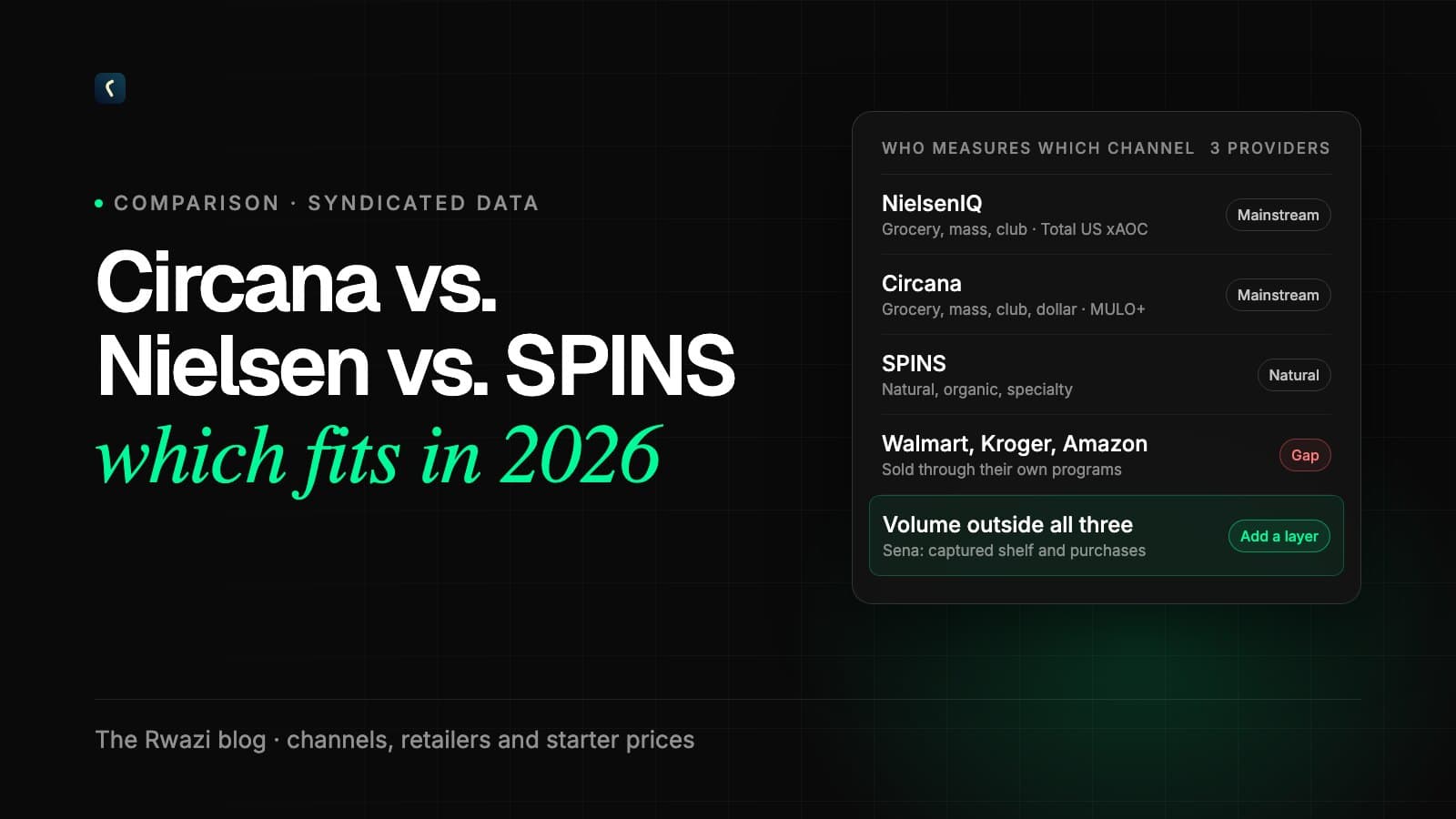
Circana and NielsenIQ sell scanned retail sales and household panels across grocery, mass, club, and drug, and Bedrock Analytics notes that "Circana is often used alongside NielsenIQ" (Bedrock Analytics, April 2026). Our guides to Circana alternatives and NielsenIQ alternatives compare each in depth.
Best for: category, share, and price tracking against competitors.
Watch for: both measure the stores that share their data, with gaps in club, marketplace, and small-store sales.
2. Numerator
Numerator builds household panels from shopper receipts, with 200K households in its Total Commerce Panel and 1M+ active households in its Measurement Panel (Numerator).
Best for: who buys, how often, and where.
Watch for: receipts show the purchase; shelf conditions need a separate capture.
3. SPINS
SPINS measures natural, organic, and specialty retail.
Best for: wellness and organic brands.
Watch for: a narrower view of mainstream grocery.
B. Survey and concept testing platforms: Kantar, Zappi, quantilope, Attest, and Qualtrics
1. Kantar and Zappi
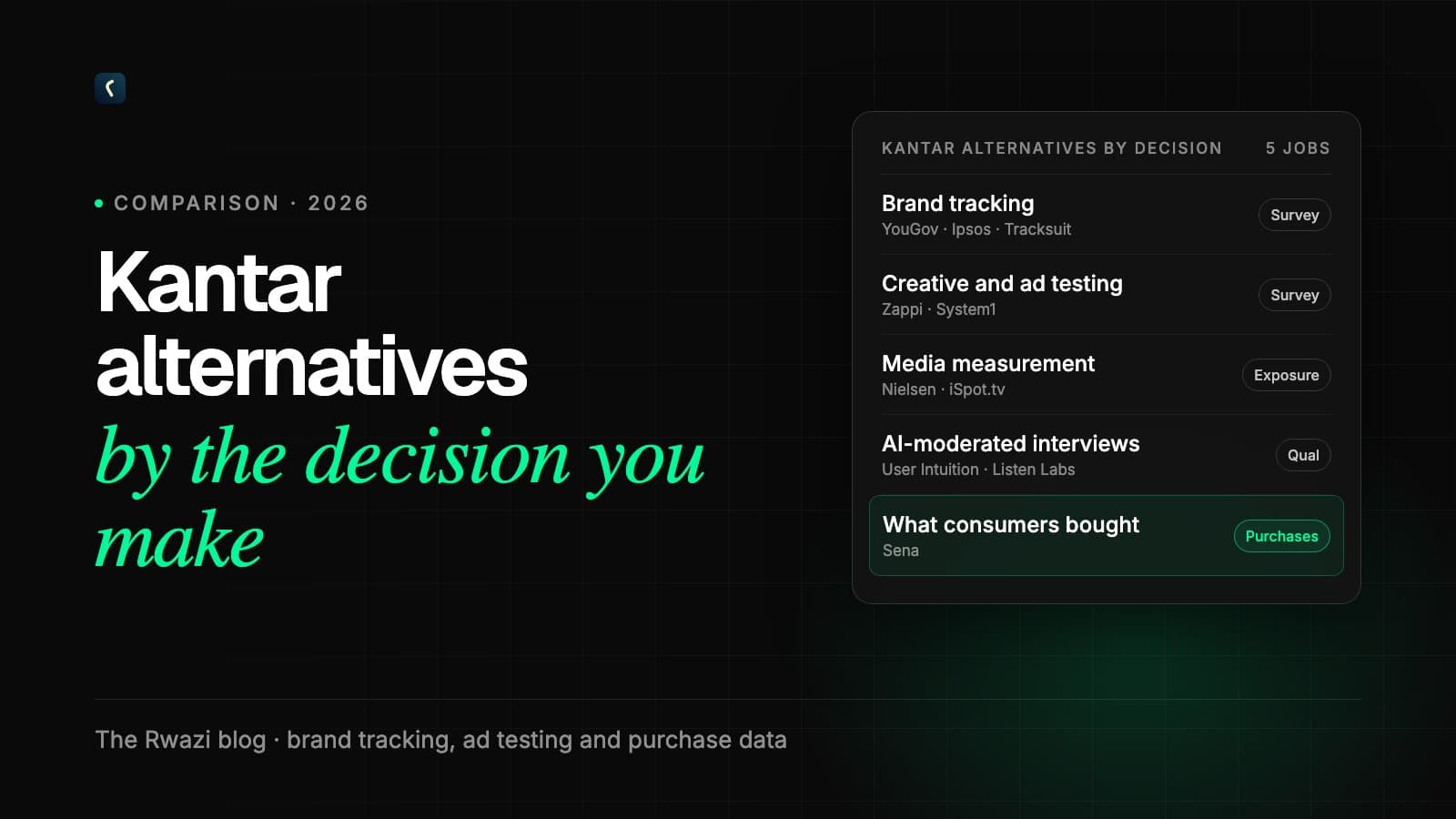
Kantar runs brand tracking and ad testing (see Kantar alternatives), and Zappi automates concept and ad tests against category norms.
Best for: brand equity programs and CPG concept screening.
Watch for: both record what people say, which needs a purchase check before a final call.
2. quantilope, Attest, and Qualtrics
- quantilope is an automated consumer insights platform for advanced methods such as conjoint, in a self-serve setup.
- Attest runs self-serve studies across many markets.
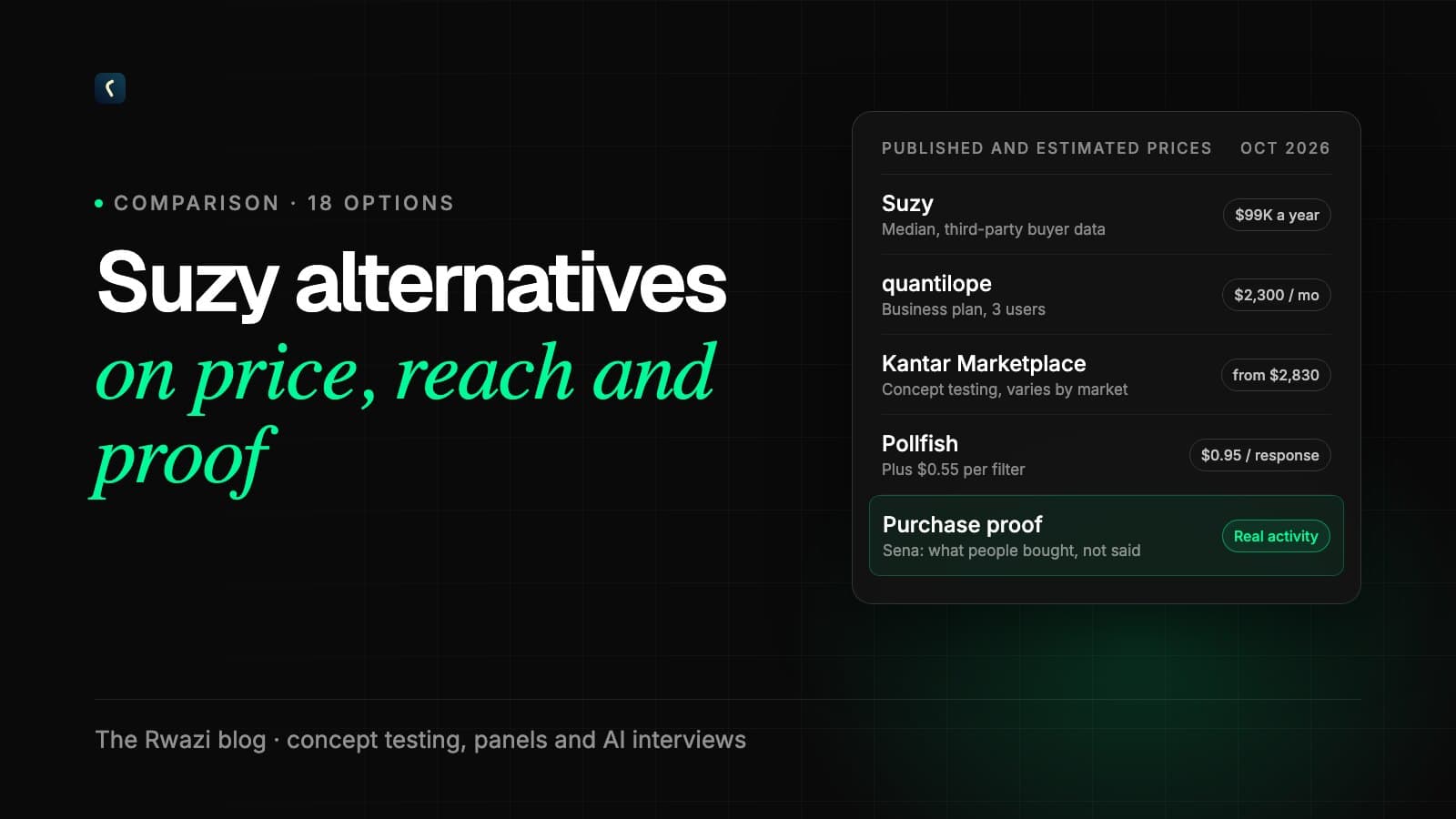
- Qualtrics runs surveys inside an enterprise experience suite. For a wider list of testing tools, see Suzy alternatives.
Best for: teams with research skills that design their own studies.
Watch for: the team owns the design and the reading of results.
C. AI-moderated interview platforms: GetWhy, Conveo, and Listen Labs
- GetWhy and Conveo run AI-moderated video interviews and turn them into themes and clips. Listen Labs runs AI-moderated interviews across 120+ languages, recruiting from a network of 50M+ participants or a company's own contact list (read Oct 20 2026).
Best for: the "why" behind a score, with consumer voice for stakeholders.
Watch for: check the sample size behind each theme before a final call.
D. Social and audience platforms: Brandwatch, Sprout Social, GWI, and YouGov
- Brandwatch tracks public social conversation.
- Sprout Social adds listening to its social media management suite, with queries that track conversations around key topics, and sells Listening as an add-on; its standard plan is $199 per seat a month, billed annually (read Oct 20 2026).
- GWI profiles audiences through large studies of media use and attitudes.
- YouGov runs brand tracking and quick studies on its online panel.
Best for: reputation, media planning, and audience targeting.
Watch for: they show what people say and post; purchases come from a purchase panel or retailer data.
E. Reports and knowledge platforms: Mintel and Stravito
- Mintel sells category reports built on its own commissioned consumer surveys plus syndicated and secondary data.
- Stravito stores a company's own research so teams can find past studies.
Best for: category context and reuse of past work.
Watch for: Mintel reports cover a category at large, and Stravito holds the studies a team has already run.
Synthetic answers vs. answers from real people
Synthetic respondents and AI-generated audiences predict what people would say, built from data that already exists. They suit early screening of many ideas, where speed matters more than precision.
Real people suit concepts, messages, and brand decisions. Observed purchases suit the final call, because they record what people did. A team can run the three in sequence: synthetic to narrow, real people to choose, and purchase evidence to confirm.
The best consumer insights platform
| Decision stage | Evidence that fits | Platforms |
|---|---|---|
| Early idea screening | Generated and fast-stated answers | AI audience tools, Attest |
| Concept and message choice | Stated answers with norms | Zappi, quantilope, Kantar |
| Understanding the "why" | AI-moderated interviews | GetWhy, Conveo, Listen Labs |
| Brand and reputation tracking | Stated answers and social conversation | Kantar, YouGov, Brandwatch, Sprout Social |
| Category and share tracking | Syndicated sales and panels | Circana, NielsenIQ, Numerator, SPINS |
| Final launch, price, and store calls | Observed purchases and shelf activity | Sena (Rwazi), next to syndicated data |
How consumer data privacy differs across platforms
Privacy depends on where the data comes from. Survey and interview platforms collect consent from participants. Syndicated data arrives under a license, so check its terms on where exports may be loaded. Social listening reads public posts.
Before choosing, ask each platform how participants consent, where data is stored, how long it is kept, and whether it trains shared models. Confirm licensed data terms with the provider before loading exports into any new system.
Which consumer insights platform fits by category, sales channel, and budget
- By category. Concept and product testing leans on Zappi or Quantilope. Social listening leans on Brandwatch. Audience profiling leans on GWI or YouGov. Research reuse leans on Stravito.
- By sales channel. Retail purchase questions lean on Circana, NIQ, Numerator, or SPINS. Brands selling through small independent stores or markets with thin published data add captured consumer activity.
- By budget. Self-serve plans such as Attest and Quantilope suit teams with in-house skills. Enterprise suites such as Qualtrics or Kantar suit large programs. Syndicated subscriptions are quoted per category and channel, with starter tiers for small brands. Rwazi's compare hub sets Sena against named alternatives.
See whether to launch in two markets or five
A head of consumer insights has a concept that won its test, a syndicated feed that shows the category growing, and social chatter that says shoppers love the idea, and leadership has to decide whether to launch in two markets or five.
Sena reads the test export, the syndicated file, and the team's sales data, adds purchase and shelf activity captured in the candidate markets, and returns priority actions: which markets show real buying in the category, where price points sit, and where to launch first.
Leadership sees the evidence behind each priority action before it commits. Book a demo to see Sena put real-world purchase evidence next to a team's existing consumer data.
Frequently asked questions
What do consumer insights do?
Consumer insights connect business decisions to evidence about people: what they buy, think, say, and do. Launch teams use them to judge which concept will sell, brand teams to see why consideration moved, and pricing teams to see how shoppers respond to price changes. The decision sets which kind of evidence matters most.
What is the best software for customer insights?
For customer insights, Qualtrics XM, Microsoft Dynamics 365 Customer Insights, Contentsquare, Mixpanel, and Dovetail read a company's own customers. For the wider market, consumer insights platforms such as Circana, NielsenIQ, Zappi, and GetWhy fit better, and final launch and price calls need evidence of what people bought.
What are some reputable companies that provide consumer insights?
Established names include Circana, NielsenIQ, Numerator, and SPINS for sales and purchase data; Kantar for brand and custom studies; Zappi and Quantilope for concept testing, GWI and YouGov for audience data; Brandwatch for social listening; and Mintel for market reports.
What is a consumer insights platform?
A consumer insights platform is software that collects or connects consumer data, such as purchases, survey answers, interviews, or social posts, and turns it into findings a business can act on. It covers syndicated data, survey and concept testing, AI interviews, social listening, audience profiling, and research repositories.
How do I choose a consumer insights platform?
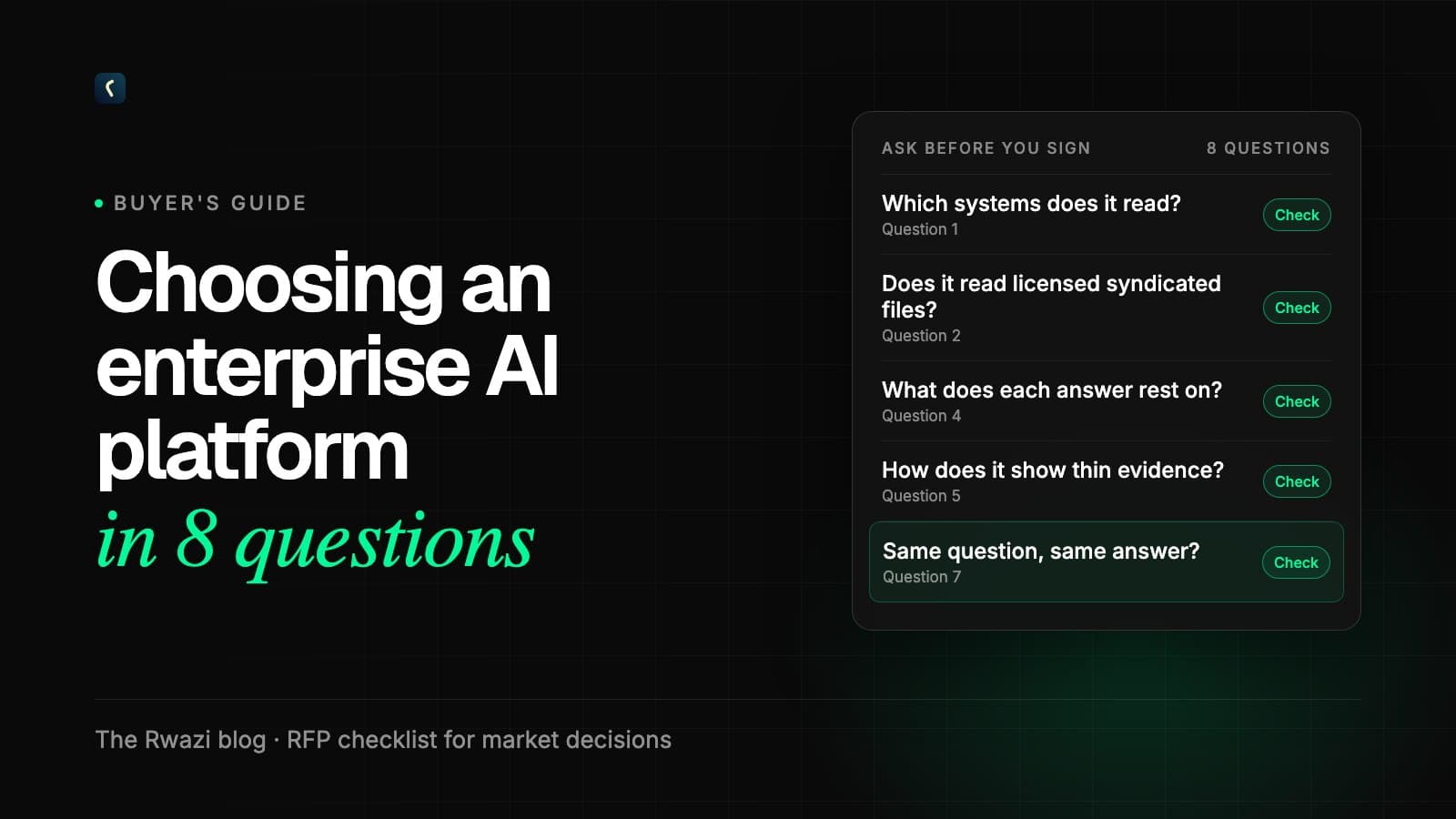
Start with the decision, then the evidence it needs. List the decisions the team makes most, map each to the evidence that fits (stated answers, social, syndicated sales, or observed purchases), then shortlist platforms by that evidence. Check data privacy and licensed data terms, and test each shortlisted platform on one live decision, using our AI platform questions.
What are examples of CX tools?
Examples of CX tools include Qualtrics XM for feedback across surveys, calls, and chat; Contentsquare for web and app journeys; Mixpanel for product analytics; Dovetail for turning calls and tickets into research; and Microsoft Dynamics 365 Customer Insights for unified customer profiles. CX tools read a company's own customers; consumer insights platforms read the wider market.
Are synthetic respondents reliable for consumer decisions?
For early screening, yes; for final calls, no. Synthetic respondents predict answers from data that already exists, so they suit early screening, where speed matters more than precision. For concept choice and final launch calls, teams bring in real people and purchase evidence. Published accuracy figures for synthetic respondents mostly come from the vendors themselves, so treat them as directional.
How do consumer insights platforms handle data privacy?
It depends on the source. Survey and interview platforms collect participant consent. Syndicated data arrives under a license, so check its terms on where exports may be loaded. Social listening reads public posts. Ask each platform about consent, storage location, retention, and model training before loading any proprietary or licensed data.