Syndicated data is market and sales data that an independent research firm collects once, standardizes, and sells by subscription to many companies in the same industry. It works as the shared scoreboard for a category. In consumer goods, NielsenIQ, Circana, and SPINS sell it as retail sales from store scans and household purchases from consumer panels.
Most guides answer "What is syndicated data?" from the seller's side. This one explains it from the buyer's seat: what it measures, how fresh it is, what it costs, and where its coverage stops. The decision a CPG team faces is what to add around it. For a large brand, the worry is the share of sales that sits outside the file: club stores, marketplaces, small independent stores, and markets where published data is thin.
Sources and method
Definitions follow Drive Research and Greenbook, linked in the text. Dataset names, coverage notes, and prices come from linked pages, with the date we read them.
Key takeaways
- One dataset, many buyers. The provider collects and cleans the data once and sells the same view to every subscriber, which keeps the cost per company below a custom study.
- Two main types in CPG. Retail measurement from scanned store sales and household panel data from consumers who record what they buy.
- It arrives with a lag. Crisp notes syndicated data is often a month old or more by the time CPG teams receive it.
- Coverage follows data-sharing deals. Each provider covers part of the market. Club stores, marketplaces, and small independent stores often sit in separate feeds.
What is syndicated data?
Syndicated data is information a research company gathers, standardizes, and sells to multiple clients on subscription, as opposed to custom data collected for one client. In CPG, the providers receive point-of-sale data from participating retailers, project it to a total market, and sell category views by product, brand, retailer, region, and week.
Every subscriber in a category sees the same numbers, which is why retailers and suppliers use them as a common reference in joint business planning. The syndicated data meaning comes from publishing. "Syndicated" means produced once and sold to many, the same way a syndicated newspaper column runs in many papers.
Key characteristics of syndicated data: shared, standardized, lower cost, delayed
- Shared: Every subscriber buys the same dataset, so competitors read the same scoreboard.
- Standardized: Products, categories, and markets follow the provider's definitions, which makes numbers comparable across brands and retailers.
- Lower cost per company: The collection cost spreads across many subscribers, so a category view costs less than a custom study of the same scope.
- Delayed: Syndicated data is retrospective. Crisp notes it is "often a month old or more by the time it is made available for CPGs" (Crisp).
Syndicated data examples: store sales, household purchases, and category share
| Example | What it shows | Typical use |
|---|---|---|
| Weekly sales by retailer and region | Units and dollars sold per product | Tracking performance against the plan |
| Category share | A brand's share of category sales | Retailer reviews and annual planning |
| Average price and promotion lift | Shelf price paid and sales during promotions | Pricing and trade spend decisions |
| Store coverage | The share of stores carrying a product | Sales team targets and listings |
| Household penetration and repeat | How many households buy, and how often do they come back? | Launch tracking and brand health |
| Syndicated consumer survey data | Media use and attitudes from a standing sample, such as MRI-Simmons | Audience targeting and planning |
Syndicated data vs. custom research
| Syndicated data | Custom research | |
|---|---|---|
| Who designs it? | The provider, for a whole market | The client, for one question |
| Who owns the data? | The provider's clients have license access. | The client |
| Cost model | Subscription shared across many buyers | One project paid by one buyer |
| Best use | Tracking a market over time against competitors | Answering a specific question the market data leaves open |
Syndicated data counts as secondary research because the provider collects it once for many users (Drive Research; Greenbook).
Syndicated data vs. panel data vs. retailer POS data, such as Scintilla and 84.51° Stratum
| Data type | Where it comes from | Freshness | Strength | Limit |
|---|---|---|---|---|
| Syndicated retail data | Scanned sales from participating retailers, projected to a market | Weekly, delivered with a lag | Market-wide view of every brand in a category | Covers the retailers that share data |
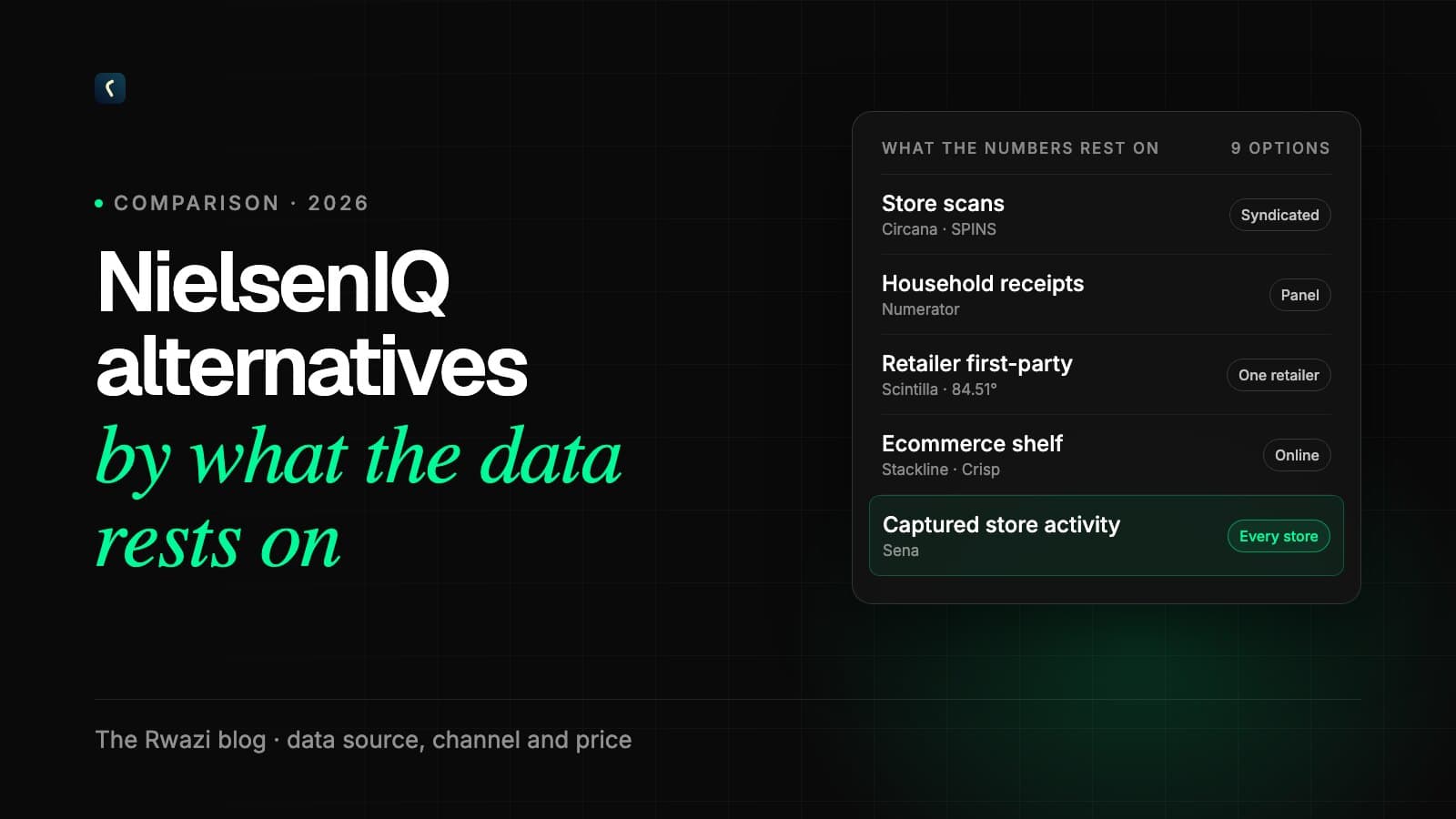
| Household panel data | Consumers who scan or photograph their purchases | Periodic | Who buys, how often, and across which retailers | Panel size limits detail for small brands and regions. |
| Retailer first-party POS data | One retailer's own transactions, shared with suppliers through programs such as Scintilla (formerly Walmart Luminate) and Kroger's 84.51° Stratum | Retailers increasingly share daily, per Crisp. | Fresh, store-level detail for that retailer | One retailer's stores |
Walmart announced in October 2024 that Walmart Luminate would become Scintilla (Walmart), and many guides still use the old name.
Syndicated data providers
| Provider | Background | Signature dataset or offer |
|---|---|---|
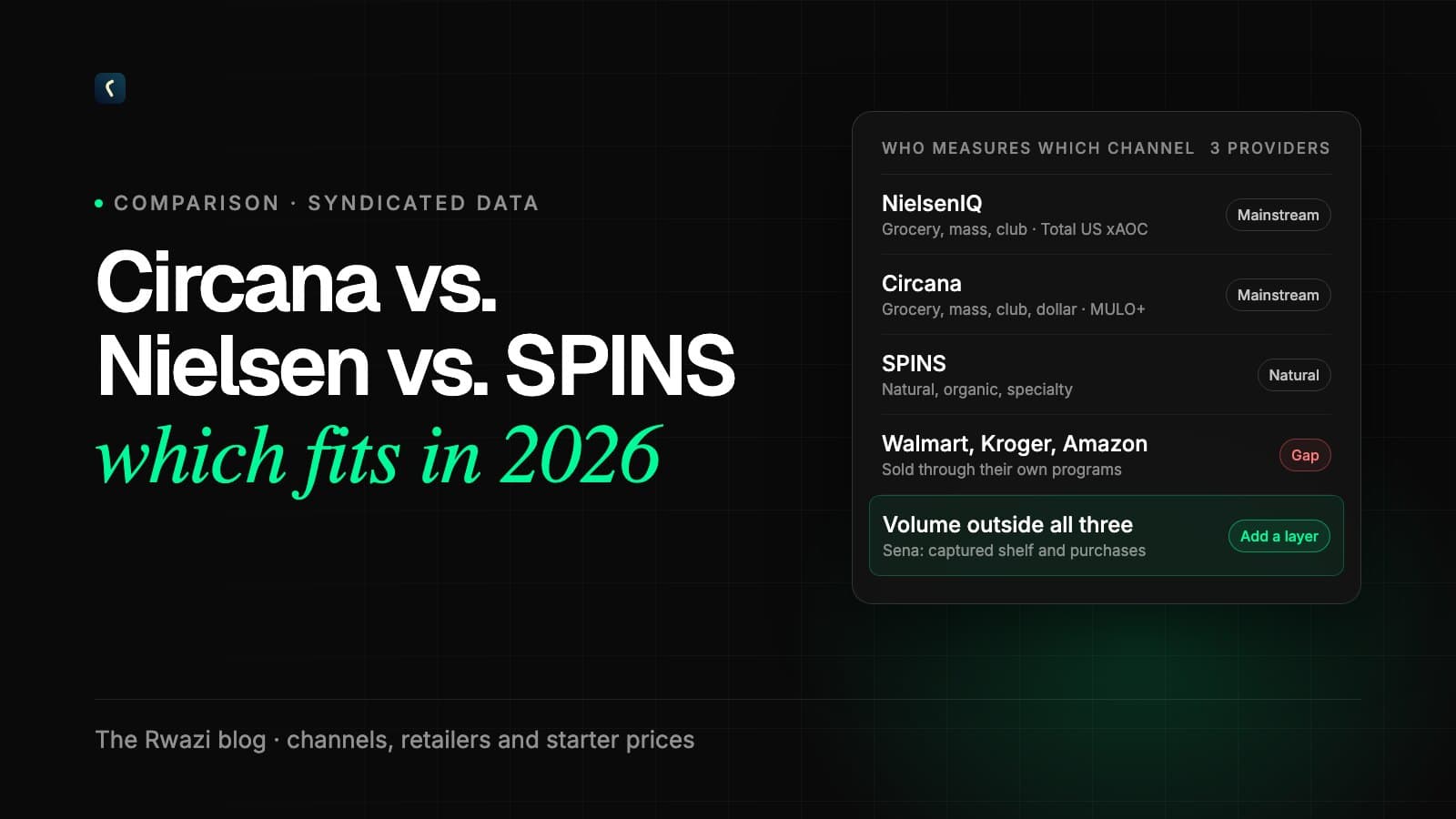
| NielsenIQ (NIQ) | Separated from Nielsen in 2021; combined with GfK in 2023; listed on the New York Stock Exchange since July 2025 (Simpson Thacher) | Total US xAOC (All Outlet Combined); the Homescan panel of 250,000+ households in 25 countries |
| Circana | Formed when IRI and NPD merged in August 2022, and took the Circana name in March 2023 (Circana) | MULO, across grocery, mass, club, dollar, and select retail; MULO+, adding ecommerce and convenience |
| SPINS | Specialist in natural and specialty retail | Natural Enhanced Channel: natural, specialty, and gourmet retail |
| Numerator | Purchase data from shopper receipts; since July 2025, Worldpanel by Numerator is the brand for its global business (Kantar) | Household receipt panels |
| MRI-Simmons | Syndicated consumer survey data on media and attitudes | US consumer study |
Dataset definitions from Bedrock Analytics, April 2026. Retailers also sell their own first-party data through programs such as Scintilla and 84.51°, which sit next to syndicated data with deeper detail for one retailer.
Which stores and channels syndicated data covers
Every syndicator leaves coverage gaps, because each provider has exclusive retailer ties (Bedrock Analytics, April 2026). Grocery, drug, and mass merchandisers are widely covered. Natural and specialty stores are a SPINS strength. Club stores, ecommerce marketplaces, and some large retailers sell their data through their own portals or programs.
Costco data is usually sold as separate retailer portal data rather than in standard store-scan packages, and Bedrock's August 2024 guide lists Costco among more than 30 retail portals (Bedrock Analytics, Aug 2024). Before buying, a team should list the retailers that carry its volume and ask each provider which of them it measures directly.
Where syndicated data stops
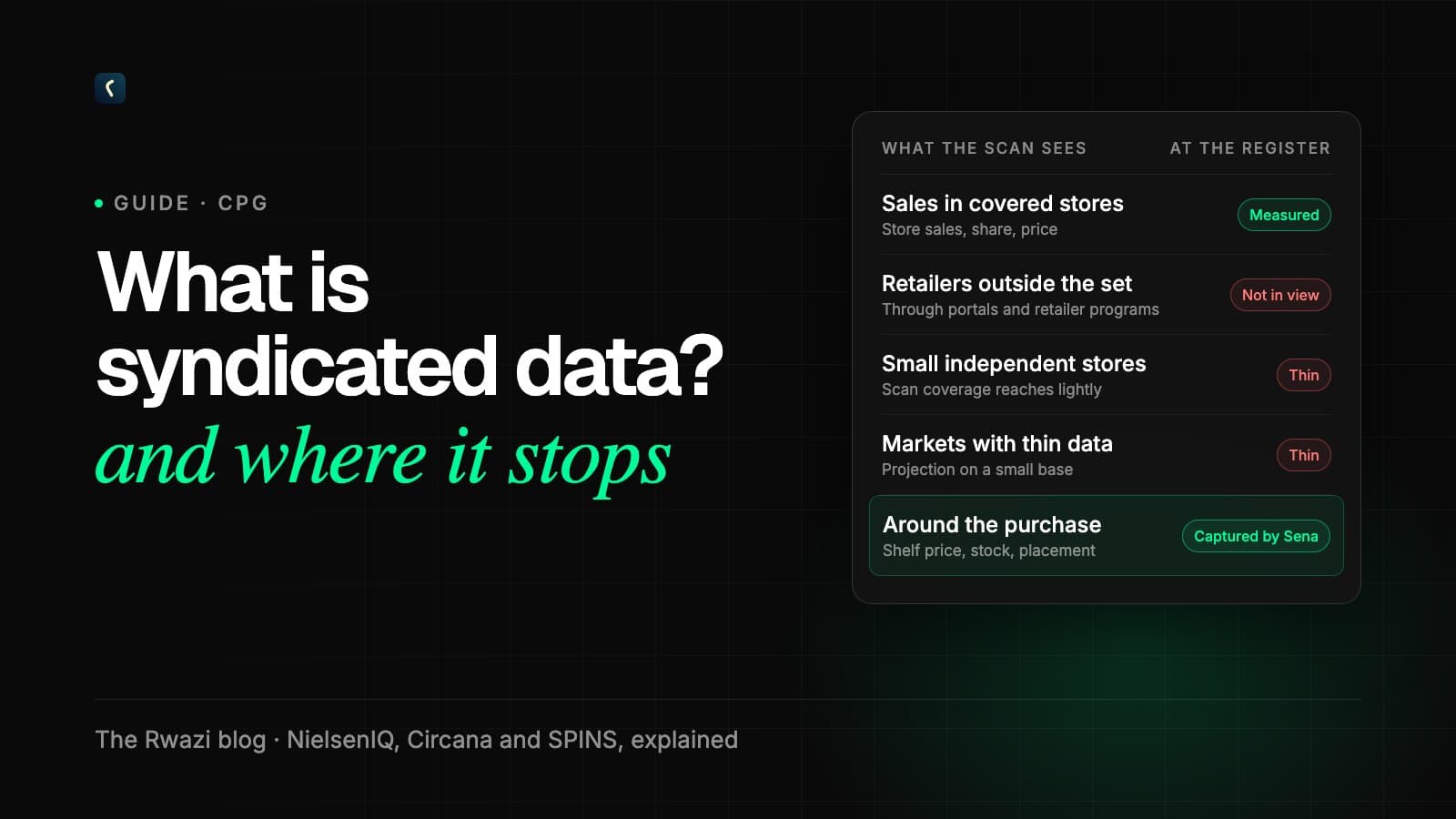
Syndicated retail data measures sales in the stores it covers, at the register. Four kinds of activity sit outside that view:
- Retailers outside the data-sharing set, whose sales arrive through portals or retailer programs.
- Small independent stores, whose scan coverage reaches lightly.
- Markets where published data is thin, where a provider's projection rests on a small base.
- Everything around the purchase: the shelf price on the day, whether the product was in stock, where it sat on the shelf, and what the shopper picked up instead.
Pros and cons of syndicated data
| Pros | Cons |
|---|---|
| A shared scoreboard that retailers and suppliers both accept | Arrives with a lag, often a month or more |
| Market-wide view of every competitor in a category | Covers the retailers that share their data |
| Lower cost per company than a custom study | Full subscriptions are quoted per category and channel and add up |
| Standardized definitions across brands and markets | Projections rest on a small base in thin-data markets. |
| Long histories for trend analysis | Records the sale at the register; shelf price, stock, and placement need a separate capture |
How CPG teams judge a syndicated contract?
Syndicated contracts are often multi-year, and retailer reviews, sales targets, and annual plans are built on them. Teams judge a contract on three questions:
- Keep: Does the provider measure the retailers that carry most of the volume? If so, the contract stays as the shared reference.
- Add: Which channels, retailers, or markets carry the volume the file reaches lightly? Each one points to an added source: a retailer program, a marketplace feed, a natural channel feed, or captured activity.
- Replace: Does a second provider measure the key retailers better? Replacement suits brands whose volume has moved to channels the current provider covers lightly.
How CPG teams combine syndicated and internal data
CPG teams map the syndicated file's product and market definitions to their own shipment and retailer data, then read the two side by side. Syndicated data gives a share against competitors, and internal data shows what was shipped and where. Where the two disagree, the gap often points to stores, channels, or markets the file reaches lightly.
Which syndicated data source fits by category, sales channel, and budget
- By category: Natural and organic categories lean on SPINS. Mainstream grocery, drug, and mass categories lean on NielsenIQ or Circana.
- By sales channel: Club stores such as Costco and online sales need retailer portals, marketplace data, or captured activity next to the syndicated file. Walmart-heavy and Kroger-heavy suppliers add Scintilla or 84.51°.
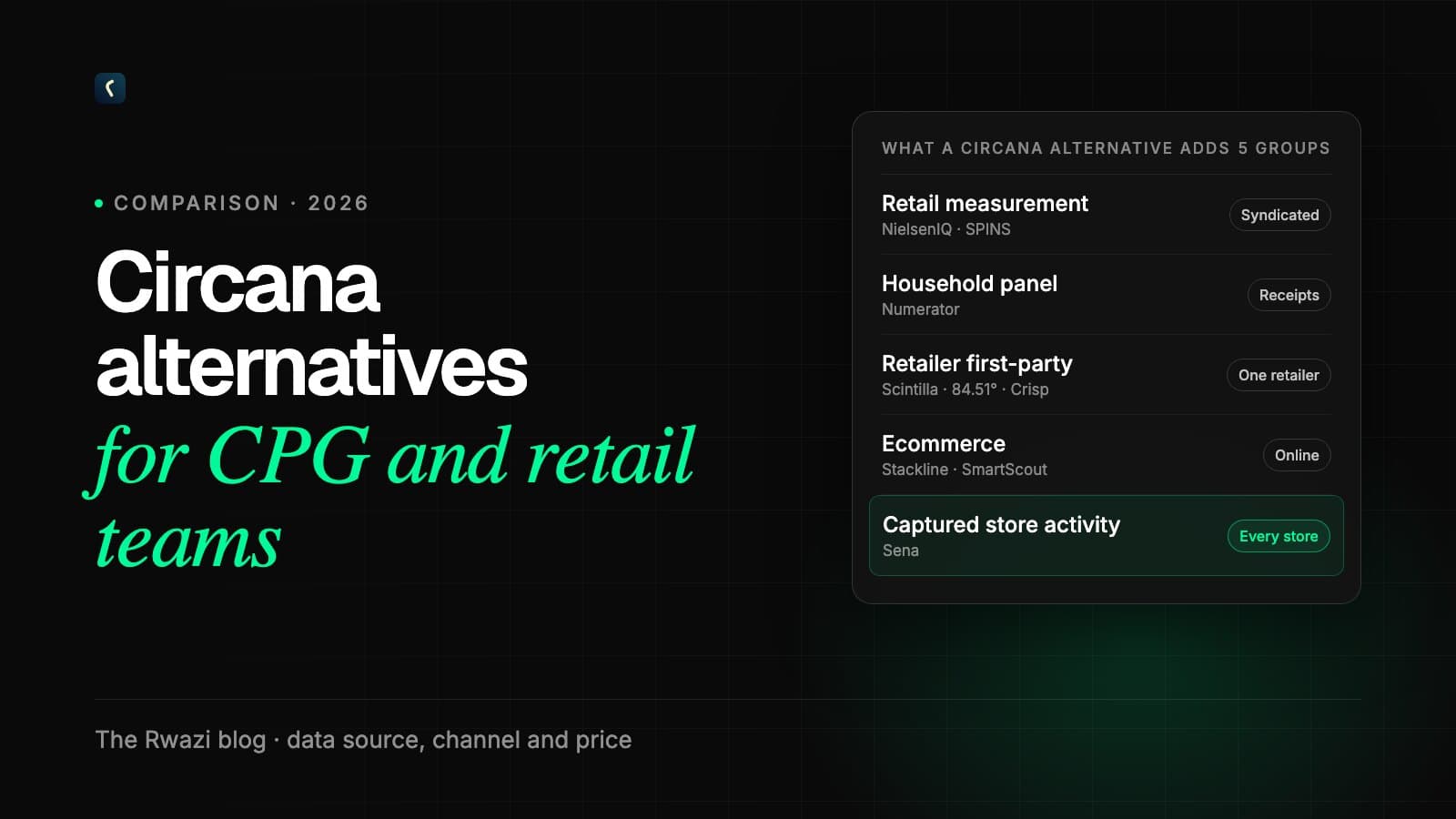
- By budget: Larger teams buy a full subscription, quoted per category and channel, and add sources for the channels that subscription reaches lightly. Smaller brands start with starter programs: NIQ's Byzzer lists data from $1K for startup CPG member brands on a first purchase (NIQ, read Oct 20 2026), and Circana's Liquid Data Go lists $499 per story of 5 reports (Circana, read Oct 20 2026). For a side-by-side view, see Rwazi vs NielsenIQ.
What to keep, add, or replace before a syndicated renewal?
An insights lead has 90 days before the syndicated renewal and needs to explain a share drop in two channels the file reaches lightly. Sena reads the team's NielsenIQ or Circana export next to its own shipment data and shelf and purchase activity captured in those channels.
Rwazi builds Sena, a Decision AI with access to real-world data, which helps a category team decide what to fix when its syndicated numbers move. Sena works from four sources: a team's own files, such as NielsenIQ or Circana exports, uploaded directly; its business systems through 250+ integrations; consumer activity from a 5M+ consumer network across 190+ countries, captured when a question needs it; and computer vision that reads shelf and store images.
It returns priority actions on stock, price, and placement in the stores behind the drop. The team decides what to keep, what to add, and what to replace before it signs, and the contract it keeps stays the shared reference for retailer reviews. See how Sena works with the syndicated files a team already licenses.
Frequently asked questions
What is an example of syndicated data?
An example of syndicated data is a weekly NielsenIQ or Circana report of salty snack sales by brand, retailer, and region across US grocery stores. The provider collects scanned sales from participating retailers, projects them to the total market, and sells the same report to every snack maker that subscribes. Category share and average price are other common examples.
What is the difference between syndicated data and panel data?
Syndicated retail data comes from scanned sales at participating stores and shows what sold, where, and at what price. Panel data comes from a group of households that record their purchases and shows who bought, how often, and across which retailers. Providers often sell both, and many teams use retail data for sales and panel data for shoppers.
What does "syndicated" mean?
"Syndicated" means produced once and sold to many buyers, the way a syndicated newspaper column runs in many papers. Syndicated data is collected and standardized once by a research firm, then licensed to many companies in the same industry, so every subscriber sees the same numbers for a market.
What is considered syndicated data?
Data counts as syndicated when a research firm collects it once, standardizes it, and licenses the same dataset to many companies in an industry. In consumer goods, that means retail sales from store scans and household purchases from consumer panels, sold by NielsenIQ, Circana, and SPINS. Data gathered for one client is custom research.
What is data syndication?
Data syndication usually means product content syndication: sending product listings, images, and descriptions from a brand to many retailer websites in the right format. It is a different practice from syndicated market data, which is sales and consumer data a research firm collects once and sells to many companies.
What does syndicated data not cover, for example, Costco or online sales?
Syndicated data leaves out retailers that do not share their data with a provider and most online marketplace sales. Costco data is usually sold as separate retailer portal data rather than in standard store-scan packages, as Bedrock Analytics notes in its August 2024 guide. Online marketplace sales come through separate feeds such as Stackline. Small independent stores and markets with thin published data sit outside most scan coverage.
Is Costco in Nielsen data?
Not as a rule. Costco data is usually sold as separate retailer portal data rather than in standard store-scan packages, and Bedrock Analytics' August 2024 guide lists Costco among more than 30 retail portals. The same guide lists Costco under Circana's portal data offer. Coverage terms change, so a team should ask NielsenIQ and Circana directly which Costco data each one includes today.
Who are the main syndicated data providers?
In US consumer goods, the main syndicated data providers are NielsenIQ, Circana, and SPINS. NielsenIQ and Circana cover grocery, drug, and mass retail broadly, and Circana also covers general merchandise. SPINS specializes in natural, organic, and specialty stores. Numerator sells household purchase data built from receipts, and MRI-Simmons sells syndicated consumer survey data.
How much does syndicated data cost?
Full syndicated subscriptions are quoted per category, channel, and retailer, so prices vary widely. Starter options publish prices: NIQ's Byzzer lists data from $1K for Startup CPG member brands, and Circana's Liquid Data Go lists $499 per story of 5 reports, both as read Oct 20 2026.
Is syndicated data worth it for a small CPG brand?
Yes, once retailer conversations depend on it, because buyers expect category share and velocity in a shared format. Before that point, starter programs such as Byzzer, SPINS Ignite+, and Liquid Data Go, plus the retailer portal data a brand already receives, cover most early decisions at a lower cost.