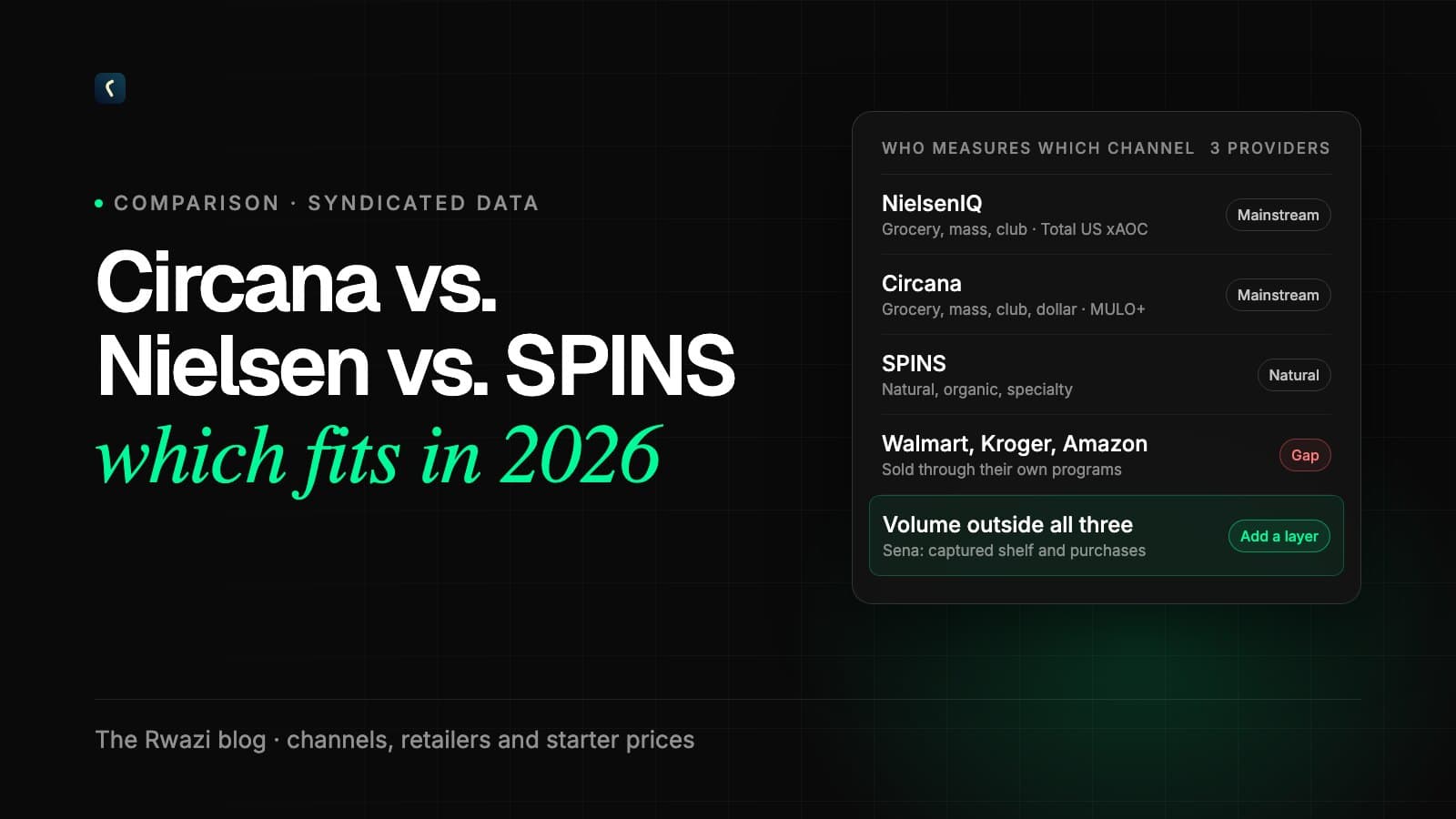
Circana vs. Nielsen comes down to retailers. NielsenIQ and Circana both sell scanned retail sales and household panels across grocery, mass, and club stores, and SPINS specializes in natural, organic, and specialty stores. The right pick is the provider that measures the retailers carrying a brand's volume directly. All three end at the register of the stores they cover.
Nielsen vs. Circana guides from the vendors compare the three on coverage and price. A team that licenses two of them meets a harder problem first: two growth numbers for the same quarter, built on different market definitions. Bedrock Analytics notes that "Circana is often used alongside NielsenIQ" (Bedrock Analytics, April 2026). This guide covers which channels each provider sees, where all three leave gaps in their syndicated data, and whether to keep one, run two, or add a layer.
How we compared the three.
- Core channels, signature datasets, Whole Foods coverage, household panels, starter tiers, and ownership, each from a linked source with the date we read it.
- Where a source is a third party, we say so.
Key takeaways
- NielsenIQ and Circana are the mainstream pair. Both cover grocery, mass, club, and ; they differ in retailer agreements and dataset definitions.
- SPINS specializes in the natural channel. Its Natural Enhanced Channel covers natural, specialty, and gourmet retail.
- Every standard package misses some key retailers. Whole Foods sits differently across the three, per Scout, and Walmart and Kroger sell their own supplier data.
- Keep one and add. Many CPG teams use multiple data sources for a more complete market view, per Bedrock Analytics: one syndicated provider plus the retailer, channel, or captured data that covers its gaps.
NielsenIQ, Circana, and SPINS in one table
| NielsenIQ | Circana | SPINS | |
|---|---|---|---|
| Origins | Nielsen's former Global Connect business; Nielsen sold it to Advent International, closing March 5, 2021 (Nielsen) | IRI and The NPD Group merged in August 2022 and took the Circana name on March 7, 2023 (Circana) | Natural and specialty retail data specialist |
| Core channels | Grocery, mass, club, , and select ecommerce | Grocery, mass, club, dollar, and select retail, plus general merchandise | Natural, organic, specialty, and gourmet |
| Signature dataset | Total US xAOC (All Outlet Combined) | MULO; MULO+ adds ecommerce and convenience | Natural Enhanced Channel |
| Whole Foods, per Scout | Receives Whole Foods POS data, citing a 2016 announcement | Projects Whole Foods into channel totals | Outside its scanner stream |
| Household panel | Homescan | Household panel | TriLens Panel, powered by Circana panel data |
| Starter tier | Byzzer from $1K; $4,950 and $10K packages (Startup CPG members) | Liquid Data Go, $499 per story of 5 reports | Ignite, free monthly insights; Ignite+, plans starting at $250 a month, pricing based on eligibility (SPINS, archived Jul 10 2026) |
| Ownership | Listed on the NYSE since July 2025, Advent Majority (Simpson Thacher); combined with GfK in 2023 | Private: Hellman & Friedman, Vestar, New Mountain Capital, and management | Private: Warburg Pincus led a growth investment in 2021 (Kirkland & Ellis) |
| Category reach | FMCG plus tech and durables, 1,800+ categories (NIQ) | 26 industries across CPG and general merchandise, including beauty, toys, apparel, and consumer technology (Circana) | Natural, organic, and specialty products, tagged by thousands of attributes (SPINS) |
| Global footprint | 90+ countries (NIQ) | Store coverage in 20 countries at its March 2023 launch; its media business cites 40 | Natural, regional, and specialty retailers |
| Media measurement | Media division since February 2024, with marketing mix modeling launched in October 2024 across 75+ countries (NIQ) | NCSolutions, bought June 2, 2025, and Nielsen's marketing mix modeling business, bought August 21, 2025 (Circana) | Focus on retail scan data |
| Best for | Mainstream CPG brands whose key retailers share data with NIQ | Mainstream CPG brands whose key retailers share data with Circana, and non-food categories | Natural, organic, and health-led brands |
Sources: channels, datasets, and household panels from Bedrock Analytics, April 2026; Whole Foods from Scout, which cites a 2016 announcement, and Bedrock Analytics (Aug 2024), which lists Whole Foods among NielsenIQ's exclusive retailers; prices from NIQ and Circana, read Oct 20 2026; Circana ownership from Vestar, Apr 23 2024; GfK from NIQ, Jul 11 2023.
Circana, Nielsen, and NielsenIQ: names and history
Is Circana the same as Nielsen?
Circana and Nielsen are separate companies. Circana formed when IRI and The NPD Group merged in August 2022 and took its name on March 7, 2023. Nielsen measures TV and media audiences, and NielsenIQ, the consumer goods measurement business Nielsen sold in 2021, is Circana's closest rival in retail data.
What is Nielsen now called?
Nielsen is still called Nielsen, and it focuses on audience measurement for media and advertising (Nielsen). Its former Global Connect business, which measures what consumers buy, became NielsenIQ (NIQ) after Advent International bought it; the sale closed on March 5, 2021 (Nielsen). NIQ has traded on the New York Stock Exchange since July 2025.
What did Circana used to be called?
Circana used to be two companies: IRI (Information Resources, Inc.), known for scanned retail sales data, and The NPD Group, known for general merchandise tracking. They merged in August 2022 and took the Circana name on March 7, 2023, per Circana's announcement.
Who are Nielsen's biggest competitors?
In TV audience measurement, the Media Rating Council's list of accredited television services names Comscore and iSpot.tv alongside Nielsen (MRC). In consumer goods measurement, NielsenIQ's main competitors are Circana, SPINS, and Numerator, plus retailer data programs such as Scintilla and 84.51°.
NielsenIQ vs. Circana: where the two retail measurement services differ
Both companies collect scanned sales from participating retailers, project them to a total market, and sell category views by product, brand, retailer, region, and week. They differ in four ways that matter to a buyer:
- Retailer agreements. Each provider holds exclusive ties with some retailers, so the list of retailers measured directly differs between them (Bedrock Analytics, April 2026).
- Market definitions. NielsenIQ reports a Total US xAOC market. Circana reports MULO and MULO+. Each total is built from its own store set, so compare share figures within one provider (Bedrock Analytics, April 2026).
- Non-food heritage. Circana carries NPD's general merchandise tracking. NielsenIQ carries GfK's consumer tech and durables tracking.
- Small-brand tiers. NIQ sells Byzzer; Circana sells Liquid Data Go. Both publish starting prices.
One input is shared. The National Consumer Panel is a joint venture of NielsenIQ and Circana, and each builds its own household panel products on that data (National Consumer Panel, read Oct 20 2026).
For each provider on its own, see Circana alternatives and NielsenIQ alternatives.
Where SPINS fits: natural, organic, and specialty channels
Nielsen vs. SPINS is a channel question: SPINS measures the natural, organic, and specialty stores that matter most to wellness and health-led brands through its Natural Enhanced Channel. Brands in those categories can pair SPINS with one mainstream provider, because mainstream grocery growth and natural channel growth tell different stories. Before buying, confirm which natural retailers SPINS measures directly; Scout reports Whole Foods sits outside the SPINS scanner stream.
Kroger, Walmart, and Whole Foods: why one syndicated package rarely covers all three
One standard syndicated package rarely covers Kroger, Walmart, and Whole Foods in depth, because each retailer shares its data on different terms:
- Walmart sells its own supplier data through Scintilla, formerly Walmart Luminate (Walmart). Walmart has shared its sales data with syndicated providers since 2012, so it sits inside NielsenIQ's xAOC and Circana's MULO; Scintilla adds item, store, and shopper detail beyond those totals.
- Kroger sells its own supplier data through 84.51° Stratum, built on Kroger's in-store and online transactions (Supermarket News, Jul 2019). Among syndicated providers, Kroger shares store data only with Circana (Bedrock Analytics, Aug 2024).
- Whole Foods sits differently across the three, per Scout: received by NielsenIQ, projected by Circana, and outside SPINS. Bedrock Analytics' August 2024 guide also lists Whole Foods among NielsenIQ's exclusive retailers.
A brand with heavy volume at all three can combine one syndicated provider with Scintilla, 84.51°, or both.
Which retailers share data with which provider, and the gaps
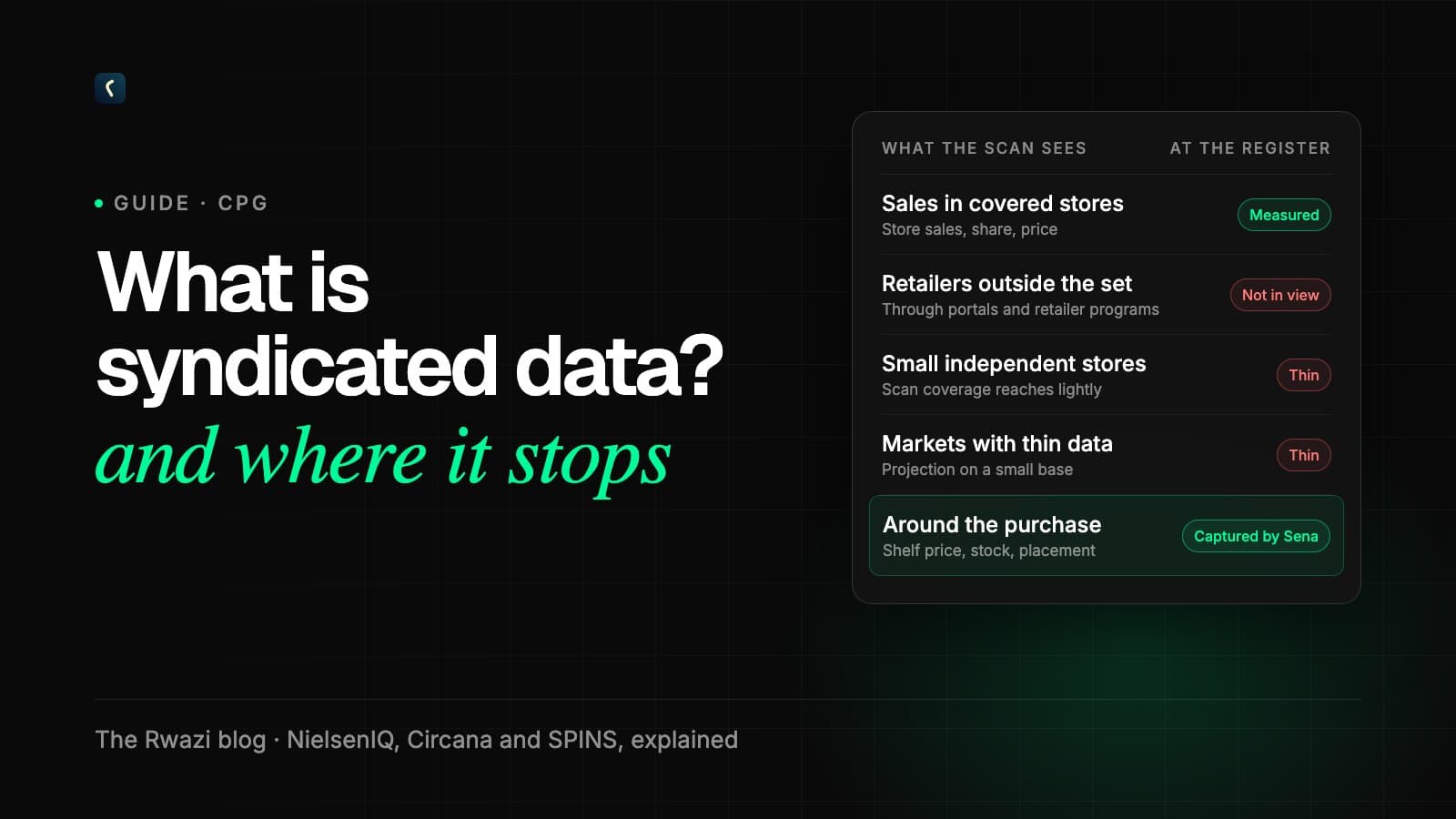
Every syndicator leaves coverage gaps because each provider has exclusive retailer ties. Beyond the named retailers, all three share the same outer edge:
| Gap | Where the data comes from |
|---|---|
| Club stores such as Costco | Retailer portals: Bedrock's August 2024 guide lists Costco among 30+ portals outside standard packages and under Circana's portal data offer (Bedrock, Aug 2024) |
| Amazon and other marketplaces | Stackline and retailer seller portals |
| Small independent stores | Captured consumer activity |
| Markets with thin published data | Captured consumer activity |
| Shelf conditions around the sale | Captured shelf images and purchase records |
Cost and buying models across the three
| Provider | Starter tier and published price | Full subscription |
|---|---|---|
| NielsenIQ | Byzzer from $1K; $4,950 for 20 report runs, 5 markets, and 6 categories; $10K with 5 team seats (NIQ, Oct 20 2026) | Quoted per category, channel, and retailer |
| Circana | Liquid Data Go, $499 per story of 5 reports (Circana, Oct 20 2026) | Quoted per category, channel, and retailer |
| SPINS | Ignite+ plans from $250 a month in July 2026 (SPINS, archived Jul 10 2026); current page quote only | Quoted |
Each provider quotes its own package, so ask each one which channels its quote includes. SPINS also gives its users access to Circana conventional data through a partnership (Bedrock Analytics, Aug 2024), so a brand can see mainstream and natural channels from one provider.
How CPG teams decide?
- Keep one when one provider measures the retailers that carry most of a CPG brand's volume. It stays the shared reference for retailer reviews.
- Run two when volume splits between mainstream and natural channels, or when two key retailers sit with different providers.
- Add a layer when volume sits outside all three: Walmart or Kroger detail, Amazon, club stores, small independent stores, or markets with thin published data. Rwazi's compare hub sets Sena against each provider.
Which provider fits: by category, sales channel, and budget
- By category: Natural and specialty categories lean on SPINS. Mainstream grocery leans on Circana or NIQ. Non-food categories lean on Circana's general merchandise or NIQ's tech and durables tracking.
- By sales channel: Map each key retailer (Kroger, Walmart, and Whole Foods) to the provider that measures it directly, then add Scintilla or 84.51° where a retailer's own data goes deeper.
- By budget: Enterprise brands run one or two full subscriptions plus a layer for the gaps. Brands with one dominant channel run one full subscription. Early-stage brands start with Byzzer, Liquid Data Go, or SPINS Ignite+. For a side-by-side view, see Rwazi vs NielsenIQ.
See which channel earns next quarter's trade budget
A CPG company with a natural and organic line has to set next quarter's trade budget by channel before a planning meeting with the chief executive. Its SPINS feed and Circana subscription show different growth for the same quarter.
Sena reads both exports side by side, next to the team's shipment data and shelf activity captured in key stores, and returns priority actions the team weighs before it sets the budget: which channel is growing, which retailer is out of stock, and which accounts to fix first. Book a demo to see Sena read two syndicated files side by side next to captured shelf activity.
Frequently asked questions
What is the difference between Nielsen and Circana?
NielsenIQ and Circana both sell scanned retail sales and household panels to consumer goods makers and retailers. They differ in which retailers share data with each other, in market definitions (NIQ's xAOC and Circana's MULO), in non-food heritage (GfK at NIQ, NPD at Circana), and in ownership: NIQ is NYSE-listed, and Circana is private.
Circana vs. Nielsen: Which is better for grocery sales data?
Neither wins across the board. The better choice is the provider that measures a brand's key grocery retailers directly. Ask both for their retailer lists in writing, compare how each builds its cross-outlet market, and check how each treats Whole Foods and Walmart before signing a multi-year contract.
Do I need SPINS if I already have Nielsen data?
Only if a meaningful share of the brand's volume sits in natural, organic, or specialty stores, because SPINS measures that channel in more depth. Mainstream brands with little natural channel volume can rely on NielsenIQ or Circana alone. Check SPINS's natural retailer list against the brand's own top accounts first.
Which syndicated data provider covers Kroger, Walmart, and Whole Foods?
No single provider measures all three directly. Kroger shares its store data only with Circana, and Whole Foods only with NielsenIQ, per Bedrock Analytics (Aug 2024); Walmart sits inside both providers' cross-outlet markets. Walmart and Kroger also sell their own supplier data through Scintilla and 84.51°. Brands can combine a provider with retailer data.
Is Costco in Nielsen data?
Usually not in standard packages: Costco sells its data through its own retail portal, and Bedrock Analytics' August 2024 guide lists it among more than 30 portals sold outside standard syndicated packages, with Costco under Circana's portal data offer. The same guide says NielsenIQ customers can buy Circana's Costco portal data as a separate purchase. Coverage terms change, so ask NielsenIQ and Circana directly which Costco data each one includes today.
Which syndicated data provider fits natural products?
SPINS fits natural, organic, and specialty products best, through its Natural Enhanced Channel covering natural, specialty, and gourmet retail. Natural brands can pair SPINS with one mainstream provider to see both channels. Confirm Whole Foods coverage separately, since Scout reports it sits outside the SPINS scanner stream.
Which retailers does Circana cover?
Circana's MULO market covers grocery, mass, club, dollar, and select retail, and MULO+ adds ecommerce and convenience, per Bedrock Analytics (April 2026). Scout reports that Circana projects Whole Foods into its channel totals, and Bedrock lists Costco under Circana's portal data offer. Ask Circana for its current retailer list in writing before signing.
How much do NielsenIQ, Circana, and SPINS cost?
Full subscriptions from all three are quoted per category, channel, and retailer. Starter tiers publish prices: NIQ's Byzzer from $1K for Startup CPG members, Circana's Liquid Data Go at $499 per story of 5 reports, both read Oct 20 2026, and SPINS listed Ignite+ plans from $250 a month in July 2026, per its own archived page.