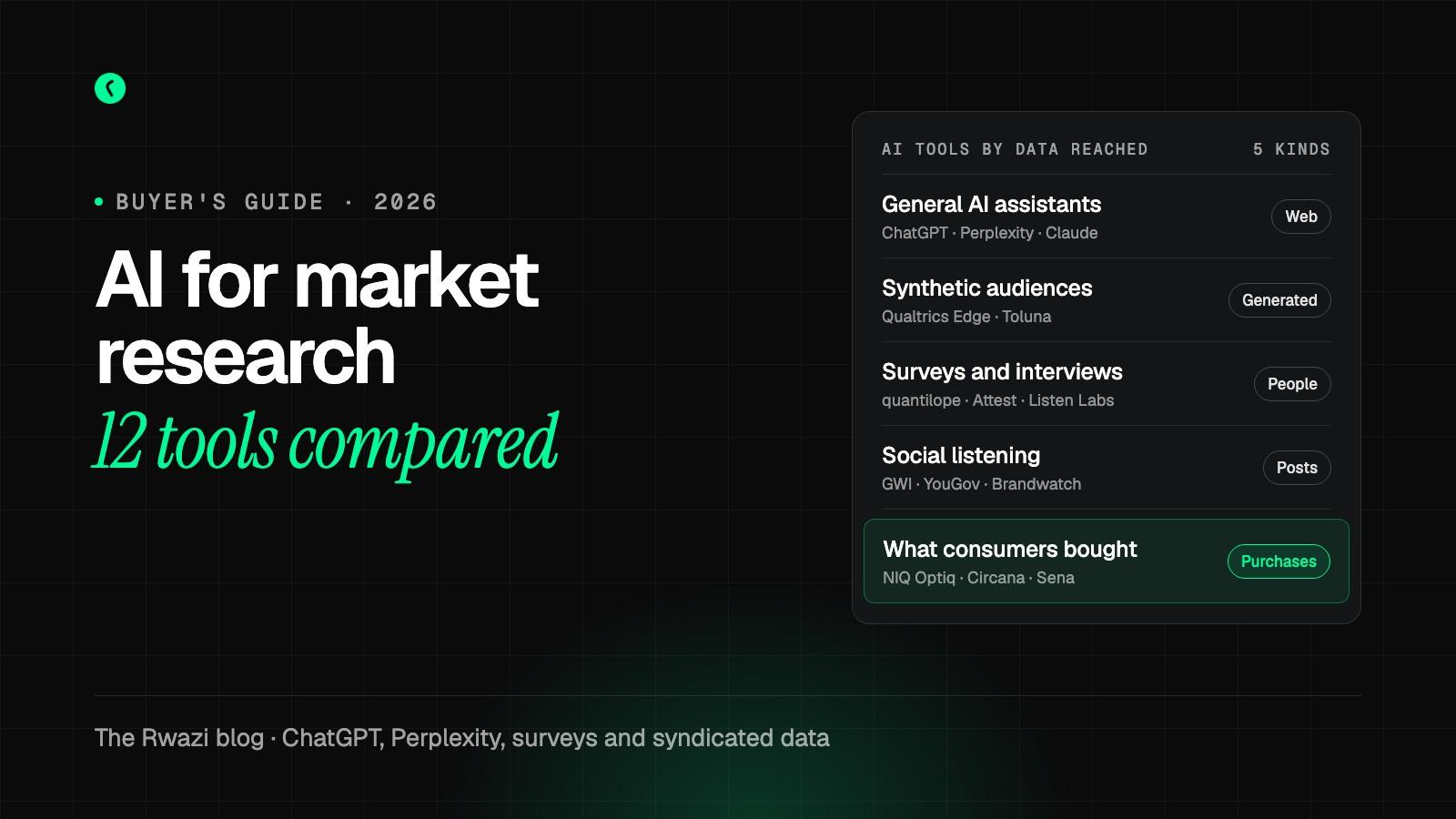
AI for market research means using AI to gather and summarize sources, analyze a team's files, run surveys and interviews, and simulate consumer responses. It works best when the tool reaches the data the decision needs. ChatGPT and Perplexity answer from the public web and a team's own files. GWI, YouGov, Listen Labs and Brandwatch add answers and posts from real people.
Purchase and store questions need syndicated data plus consumer activity captured in the stores those files reach least. Sena, the Decision AI from Rwazi, answers from both, with the source behind every number.
Key takeaways
- Sort by data reach: The open web, a team's files, generated answers, real people's answers, social posts, and captured purchases each answer a different question.
- Assistants cover public facts and company files. ChatGPT and Perplexity both cite sources and read connected files on business plans.
- Real consumer data comes from people and stores. Panels, interviews, social listening, and captured activity carry the signal a final call needs.
- Check fit before features. Integration, security terms, and licensed data rules decide what an enterprise team can use.
How to use AI for market research
- Name the decision. Write down the call and the date it is due.
- List the data it needs. Public facts, the team's own numbers, people's answers, or what sold in which stores.
- Start with public facts. Run ChatGPT or Perplexity for deep research and keep the citations.
- Connect the team's own files and systems for internal numbers.
- Ask real people for the why. Run surveys or AI-moderated interviews.
- Add purchase and store data for questions about what sold where, then check the source and date behind every number before the final call.
Best AI for market research with real consumer data
The best option is the one built on the data the question needs:
- What people think: surveys and audience panels such as GWI, YouGov, Attest, and quantilope.
- Why they think it: AI-moderated interviews such as Listen Labs, Conveo, GetWhy and Outset
- What they say in public: social listening such as Brandwatch and Sprout Social
- What they bought, and what stores carried: syndicated data and captured consumer activity
The consumer insights platform comparison covers each group in depth.
Can AI do market research for an enterprise team?
Yes. AI in market research handles most of the work, and final calls rest on real people and real purchase data.
What AI automates in market research
Market research automation with AI covers these jobs today:
- Searches and summarizes public sources
- Analyzes a team's own files
- Drafts questionnaires and moderates interviews, as ChatGPT, quantilope and Listen Labs each describe on their own pages
ChatGPT for market research
Where it helps
- Web search: Current answers with links to sources.
- Deep research: Reads many sources and writes a cited report in 5 to 30 minutes, with attached files and enabled apps.
- Data analysis: Reads uploaded spreadsheets and CSV files and builds tables and charts.
Where its reach ends
- Its reach covers the public web, uploaded files, and connected apps.
- OpenAI notes that search results and citations "can be incomplete, outdated, or incorrect," and that deep research "may struggle with distinguishing authoritative information from rumors."
- Questions about what shoppers bought in specific stores need a purchase panel, retailer data, or captured consumer activity.
Perplexity vs ChatGPT for market research
Perplexity AI for market research suits fast desk work with numbered citations. ChatGPT suits longer reports that draw on connected apps.
Perplexity
- Numbered citations on every answer
- Deep Research runs dozens of searches and reads hundreds of sources in 2 to 4 minutes
- Pro and Max plans add premium sources such as PitchBook, Statista and S&P Capital IQ (Perplexity)
ChatGPT
- Deep research takes 5 to 30 minutes
- Draws on connected apps such as Google Drive and SharePoint
How the two split across three types of market question
| Question type | Example | ChatGPT | Perplexity |
|---|---|---|---|
| Public facts | Which snack brands launched protein lines this year? | Web search or deep research, with citations | Cited answers or deep research, with numbered citations |
| Company files | How did third-quarter sales compare with the category trend in the team's syndicated file? | Uploaded files and data analysis, plus apps such as Google Drive and SharePoint on Business and Enterprise | Internal Knowledge Search and File Connectors for Google Drive, OneDrive, SharePoint, Dropbox and Box on Enterprise Pro and Max |
| Shopper activity in specific stores | Which stores ran out of the product last week, and what did shoppers buy in its place? | Reaches the data a team uploads or connects | Reaches the data a team uploads or connects |
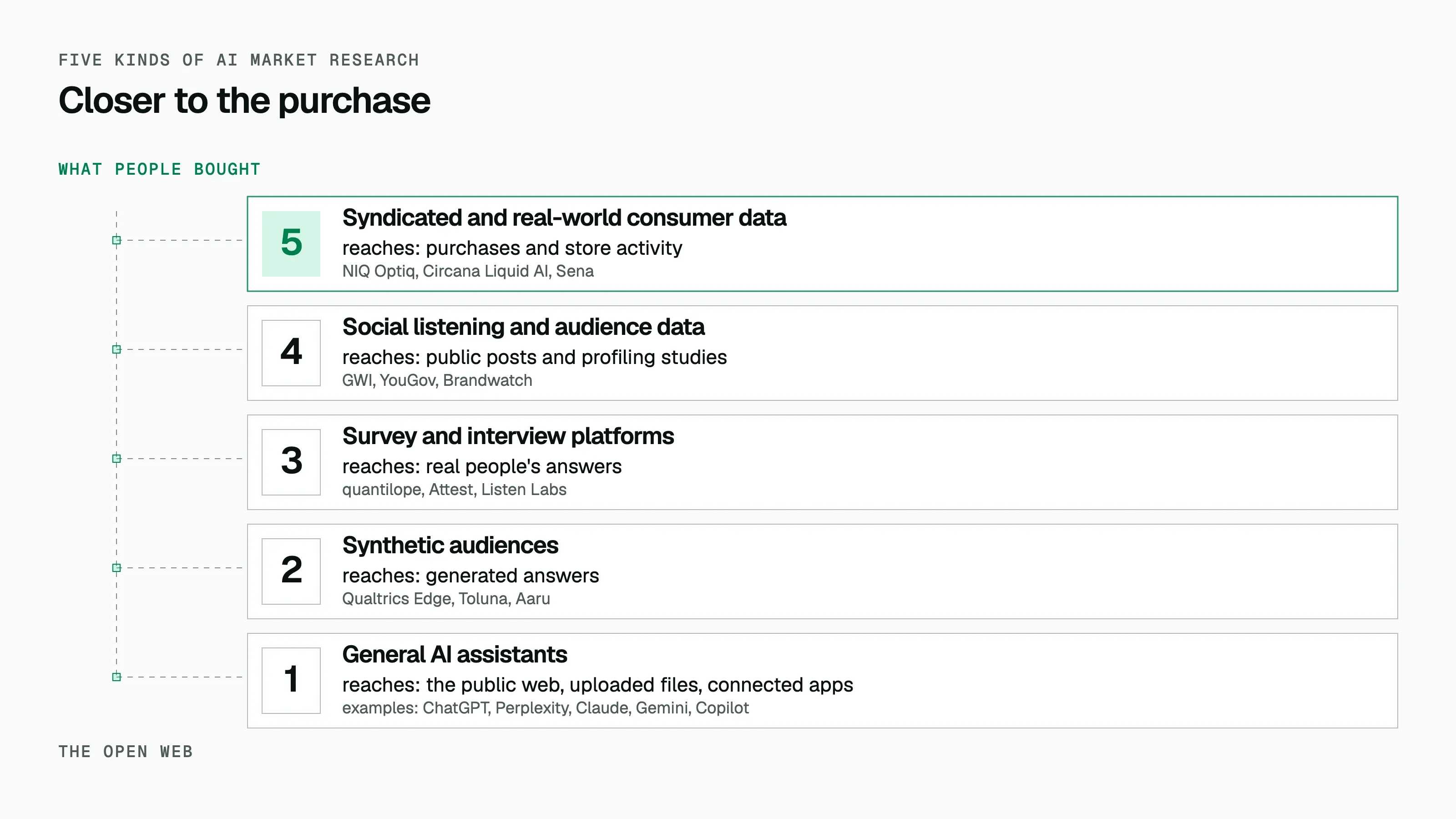
For the third type, the answer comes from a purchase panel, retailer data or consumer activity captured in those stores.
5 kinds of AI market research tools
The best AI tools for market research fall into five kinds. Each kind answers from a different source, and that source sets which questions it can settle.
1. General AI assistants
- Data: The public web, uploaded files, and connected apps such as Google Drive, SharePoint, and Slack
- Tools: ChatGPT, Perplexity, Claude, Gemini, and Microsoft Copilot. Google's NotebookLM, now presented as Gemini Notebook, analyzes the sources a team uploads.
- Privacy: On business plans, each states that company data stays out of model training by default
- Price: $20 per user a month billed annually for ChatGPT Business and Claude Team (OpenAI, Anthropic), $14 for Google Workspace Business Standard with Gemini, and $30 for the Microsoft 365 Copilot enterprise add-on.
- Best for: Public facts, summaries, and analysis of a team's own files
- Watch for: The reach ends at the web, and the data a team uploads or connects
The enterprise AI platform guide compares the four business tiers in one table.
2. Synthetic audiences
- Data: Generated answers
- Qualtrics Edge Audiences: Synthetic responses for specific demographics in minutes, built from public data and Qualtrics' own human experience data (Qualtrics)
- Qualtrics coverage: The synthetic panel covers the US general population in English and is "less applicable for studies on past behaviors, detailed recall, brand recall, or awareness questions."
- Toluna Synthetic Personas: Built from anonymized first-party data from a panel of more than 81 million people
- Aaru: Simulated populations from public and licensed records, including anonymized transaction records and point-of-interest visit patterns
- Electric Twin: Synthetic audiences built from a client's own survey, focus group, and interview data.
- Best for: Screening many ideas before a study.
- Watch for: Accuracy figures come from each vendor's own tests, such as Qualtrics' study of 518 matched human and synthetic respondents on one 11-question survey (Qualtrics). Validate against real people before a final call.
3. Survey and interview platforms
- Data: Answers from real people, gathered through AI survey tools and AI-moderated interview platforms
- quantilope: 300M+ consumers through its panel network. Its AI assistant, quinn, drafts questionnaires, audits survey logic, and analyzes data
- Attest: Consumer surveys across 150M+ consumers in 59 countries, plus AI-moderated interviews
- Listen Labs: AI-moderated interviews in 120+ languages, recruiting from 50M+ participants
- Conveo: AI-moderated video interviews with analyzed results within hours
- Outset: AI-moderated interviews at the speed and scale of a survey
- Best for: Concept choice and the "why" behind a result
- Watch for: Answers record what people say they will do. Purchases come from a panel or retailer data.
4. Social listening and audience data
- Data: Public posts and profiling studies
- GWI: Its own online surveys of almost a million internet users a year across 50+ markets. Its AI analyst, Agent Spark, answers from that data inside GWI or in ChatGPT and Claude through MCP
- YouGov: A panel of over 30 million registered members across 55+ markets. BrandIndex tracks 16 brand health metrics daily
- Brandwatch: Consumer Research draws on over 100 million online sources. Iris AI answers plain-language questions across social and traditional media. Every Brandwatch product is ISO 27001:2022 certified
- Sprout Social: Listening inside its social media management suite
- SparkToro: Shows the websites, podcasts, social accounts, and publications that reach an audience
- Best for: Audience profiles, brand health, and reputation
- Watch for: Attitudes and public posts describe what people think and say. Purchases come from a panel, retailer data, or captured activity.
5. Syndicated and real-world consumer data
- Data: Purchases and store activity
- NIQ Optiq: An AI agent built on licensed NIQ data, with access tied to a client's licensed datasets
- Circana Liquid AI: Powered by the Emiri agent. It answers plain-language questions from governed Circana data and links to Copilot, Claude, Gemini, and ChatGPT through MCP
- SPINS AdvisorAI: Turns a team's SPINS subscriptions into monthly reports
- Sena: A Decision AI that reads the syndicated exports a team uploads next to its business systems, then adds consumer activity captured in the stores and markets those files reach least, so a pricing or launch call rests on one sourced answer
- Best for: Category, share, and price questions inside one provider's coverage, and with Sena, decisions that need signals from beyond one provider's scan
- Watch for: Each provider answers within its own data and a team's license
Also named by AI assistants: competitive intelligence tools
- AlphaSense: Company and market data across 500M+ documents
- Similarweb: Digital traffic and channel data
- Crayon: Competitor monitoring for sales teams
The market intelligence tools roundup compares them.
Which AI is best for market research?
The best AI for market research depends on the question. ChatGPT and Perplexity suit public facts and company files; synthetic audiences suit idea screening; surveys and interviews explain why; social listening tracks brand talk; and syndicated data plus captured consumer activity show what was sold and where.
The table below matches the best AI market research tools to the question each one answers.
| Question | Best-fit option | Data it rests on |
|---|---|---|
| What is happening in the category in public? | ChatGPT or Perplexity deep research | The public web, with citations |
| What do a team's own files and systems show? | Business plans of ChatGPT, Perplexity, Claude, Gemini or Microsoft Copilot, with connectors | Company files and connected apps |
| Which of 30 ideas should go to testing? | Synthetic audiences | Generated answers |
| Which concept wins, and why? | Survey platforms and AI-moderated interviews | Real people's answers |
| How do people talk about the brand? | Social listening | Public posts |
| What sold, and where? | Syndicated data and captured consumer activity | Purchases and store activity |
How to choose an AI market research platform
Three checks separate enterprise-ready market research AI tools from personal ones:
- Integration. List the systems the option reads today, such as CRM, sales and finance data, document stores and data warehouses. An option on top of those systems answers from the team's own numbers.
- Security. Ask for current audit reports such as SOC 2 Type 2 and ISO 27001, the data processing terms, and a written statement on whether company data trains shared models.
- Licensed data. Syndicated exports from NielsenIQ, Circana, or SPINS come under license, so check where the provider contract allows them to be loaded.
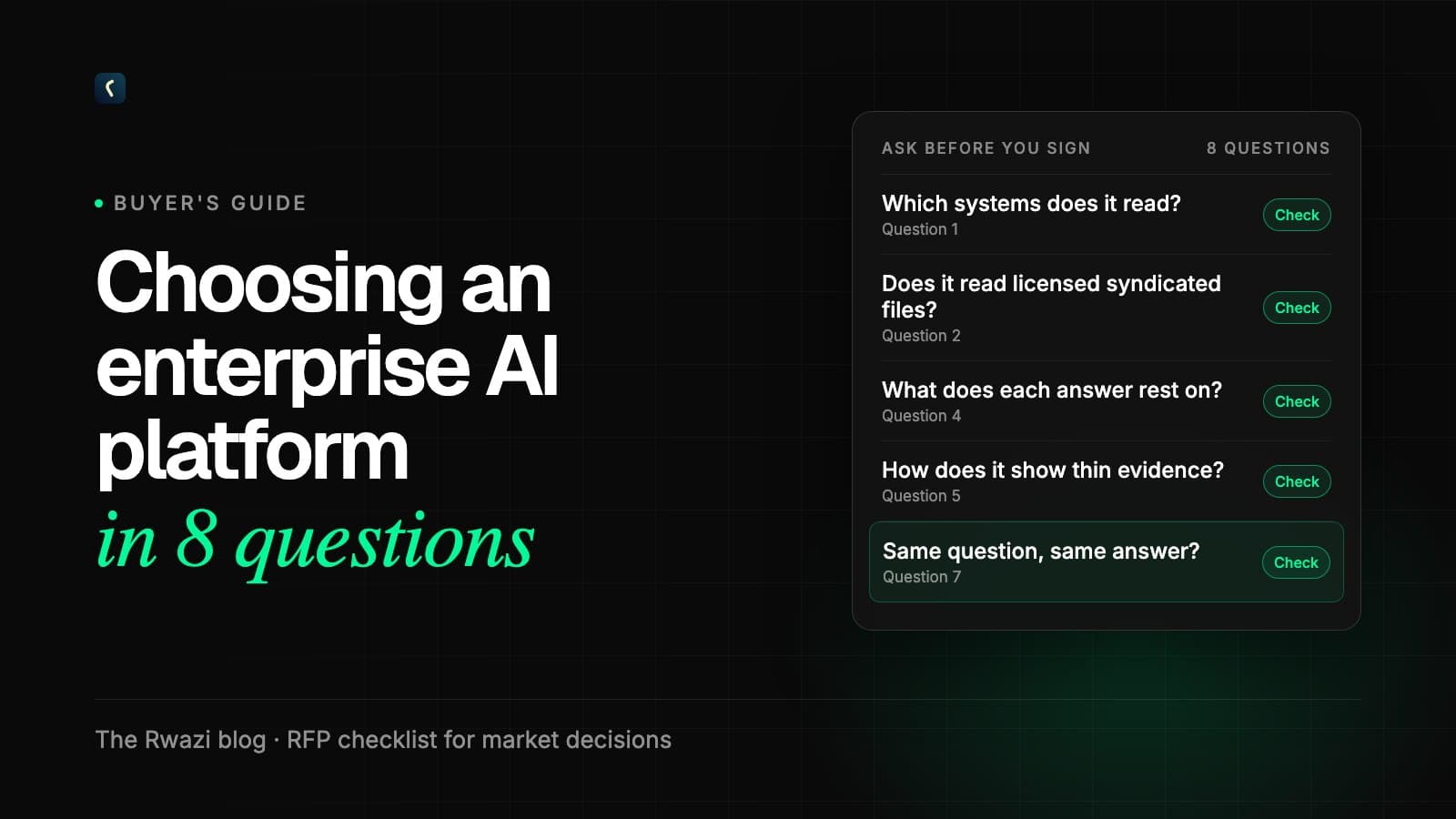
The enterprise AI platform guide turns these checks into 8 questions and an RFP checklist.
AI market research tools compared
Twelve AI options, side by side, sorted by the data behind each answer:
| # | Option | Kind | Data its answers rest on | Integration | Published security | Published price |
|---|---|---|---|---|---|---|
| 1 | ChatGPT Business | General assistant | The public web, uploaded files and connected apps | Apps for Google Workspace, Slack, GitHub and Microsoft 365 | SOC 2 Type 2 (OpenAI), business data out of training by default | $20 per user a month billed annually (OpenAI) |
| 2 | Sena (Rwazi) | Decision AI with access to real-world data | A team's uploaded files, including syndicated exports · its business systems · consumer activity captured when a question needs it · computer vision on store photos | 250+ integrations | Isolated environment per client and GDPR ready, per Rwazi, reports on request | Free chat before sign-up, enterprise plans quoted |
| 3 | Perplexity Enterprise Pro | General assistant | The public web with citations, plus internal files | File Connectors for Google Drive, OneDrive, SharePoint, Dropbox and Box (Perplexity) | SOC 2 Type II, HIPAA, GDPR and PCI DSS, customer data out of training | US$34 per seat a month billed annually (Perplexity) |
| 4 | Qualtrics Edge Audiences | Synthetic audience | Generated answers built from public data and Qualtrics human experience data | Inside the Qualtrics platform | SOC 2 Type 2, ISO 27001 and ISO 42001 (Qualtrics) | Quote only |
| 5 | Toluna Synthetic Personas | Synthetic audience | Generated answers built from its panel of 81M+ people | Inside Toluna Start | ISO 27001 for Toluna Start (Toluna) | Quote only |
| 6 | quantilope | Survey platform | Answers from 300M+ consumers through its panel network | Inside quantilope, with the quinn AI assistant | ISO 27001 (quantilope) | Business plan from $2,300 a month for 3 users (quantilope) |
| 7 | Attest | Survey platform | Answers from 150M+ consumers in 59 countries | Inside Attest | ISO 27001, GDPR-compliant (Attest) | Credits, quote only |
| 8 | Listen Labs | AI-moderated interviews | Interviews with a 50M+ participant network or a team's own contacts | Inside Listen Labs | Trust center at trust.listenlabs.ai | Quote only |
| 9 | GWI | Audience data | Its own surveys of almost a million internet users a year in 50+ markets | Agent Spark in ChatGPT, Claude and Copilot through MCP and API | Reports on request | Quote only |
| 10 | Brandwatch | Social listening | Over 100 million online sources | Iris AI inside Brandwatch | ISO 27001:2022 (Brandwatch) | Quote only |
| 11 | NIQ Optiq | Syndicated data with AI | Licensed NIQ data | Inside NIQ Discover, with Optiq Bridge into external AI tools | Reports on request | Within an NIQ contract |
| 12 | Circana Liquid AI | Syndicated data with AI | Governed Circana data | MCP to Copilot, Claude, Gemini and ChatGPT | Reports on request | Within a Circana contract |
All read October 20 and 21, 2026. "Reports on request" marks vendors whose public pages leave certifications unstated. Ask for the SOC 2 or ISO 27001 report during procurement.
Best fit by category, channel, and budget
By category
- Measured stores: NIQ Optiq or Circana Liquid AI answers share and price questions inside the license a team already holds.
- Stores and channels with the least coverage: purchase and store questions call for syndicated data plus captured consumer activity.
- Attitude, conversation, and "why" questions: GWI, YouGov, Brandwatch, and Listen Labs, in any category.
By sales channel
- Retail-heavy teams: options that read syndicated and retailer data next to their own sales, plus captured store activity where retailers share little sell-through data.
- Teams that also sell direct: first-party data through connectors, in a business assistant, or through Sena's 250+ integrations.
By budget
- Business assistants: priced per seat.
- Survey, interview, and audience platforms: subscriptions or credits.
- Syndicated data and enterprise platforms, Sena included: quoted per contract.
- At an enterprise scale: much of the budget already sits in multi-year syndicated and panel contracts, so the question becomes which decisions the added signals settle.
The compare hub sets Rwazi beside named AI market research companies, and the decision intelligence platforms comparison covers platforms built for business decisions.
Where Sena fits: a rival's price cut
A rival cuts prices in two regions. The commercial lead has to decide whether to follow before the next promotion window, and each option brings a different piece:
- A general assistant summarizes the rival's announcement.
- A survey asks shoppers what they would do.
- Sena reads the team's syndicated export and sales data next to in-store prices and purchase activity captured in those regions' stores when the question comes in.
What comes back
- Where the cut is moving volume
- Where stores hold the current price
- Which stores moved first
- The source behind every output: the file, the photo, or the signal it came from
The commercial lead matches the price only where the cut is moving volume, holds it where stores keep selling at the current price, and acts before the next promotion window opens.
“Winning today means anticipating shifts, seeing around corners, and making confident moves before the competition even senses a change.”
Joseph Rutakangwa, co-founder and CEO of Rwazi, to TechCrunch in July 2025
Frequently asked questions
Which AI tool is best for market research?
The best AI tool for market research depends on the data the question needs. ChatGPT and Perplexity suit public facts and company files. GWI, YouGov, Attest and quantilope suit survey questions. Listen Labs and Conveo suit interviews, and Brandwatch suits social conversation. Purchase and store questions need syndicated data or consumer activity captured in stores, and Sena, Rwazi's Decision AI, reads both in one answer.
How do teams use AI for market research?
Start with the decision and the data it needs. Use ChatGPT or Perplexity deep research for public facts, connect the team's own files and systems for internal numbers, run surveys or AI-moderated interviews for the why, and add captured purchase data for store questions. Check the source and date behind every number before the final call.
Can a team use AI for market research?
Yes. Teams use AI to search and summarize public sources, analyze their own files, draft questionnaires, run AI-moderated interviews and read social conversation. Simulated respondents suit early idea screening. A Harvard Business Review article on these tools advises validating synthetic data against real-world benchmarks, so final calls rest on real people and real purchase data.
Is ChatGPT good for market research?
ChatGPT is good for public-fact questions, summaries and analysis of uploaded spreadsheets, and its deep research writes cited reports in 5 to 30 minutes. OpenAI notes its search results and citations can be incomplete, outdated or incorrect, so check the sources. Store-level purchase questions need a purchase panel, retailer data or captured activity.
Is Perplexity better than ChatGPT for research?
Each suits a different way of working. Perplexity attaches numbered citations to every answer and runs Deep Research in 2 to 4 minutes. ChatGPT's deep research takes 5 to 30 minutes and can draw on connected apps. On enterprise plans, both read company files and keep company data out of model training. Store-level purchase data comes from other sources for both.
Are AI-generated respondents reliable for market research?
They suit early screening of many ideas, where speed matters more than precision. A Nuremberg Institute for Market Research study of 500 real US consumers and 500 AI-generated respondents found the AI answers tended to be overly positive, with less depth and variability. Validate synthetic results against real consumers before a final call.
How does AI improve market research accuracy?
AI improves accuracy when it reaches better data and shows its sources. Cited answers let a team check each claim, AI-moderated interviews reach larger samples faster, and captured purchase data records what people did. Accuracy still depends on the inputs, so check the date, coverage and source behind every number.
What should an enterprise check before buying an AI market research platform?
Check four things: which systems and licensed files it reads, which markets and real consumer data it reaches, its security terms, including SOC 2 Type 2 or ISO 27001 reports and whether company data trains shared models, and its pricing model. Then test it on one live decision with the team's own data.
How will AI change corporate market research?
AI moves routine work into minutes and hours. OpenAI and Perplexity describe deep research reports in minutes, quantilope describes going from research brief to dashboard in minutes, and Conveo returns analyzed interview results within hours. Enterprise teams can put the saved time into framing decisions and checking signals, with real consumers and real purchase data behind the final call.
Are there free AI tools for market research?
Yes, for questions the public web can answer. ChatGPT and Perplexity both offer free tiers that answer from the open web, and Sena opens a free chat before sign-up for market questions. Free tiers carry usage limits, and a pricing or launch call still needs licensed or captured consumer data behind each number.
What are AI agents for market research?
AI agents run a multi-step research task on their own: they plan searches, read sources and write up the result. ChatGPT deep research and Perplexity Deep Research work this way on the public web. Inside licensed data, GWI's Agent Spark answers from GWI's own surveys, NIQ Optiq answers from licensed NIQ data, and Circana's Emiri agent powers Liquid AI on governed Circana data.
Ask Sena a market question, free · Book a demo
Read next: the market intelligence tools roundup and how to gather market intelligence