Synthetic users and synthetic respondents are AI-generated stand-ins for real people in surveys, interviews, and product tests. The 2026 accuracy data shows they come close to real consumers on broad patterns and miss on detail.
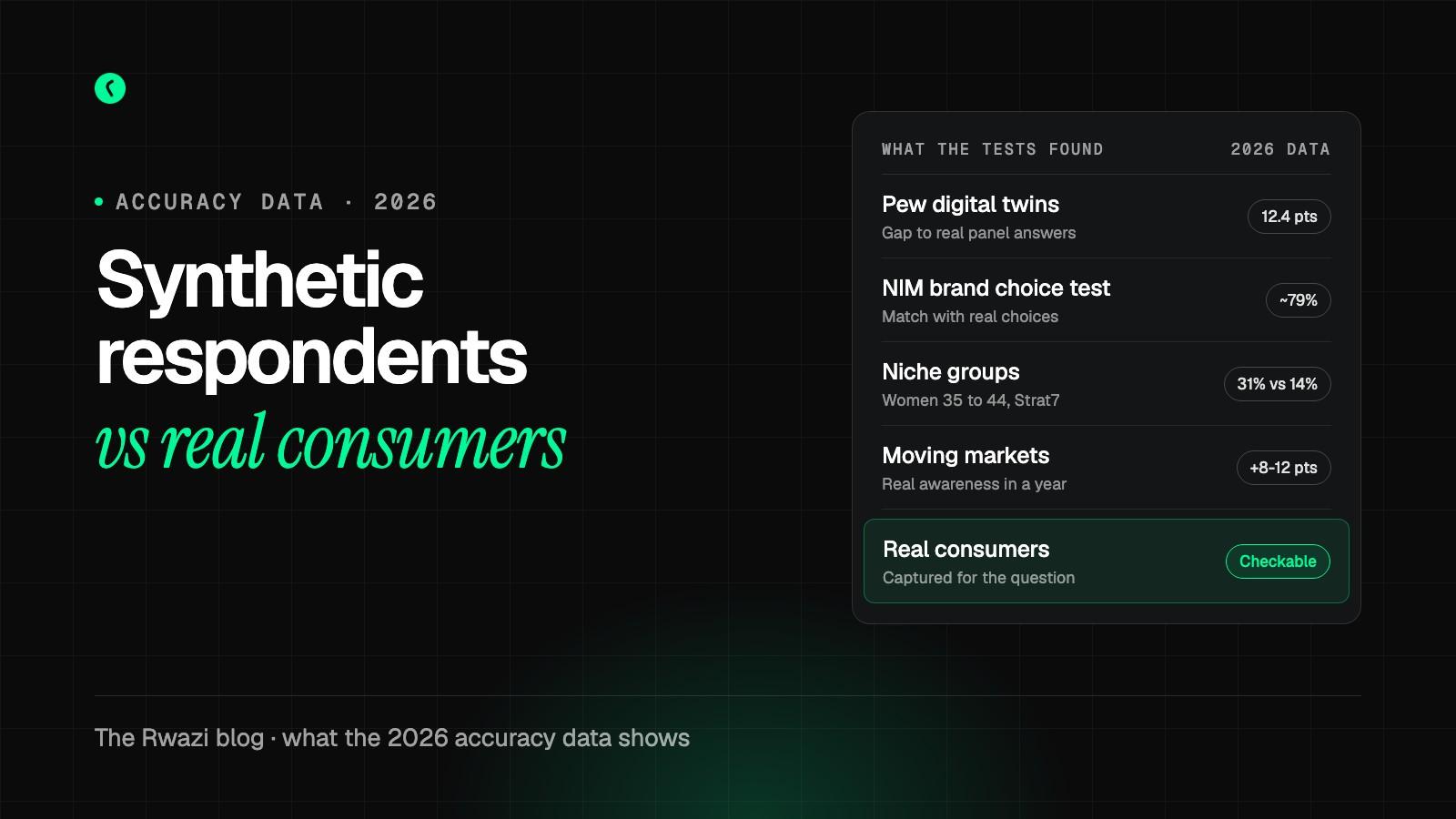
Pew Research Center's AI "digital twins" of its own panelists missed real answers by 12.4 percentage points on average. In a NIM test, synthetic participants matched real brand choices about 79% of the time and overrated well-known names. Nielsen Norman Group found 120 synthetic respondents reached the same conclusion as 604 people, with far fewer distinct answers. And in a Strat7 test, synthetic respondents contradicted their own price ordering 68% of the time.
Key takeaways
- Every synthetic answer has a source. A persona recombines its source data and inherits the gaps in it.
- Accuracy scores measure different things. Parity, distribution match, test-retest ratio, and direction of change can disagree for the same model.
- The gaps are predictable. Published tests show misses on new categories, niche groups, and year-on-year change.
- Match the method to the decision. Early screens suit synthetic runs. Launch, pricing, and market entry calls need current consumer activity from that market.
What are synthetic users and synthetic respondents?
Synthetic users and synthetic respondents are answers an AI model generates to stand in for real people in a survey, interview, usability test, or concept test. UX teams say synthetic users. Market research teams say synthetic respondents.
- NIQ: Synthetic respondents are "artificial personas generated by machine learning models to mimic human responses," per its explainer.
- Qualtrics: Synthetic data is "AI-generated responses that replicate the statistical patterns., relationships, and characteristics found in real-world data," per its guide.
- Kantar: "The ability to use generative AI to literally generate human-style responses to questions, based on the datasets available," per its explainer.
- The point that matters: A synthetic respondent recombines the data behind it, so its answers cover what that data covers.
Synthetic users, synthetic personas, and synthetic audiences
The names change by team. The method stays the same:
- Synthetic respondents: The market research name for model answers to survey, concept, or pricing questions.
- Synthetic users: The UX and product name. Nielsen Norman Group calls them "AI-generated stand-ins for research participants," and teams use them for synthetic user testing.
- Synthetic personas and AI personas: Strat7 describes them as conversational simulations of how a group might think or react, often called twins.
- Synthetic audiences: The marketing name, used by Qualtrics Edge Audiences and Electric Twin.
- Synthetic people: A broad name for any AI-generated stand-in for a human participant.
- Synthetic research: The umbrella term for work that runs on any of the above.
Synthetic data in market research: who sells it
Each company builds its personas on different data, and that data sets what the answers can cover:
| Offer | What it does | What it draws on | Published price |
|---|---|---|---|
| Qualtrics Edge Audiences | Synthetic responses for chosen demographics | Public data and Qualtrics' own data, with a US general population panel | Quote only |
| Kantar | Boosts reads "among hard-to-reach or small groups" | Real data, augmented | Quote only |
| NIQ BASES AI Screener | Idea screening with synthetic respondents, launched April 15, 2025 | NIQ's consumer panel data | Quote only |
| Synthetic Users | "Test a product, a message or a policy on synthetic respondents" | Language models, plus a client's own files | Plans from $12,500 a year |
| Toluna Synthetic Personas | Personas for consumer questions | Anonymized first-party data from Toluna's panel of more than 81 million people | Quote only |
| Ipsos | Persona bots that "respond to new product concepts, messaging strategies, or competitive scenarios" | Models trained on its own data | Quote only |
| Aaru | "Simulated populations" | Real-world outcomes, per Aaru | Quote only |
| Electric Twin | Synthetic audiences | A client's customer data | Quote only |
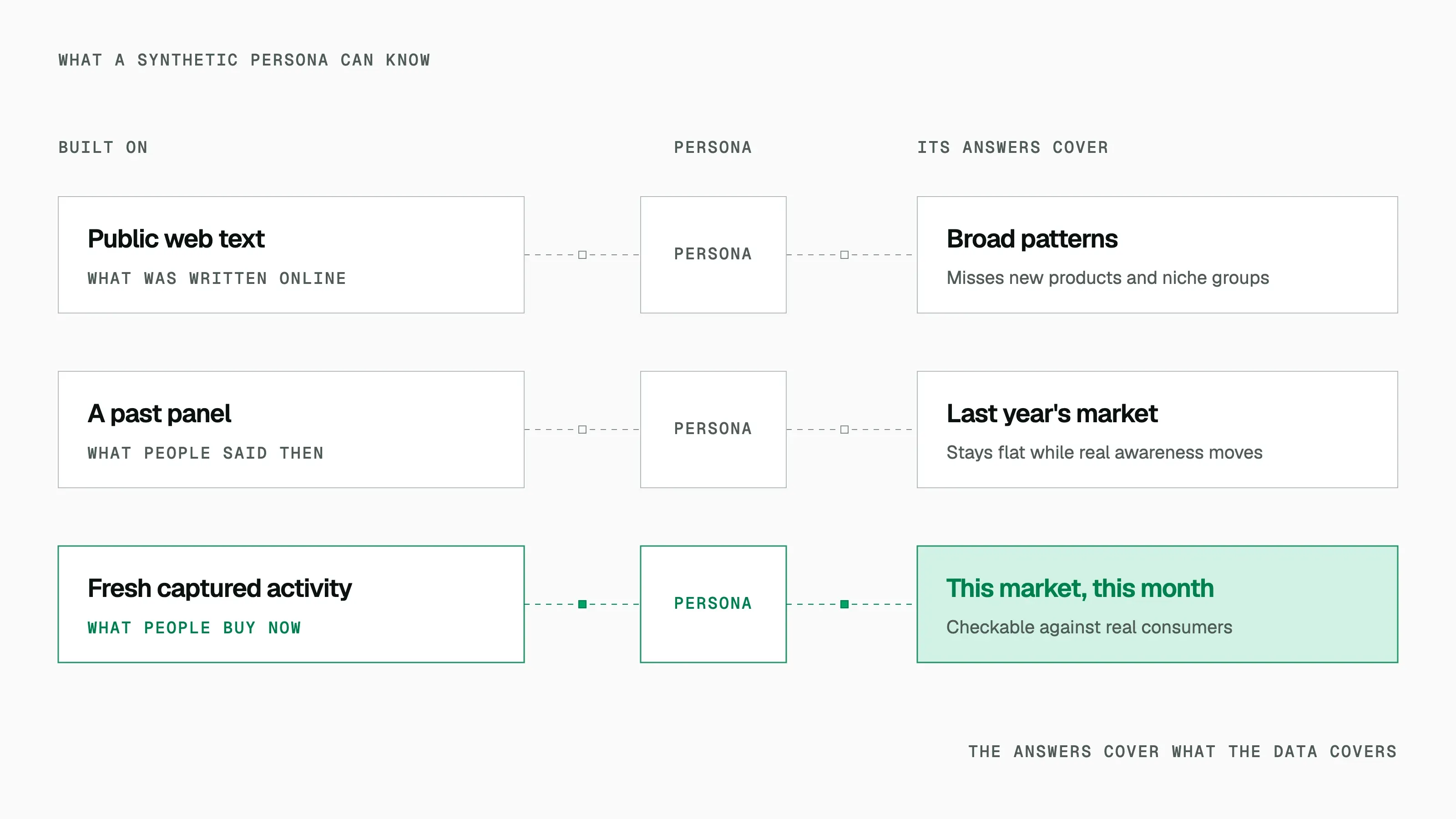
Industry bodies ask buyers to check the third column:
- Market Research Society: "Organizations should disclose how synthetic data is created, what real-world data it is based on, and any assumptions made in its generation," per a 2025 council paper.
- Insights Association Code: AI-generated data "must be clearly distinguished from data directly derived from research subjects," per its Code of Standards.
- Insights Association guidance: Synthetic participants "should be fully disclosed to research buyers and stakeholders," per its 2026 update.
How accurate are synthetic respondents?
Each published figure measures a different thing, so read the "what it measured" column first:
| Source | Who ran it | What it measured | Result |
|---|---|---|---|
| Pew Research Center, Sep 2026 | Independent | AI digital twins of its own panelists, run on Claude Opus 4.6, across three survey waves | 12.4-point average error |
| Nielsen Norman Group, Oct 2026 | Independent | One open question, 120 synthetic respondents against 604 people | Same conclusion, far fewer distinct answers |
| NIM | Independent | Brand choice by synthetic participants against real ones | About 79% matched, with well-known names overrated |
| Park et al., Stanford | Academic | Answers to General Social Survey items against people's own two-week test-retest | 82% to 86% of test-retest consistency, against 74% for demographics-only agents |
| PyMC Labs | Industry | Purchase intent across 57 personal care surveys and 9,300 human answers | 90% of human test-retest reliability |
| Brand, Israeli, and Ngwe, HBS | Working paper | Willingness to pay | "often inaccurate and in some cases wrong-signed" |
| Strat7, Jul 2026 | Research agency | Price ordering and year-on-year change, against about 3,000 UK people | Price ordering contradicted 68% of the time, change tracked correctly 19% of the time |
| Artificial Societies | The company itself | Match of opinion distributions across 1,000 real-world surveys | 86% distribution accuracy |
| Synthetic Users | The company itself | Parity on themes and depth | "between 85% and 92% depending on audience type" |
Why the figures disagree:
- Test-retest ratios compare a model with how consistently people repeat their own answers.
- Distribution matches compare the spread of answers.
- Parity scores compare themes.
- Direction of change asks whether the model moves when the market moves.
- Self-reported scores come from each company's own published evaluation.
- General chatbots: Is ChatGPT accurate for market research covers the same question for ChatGPT, Gemini, and Claude.
Where synthetic users fall short
The gaps sit where the data behind a persona runs thin:
- New products: Kantar says "the trial of a new product is hard." The HBS paper found gains from added human data fell away for new categories.
- Niche groups: In Strat7's test, among women aged 35 to 44, the real figure was 31% and one provider read 14%.
- Subgroups: Pew found synthetic surveys "especially error-prone for some subgroups, including Republicans and Black adults."
- Moving markets: Real awareness of many products rose eight to twelve points in a year, per Strat7. The synthetic data stayed almost flat.
- Validation: The Market Research Society says synthetic data for niche groups "must be validated against real-world findings."
- High-stakes calls: Qualtrics lists launch decisions, major pricing commitments, and regulatory submissions as weaker fits for synthetic data, per its guide.
Synthetic users vs real users: which fits
The deciding question is whether current consumer data exists for the decision at hand.
| Decision | Synthetic run on older data | Fast online panel | Consumer activity captured for the question |
|---|---|---|---|
| Screening early ideas in an established category | Strong fit | Fit | More than the decision needs |
| Launch aimed at a niche group | Early read only | Fit where the panel reaches the group | Strong fit |
| Concept read with a general population | Early read | Strong fit | Fit |
| Launch call on a new-to-world product | Early read only | Fit | Strong fit |
| Price change after a market move | Early read only | Fit | Strong fit |
| Launch into a new market or channel | Early read only | Fit where the panel reaches | Strong fit |
- By category: Established categories with years of published data give a persona a deep record to draw on. A new flavor in an established category sits there, and a new-to-world format sits where the record is thin.
- By sales channel: A new country, or a channel the company has yet to sell in, leaves a persona little to recombine. A launch there needs consumer data captured in that channel.
- By budget: Synthetic Users plans start at $12,500 a year. Fast online panels price per response, such as Pollfish from $0.95 and SurveyMonkey Audience from $1.
- The real cost: For a launch, price, or market entry call, weigh the cost of a wrong call against the cost of the read.
How to combine synthetic research with real consumers
- Screen with synthetic runs: Use them for early ideas, question drafts, and hypotheses.
- Boost small groups carefully: Strat7's 2025 test advised capping synthetic data at 5% of the total and using it only to boost small, hard-to-reach groups.
- Validate the niche reads: The Market Research Society advises checking synthetic reads on niche groups against real consumers.
- Label it: Disclose synthetic data to buyers and stakeholders, per the Insights Association.
- Decide on real activity: Run the launch, price, or market entry call on consumer activity from the target market.
- Compare platforms: Consumer data platforms compared and best concept testing platforms cover the options.
Where Sena fits: a launch in two markets
- The decision: An innovation team has a new snack format headed for two markets, and the launch call is due.
- The synthetic read: A synthetic run gave a strong early read on the concept. The launch call needs real people in those markets.
- What Sena reads: The team's concept results and sales files, consumer activity captured on request through Rwazi's 5M+ consumer network, and store photos read by computer vision. Those show who sells in each market, at what price, and in what formats.
- What consumers share: In each market, consumers see the concept and share their preference, purchase intent, and willingness to pay.
- Consent: Every answer is zero-party data, shared directly by a consumer who chose to share it.
- What comes back: The willingness-to-pay range for the concept against store prices today, and which market shows stronger purchase intent, with sources and a confidence level on the answer.
- The source behind each answer: The file, the photo, or the signal it came from.
The innovation team launches first in the market with the stronger purchase intent, at a price inside the range where volume and margin both hold. It takes that call to the investment committee with every figure traced to its source.
Frequently asked questions
What are synthetic respondents?
Synthetic respondents are AI-generated stand-ins for real people, used to answer surveys, interviews, and concept tests. A model writes each answer from its source data. Any gap in that data carries into the answers.
What is a synthetic user?
A synthetic user is an AI-generated stand-in for a real participant in UX and product research. Synthetic users matched people on the main conclusion in a Nielsen Norman Group test. Their answers showed far less range.
What are synthetic personas and AI personas?
Synthetic personas, also called AI personas, are AI profiles a team can question like an interview group. Strat7 describes them as a fast way to pressure-test ideas in conversation. Toluna builds its personas from its own panel of more than 81 million people.
What does "synthetic people" mean?
Synthetic people is a broad name for AI-generated stand-ins for human participants. Market research teams say synthetic respondents, marketing teams say synthetic audiences, and UX teams say synthetic users. All three names describe the same method.
What is an example of synthetic data in market research?
Synthetic data in market research means model-generated survey answers, personas, or boosted groups. Teams use it beside recruited people or in their place. One example is Kantar boosting a small, hard-to-reach group inside real data. Another is a Qualtrics synthetic panel of the US general population.
How accurate are synthetic respondents?
It depends on what the test measured. Pew put the average error of its digital twins at 12.4 points. A Stanford test reached 82% to 86% of people's own test-retest consistency. The company Synthetic Users reports its own parity at 85% to 92%.
Synthetic users vs real users: which is better?
Each fits a different decision. Synthetic users suit early screens, question drafts, and hypotheses in well-documented categories. Real users suit concept reads, launch calls on new products, price changes after a market move, and entry into a new market.
What are AI focus groups?
The term covers two methods. AI-moderated groups put an AI moderator in front of real participants. Synthetic focus groups put questions to generated personas and read the answers as a group discussion. That format suits early screens more than a launch call.
What is a Qualtrics synthetic panel?
It is part of Qualtrics Edge Audiences, which generates synthetic responses for chosen demographics. Its help page says the panel covers the US general population. Qualtrics also says the panel is less applicable to questions on past purchases, detailed recall, or brand awareness.
What does "synthetic response" mean?
A synthetic response is one answer an AI model generates in place of a real person's answer to a survey or interview question. A set of synthetic responses from one profile makes up a synthetic respondent. Each response reflects the model's source data, so it carries that data's gaps.