ChatGPT is accurate enough to start from well-documented public facts and less reliable on specific market figures. OpenAI says as much. Its Help Center warns that ChatGPT “can produce incorrect or misleading outputs,” even as OpenAI reports that GPT-6 Sol makes about half as many mistakes as its predecessor.
Independent tests show where the errors land. In Resonance’s 2026 check of almost 50,000 AI answers about 116 B2B technology companies, ChatGPT had an error in 49% of answers, the lowest rate of the assistants compared. On what shoppers will pay, a Harvard Business School working paper, first issued in 2023 and testing mainly OpenAI’s GPT models, found estimates “often inaccurate and in some cases wrong-signed.” And Pew Research Center found that AI stand-ins for survey takers “do a poor job of estimating the public mood.”
Key takeaways
- Accuracy depends on the test. Each benchmark measures one task, such as summaries, company facts, or multiple-choice answers.
- Company facts go wrong often. ChatGPT erred in 49% of answers about companies in one 2026 check and still scored the best of the assistants compared.
- Market accuracy follows reach. Published facts can carry a citation. Store prices and purchases sit off the public web.
- Check by question type. Public facts get a link test. Market figures get a provenance test.
How accurate is ChatGPT?
ChatGPT accuracy, as a percentage, changes with what each test measures:
- OpenAI's own evaluation: GPT-6 Sol "makes about half as many mistakes as its predecessor," per OpenAI's launch post. The test uses real conversations where users flagged mistakes.
- OpenAI's caveat: Those conversations are harder than typical usage, "where factual errors are more rare."
- The October update: A system card published October 7, 2026, reports "significant improvements in factuality" over GPT-5.6 Sol "across nearly all evaluation metrics."
- Company facts: Resonance checked answers from April to September 2026. ChatGPT had an error in 49% of them and a serious error in 5%.
- Multiple choice: A 2024 paper in Cureus found ChatGPT 4 answered 65% to 69% of hearing-test questions correctly. ChatGPT 3.5 scored 48% to 49%.
How often is ChatGPT wrong, and on which questions?
OpenAI's Help Center lists the errors to expect:
- Wrong facts: Incorrect definitions, dates, or facts.
- Invented sources: Fabricated quotes, citations, or references to made-up sources.
- False confidence: Overconfident answers to ambiguous or complex questions.
- Knowledge cutoff: Answers leave out events after the cutoff until ChatGPT runs web search or another connected app.
- Access limits: Paywalls, technical issues, and robots.txt settings keep some websites out of reach.
- Web search: "Search results and citations can be incomplete, outdated, or incorrect," per its web search page.
ChatGPT vs. Gemini, Claude, and Google AI on accuracy
Is Gemini or ChatGPT more accurate?
The leader changes with the task:
- Summaries: On Vectara's hallucination leaderboard, last updated October 22, 2026, GPT-6 Sol added unsupported claims to 6.5% of document summaries. The eight Gemini versions listed ranged from 3.3% to 13.6%.
- Company facts: In Resonance's check, Gemini had an error in 83% of answers and Perplexity in 63%, against 49% for ChatGPT.
Is Claude more accurate than ChatGPT?
- Summaries: The ten Claude versions on Vectara's leaderboard ranged from 9.8% to 12.2%, against 6.5% for GPT-6 Sol.
- Company facts: Resonance also checked Claude, and said it had too few answers for a fair comparison.
Is Google AI or ChatGPT more accurate?
- Gemini: The leaderboard and company-fact figures above cover Google's Gemini models.
- AI Mode and AI Overviews: Resonance checked both, and their answer counts came in too small to rank.
What matters more than the model
For a market number, the data a model reaches matters more than the model. Gemini, Claude, Copilot, and ChatGPT all answer from training data and the public web until a team connects its own files. The provenance test below applies to each of them.
Is ChatGPT reliable for market research?
ChatGPT is a reliable starting point for published market facts it can cite, once each cited page is checked. Figures nobody published come back as estimates:
- What shoppers will pay: A Harvard Business School working paper by Brand, Israeli, and Ngwe found model estimates of willingness to pay "often inaccurate and in some cases wrong-signed."
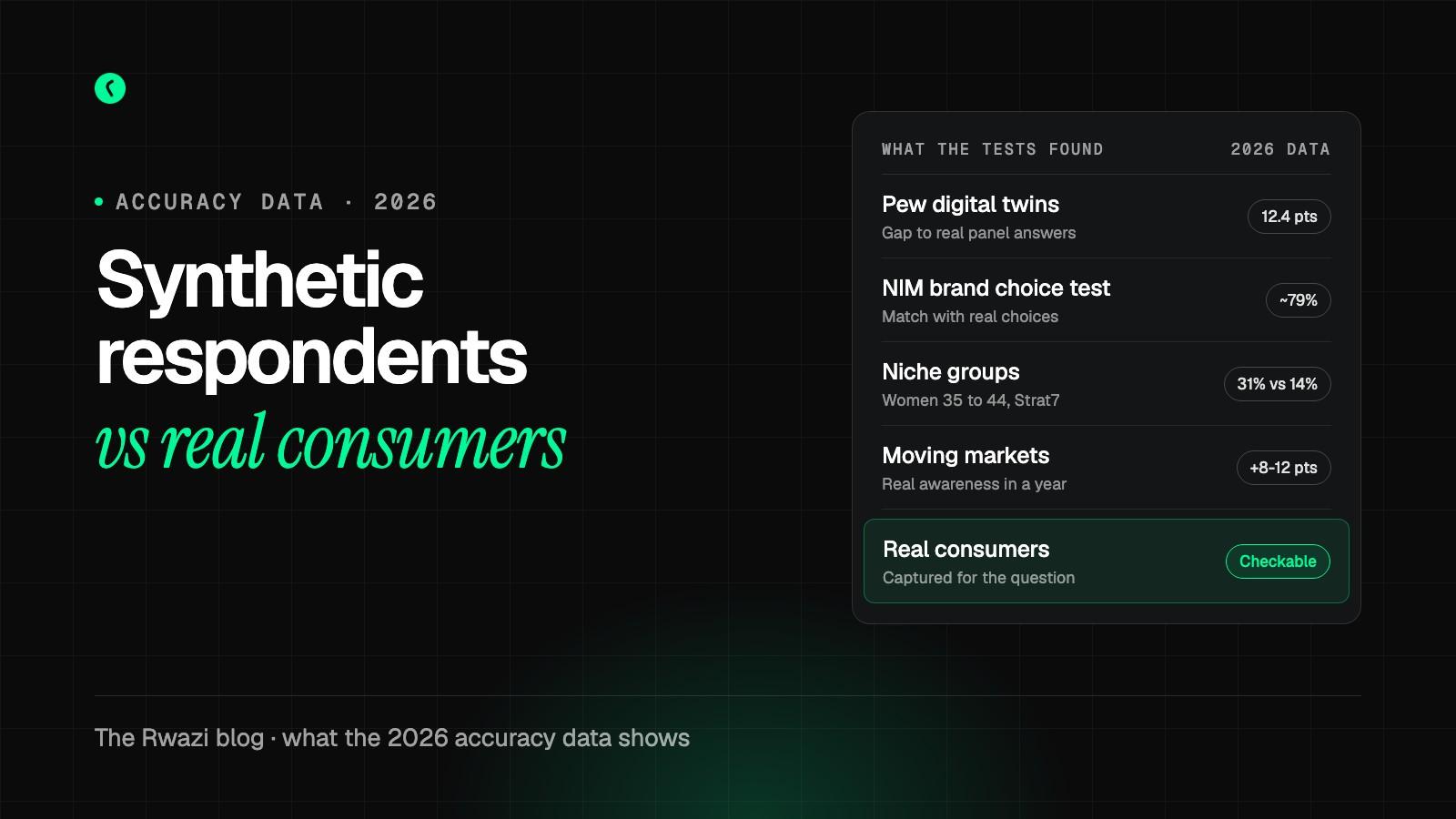
- Public opinion: The Pew Research Center found on September 30, 2026, that synthetic surveys are especially error-prone for some subgroups.
- Conjoint analysis: A preprint revised on April 17, 2026, reports "a significant gap between LLM-generated and human data."
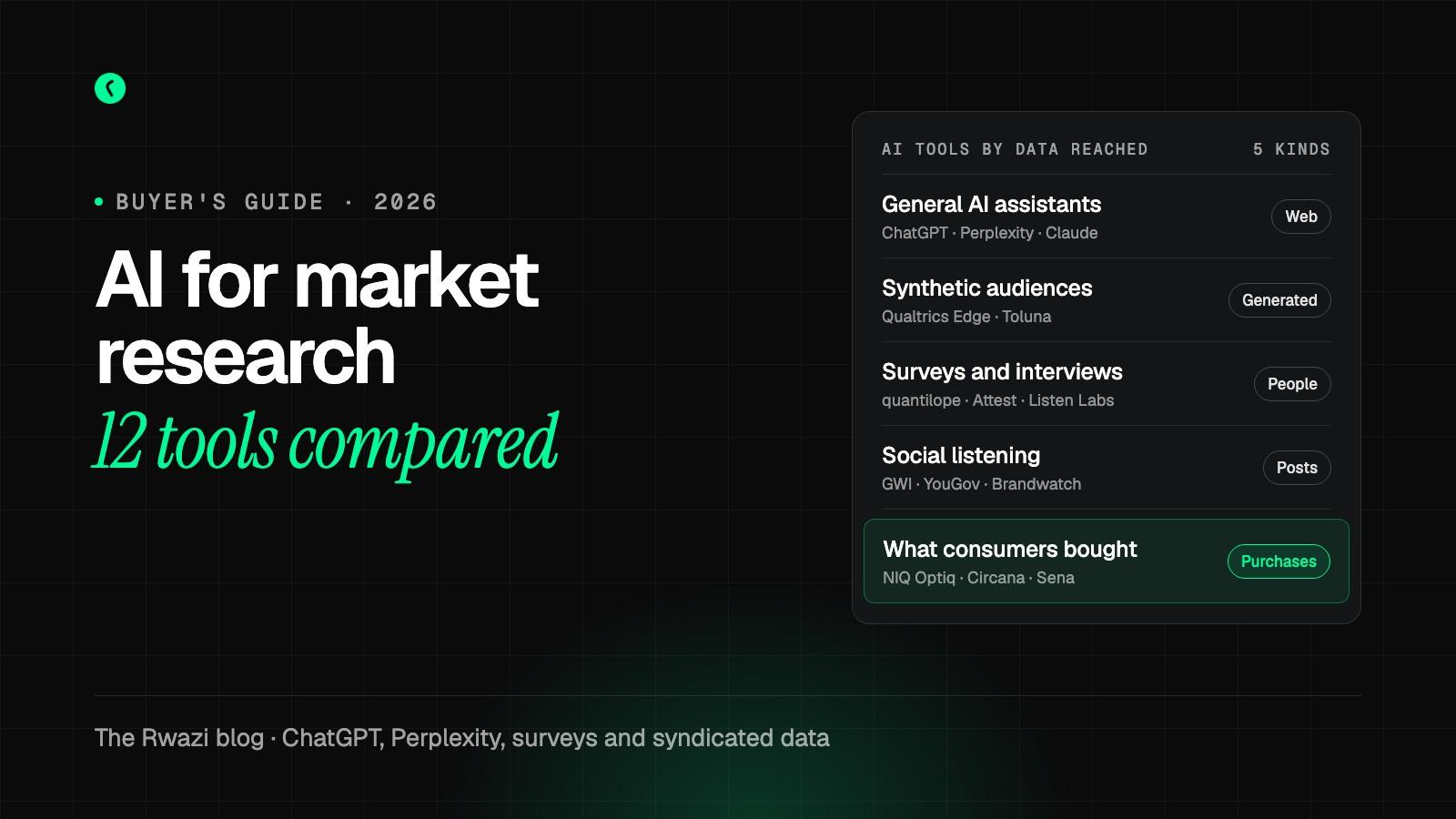
- Platforms that reach consumer data: AI for market research compares them.
Can ChatGPT do market research?
- Desk work: ChatGPT summarizes published reports, drafts survey questions, and organizes competitor facts.
- Its sources: Training data, the public web, and files a team uploads.
- Where it stops short: What shoppers bought, or what a product sells for in one city, needs data from stores and purchases.
ChatGPT accuracy by data source
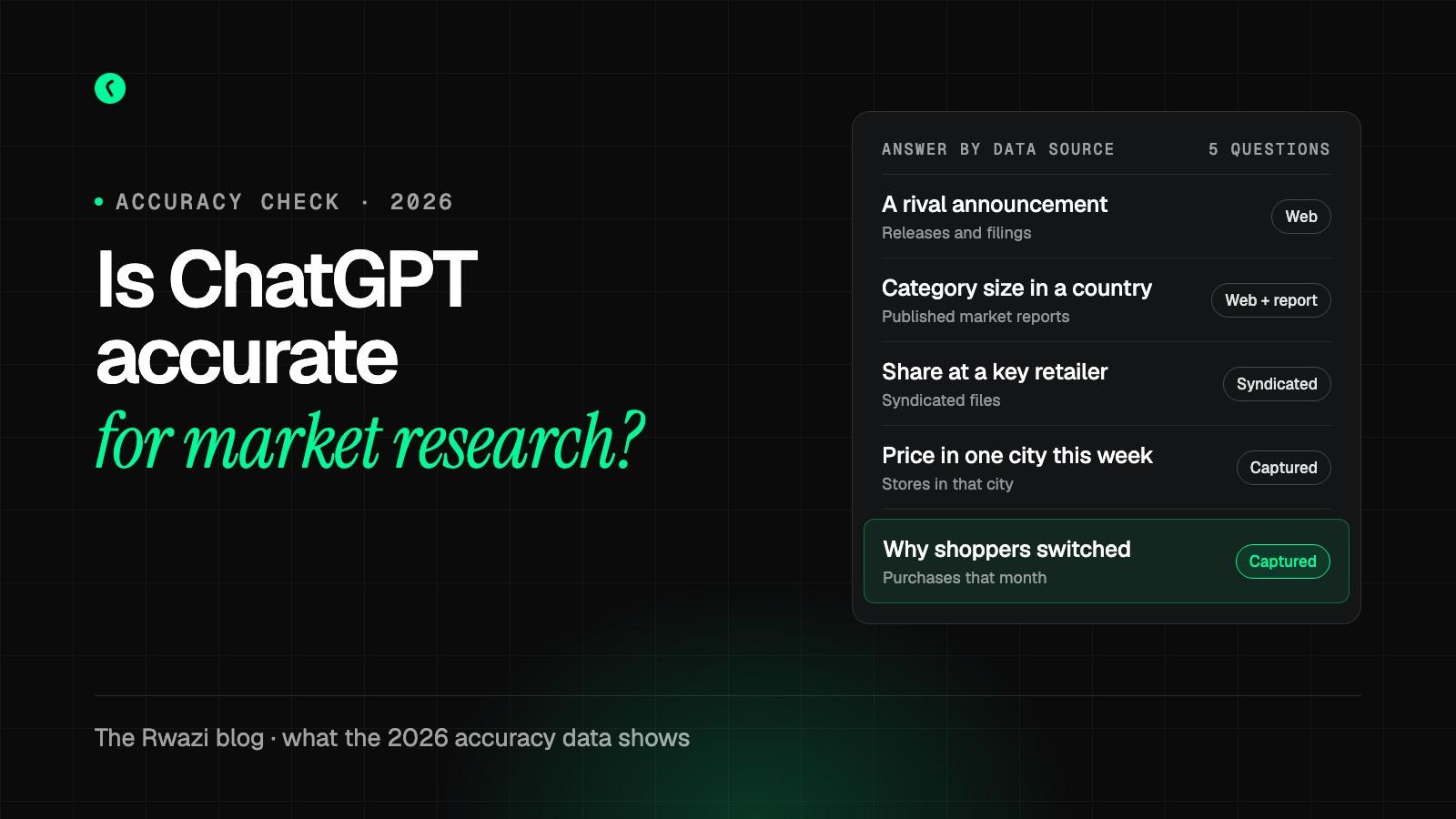
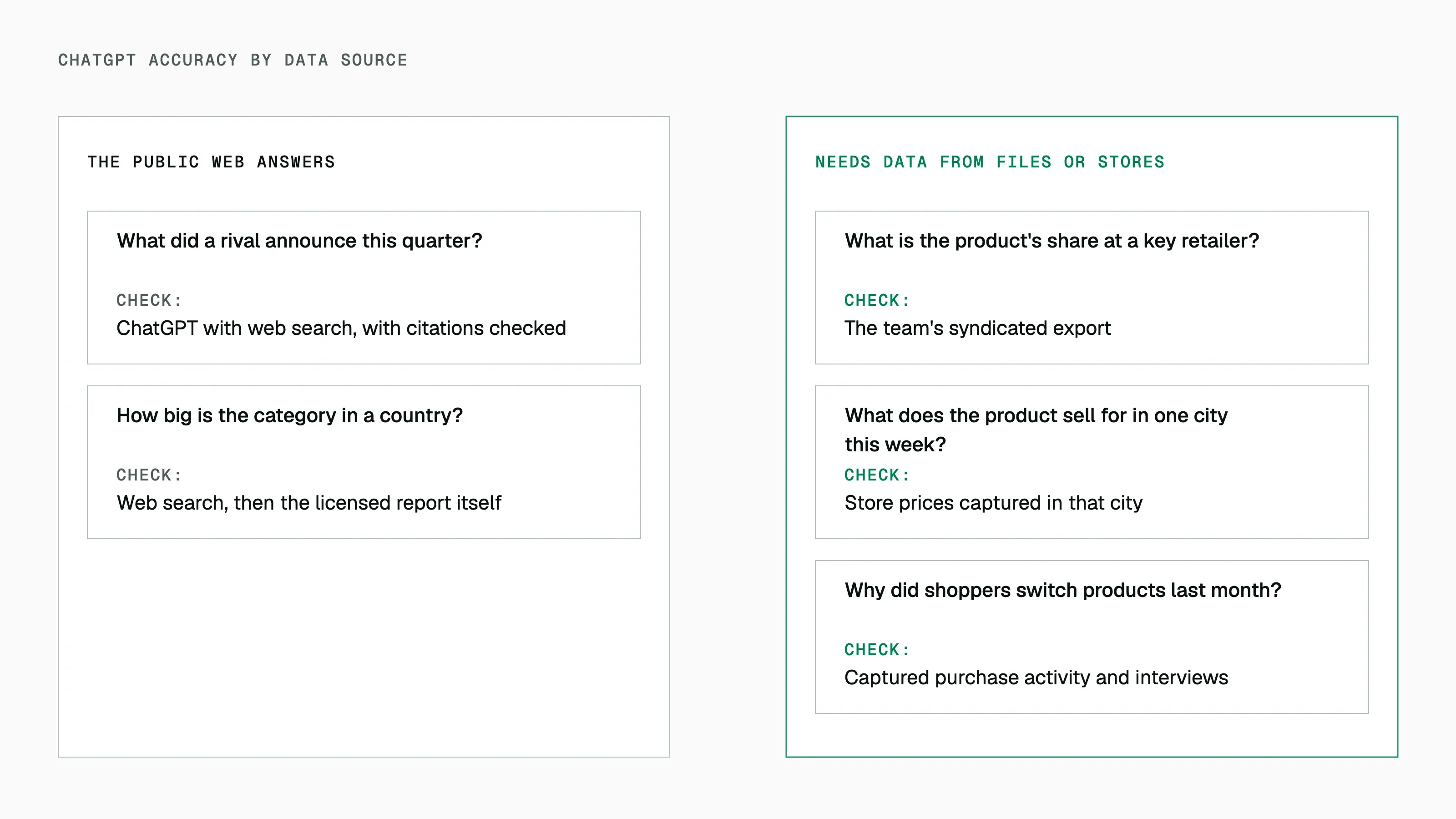
For a market question, the model matters less than whether anyone published the answer. ChatGPT reads the public web, files a team uploads, and the apps it connects.
| Market question | Where the answer sits | What answers it |
|---|---|---|
| What did a rival announce this quarter? | Releases and filings on the public web | ChatGPT with web search, with citations checked |
| How big is the category in a country? | Published market reports, some licensed | Web search, then the licensed report itself |
| What is the product's share at a key retailer? | Syndicated files | The team's syndicated export |
| What does the product sell for in one city this week? | Stores in that city | Store prices captured in that city |
| Why did shoppers switch products last month? | Shoppers' purchases that month | Captured purchase activity and interviews |
Signs a ChatGPT market number needs checking
These signs mark a number to check before it reaches a deck:
- A precise figure with zero linked sources: A decimal-point share stays an estimate until a cited source backs it.
- A cited page missing the number: Open every cited source and find the figure on the page.
- A figure for one city, store, or week: Figures at that grain sit in licensed files or in stores.
- An answer that changes on a second ask: In the 2024 Cureus paper, ChatGPT 4 gave the same answer within a day 87% to 88% of the time.
- A confident tone: OpenAI warns that "the model may express high confidence even in incorrect answers."
- A recent event answered from memory: Events after the knowledge cutoff need web search or a dated source.
How to verify ChatGPT answers
The link test, for public facts
- Open the source: "Open a cited source to check that it supports the answer," per OpenAI.
- Check the date: Review when the page was published or updated.
- Use an authority: OpenAI advises an authoritative source "when accuracy matters."
- Treat it as a draft: OpenAI's Help Center says to use ChatGPT "as a first draft" and to check important information.
The provenance test, for market figures
- Which dataset? A named report, a syndicated file, or a company filing.
- Which stores, channels, and markets? The coverage behind the figure.
- Which dates? The capture date and how fresh the data is.
- Which method produced it? A scan, a survey, a panel, or a model estimate.
- Can the team open it? A figure that traces to a file or a capture passes. A figure that traces to a fluent paragraph goes back for a sourced number.
The frameworks behind both tests
- NIST: The AI Risk Management Framework Generative AI Profile names confabulation, "the production of confidently stated but erroneous or false content," as a core risk.
- ESOMAR: Its 20 Questions gives research buyers the questions to ask about an AI service's data sources, models, and human oversight.
- The review step: How to make data-driven decisions covers it.
ChatGPT fits by category, channel, and budget
- By category: In a well-documented category, size and trend can be checked against published reports. Share at one retailer, price in one city, and the reason shoppers switched sit in syndicated files or in stores.
- New or niche categories: Most questions need captured consumer data because their figures sit in stores more than in reports.
- By sales channel: Online-led sales leave a public trail, such as listings, prices, and reviews. Store-led sales, especially in small independent stores, call for capture in those stores.
- By budget: The link and provenance routine cost analyst time. Teams that license syndicated files already hold a dated reference for the stores those files measure.
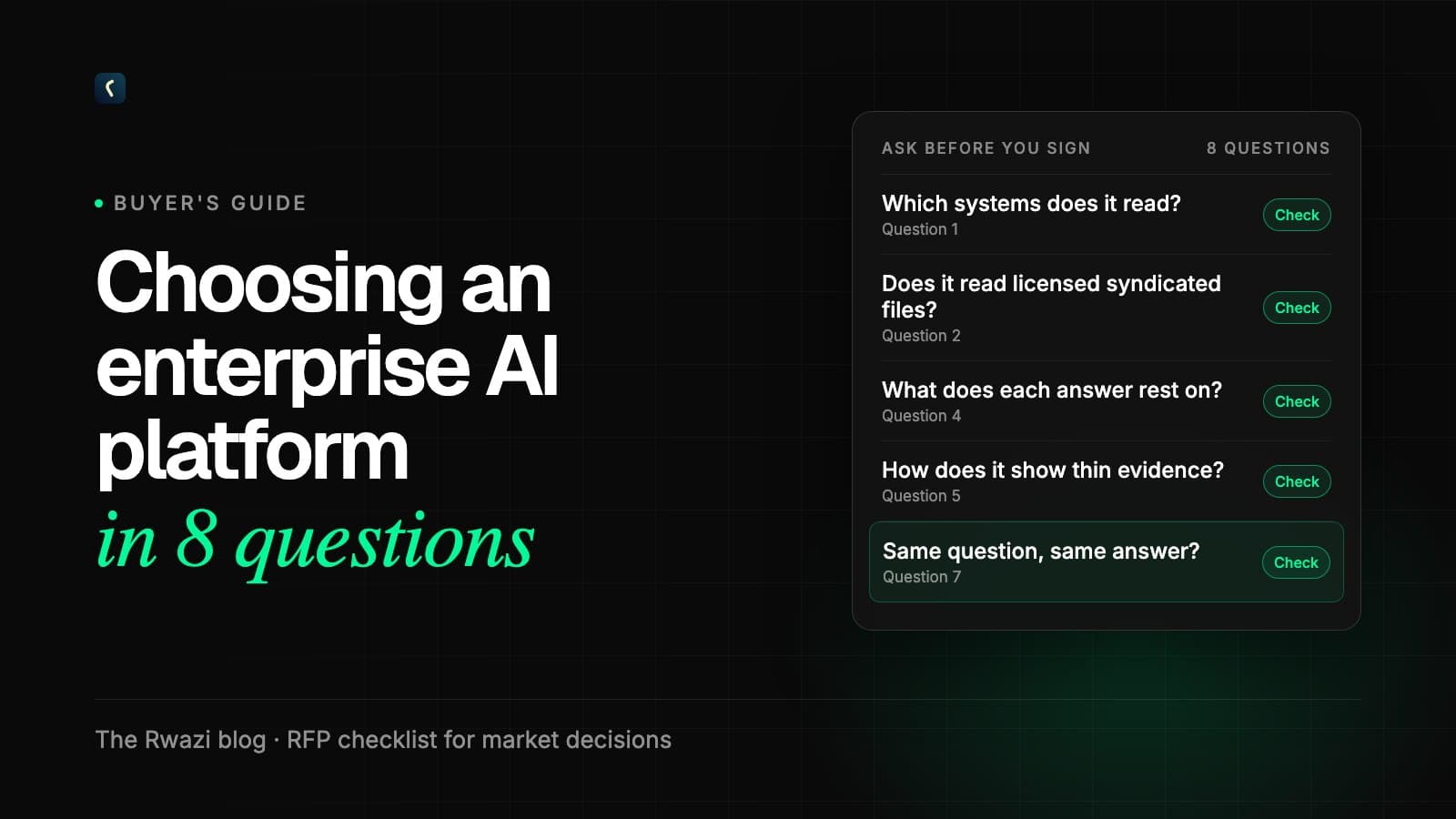
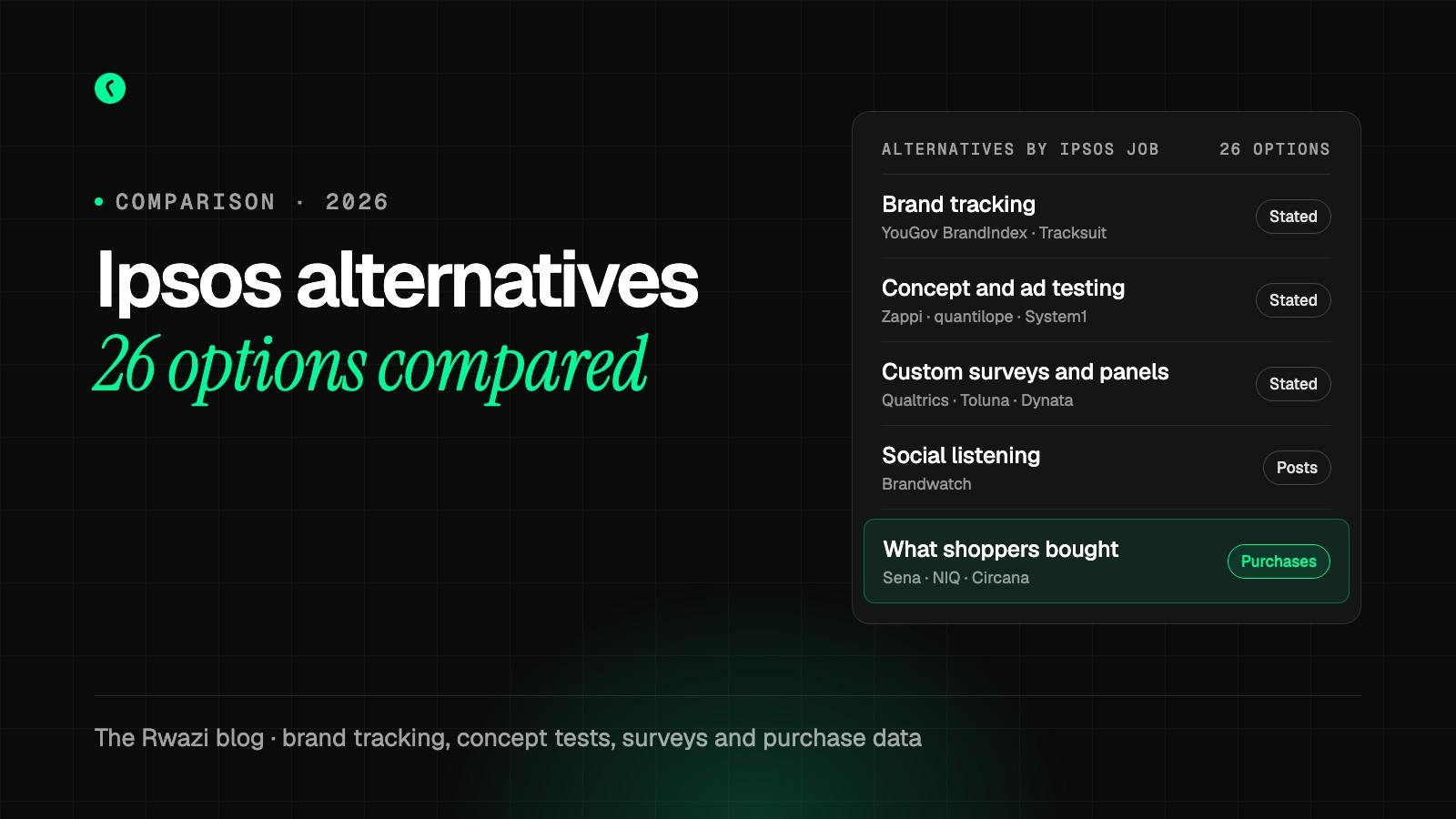
- Choosing a platform: How to choose an enterprise AI platform lists the questions to ask, and the compare hub covers named alternatives.
Where Sena fits: a price move in two cities
- The decision: A commercial director has to decide by month end whether to raise a product's price in two cities.
- The ChatGPT answer: With web search, ChatGPT returns published list prices and online listings. Prices in those two cities' stores this week sit off the public web.
- What Sena reads: The team's sales data and syndicated export, plus store prices captured on request in those cities.
- What comes back: A city-by-city read of where the product sits above or below rivals, with sources and a confidence level on the answer.
- Repeatable: The same question returns the same answer, so the figure in the deck matches the figure in the review.
- The source behind each answer: The file, the photo, or the signal it came from.
The commercial director raises the price in the city where the product sits below rivals and holds it where it already sits above. The call closes by month-end with one set of figures in the deck and the review. Pricing analytics covers that decision.
Frequently asked questions
Is ChatGPT accurate?
ChatGPT gets well-documented public facts right more often than specific market figures. OpenAI's own Help Center warns that its answers can mislead. A price in one city this week sits off the public web, so ChatGPT returns an estimate.
How often is ChatGPT wrong?
The error rate changes with the task. Resonance checked almost 50,000 answers about B2B technology companies in 2026. Almost half of ChatGPT's answers held an error, and 1 in 20 held a serious one. On OpenAI's internal evaluation, GPT-6 Sol made about half the mistakes of its predecessor.
Is ChatGPT always 100% accurate?
ChatGPT makes mistakes, so it falls short of 100% accuracy. OpenAI warns that it may sound confident when it is wrong. Newer models make fewer factual errors on OpenAI's evaluations. Accuracy still turns on the data the model can reach.
Is ChatGPT a reliable source for research?
ChatGPT works as a first draft, which is how OpenAI says to use it. For anything headed into a decision, open the cited source, check the date, and confirm the figure appears there. Store-level figures, such as prices or share at one retailer, need syndicated files or captured activity.
Can ChatGPT do market research?
ChatGPT can take on the desk work, such as reading published reports and sorting competitor facts. Its estimates of what shoppers will pay often miss, per Harvard Business School researchers. Purchase and store-price questions call for captured store data.
How does AI contribute to marketing research?
AI contributes in two layers. Language models such as ChatGPT speed up desk work on published sources. Sena, the Decision AI from Rwazi with access to real-world data, answers market questions from data captured on request, with sources and a confidence level on each answer.
Is Gemini more accurate than ChatGPT?
Gemini's best version leads on summaries, and ChatGPT leads on company facts. Vectara's October 22 leaderboard puts Gemini versions at 3.3% to 13.6% unsupported claims in summaries. GPT-6 Sol sits at 6.5%. Resonance found errors in 83% of Gemini's company answers and 49% of ChatGPT's.
Is Claude more accurate than ChatGPT?
GPT-6 Sol leads on summaries. Vectara puts it at 6.5% unsupported claims, and Claude versions at 9.8% to 12.2%. Resonance logged too few Claude answers to rank it. Testing each model on the team's own questions gives the clearest answer.
How do teams verify ChatGPT answers?
Teams run two checks. The link test covers public facts: open each cited source, confirm it supports the answer, and check its date. The provenance test covers market figures: confirm the dataset, the stores and markets, the dates, and the method behind the number.
How can a team make ChatGPT more accurate?
Give it the source. Upload the report or dataset the answer should rest on, ask for a cited page behind every figure, and run the link test on each citation. A market number that names its dataset, date, market, and method is ready for review.