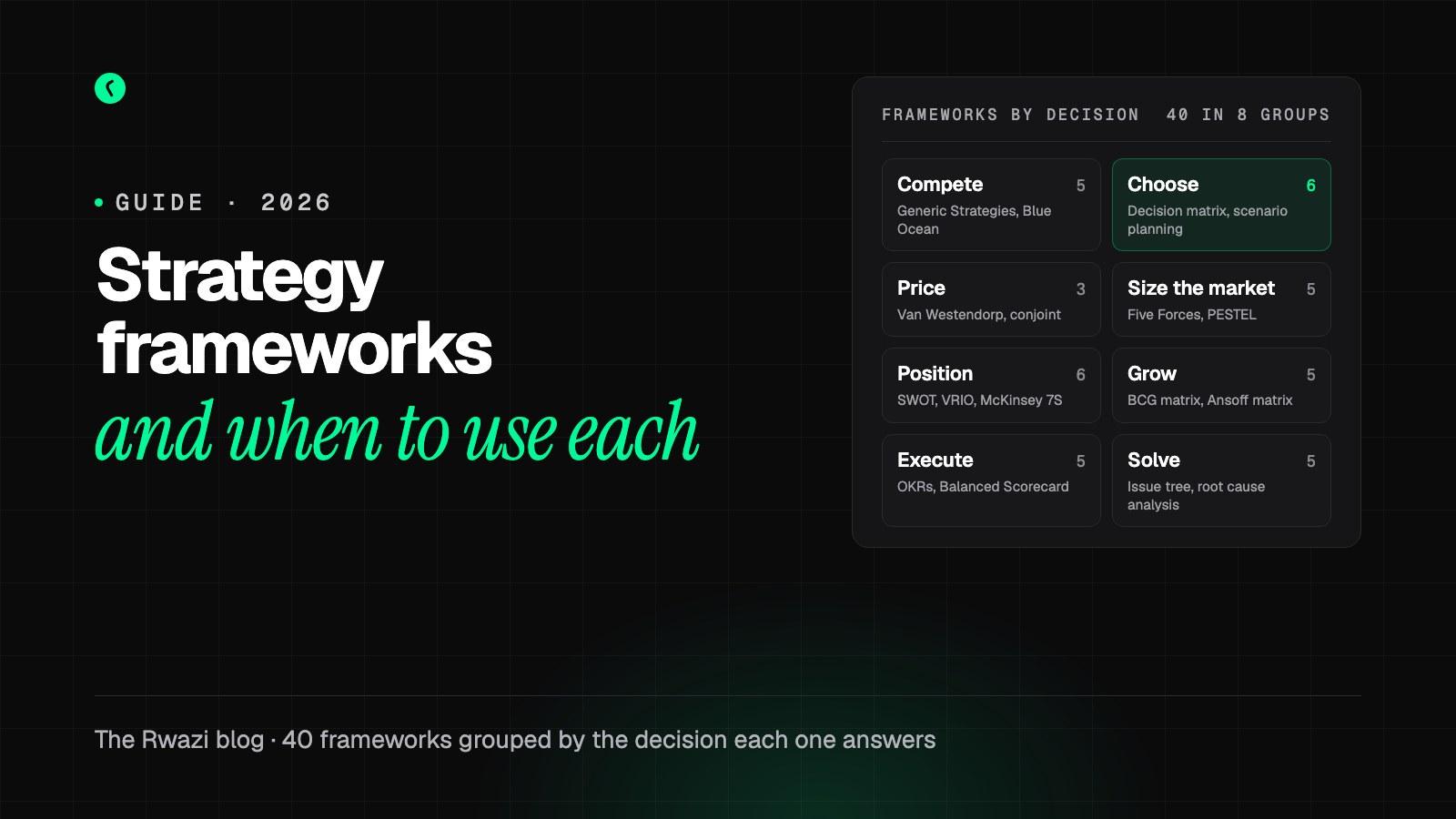
Strategy frameworks are structured ways to answer one business question at a time: where to compete, which option to pick, what to charge, how attractive a market is, where the company stands, where to grow, how to execute, or why a problem keeps happening. Each framework fits one kind of decision.
This guide lists 40 strategic frameworks grouped by the decision each one answers, with one line on when to use it. Start from the decision, pick the framework, and fill it with evidence.
Ask Sena about this article
Which strategy framework fits a market entry decision?
Run a SWOT on my business with sources.
Which of my products should get investment next year?
Answers come back with their sources.
Key takeaways
- Start from the decision: Each framework answers one question; the question picks the framework.
- Eight groups: Compete, choose, price, size the market, position, grow, execute and solve.
- The most used: SWOT, Porter's Five Forces, PESTEL, the BCG matrix, the Ansoff matrix and the decision matrix.
- Evidence decides the answer: A framework filled with opinions gives an opinion back; each cell needs a source.
Which framework for which question
| The question | Frameworks to use |
|---|---|
| Where and how to compete? | Porter's Generic Strategies, Playing to Win, Blue Ocean Strategy |
| Which option to choose? | Decision matrix, cost-benefit and NPV, scenario planning |
| What to charge? | Van Westendorp, conjoint analysis |
| How attractive is this market? | Porter's Five Forces, PESTEL, industry lifecycle |
| Where does the company stand? | SWOT, VRIO, McKinsey 7S |
| Where to grow or invest? | BCG matrix, GE-McKinsey nine-box, Ansoff matrix |
| How to execute the plan? | OKRs, Balanced Scorecard, RACI |
| Why does this problem keep happening? | Issue tree, root cause analysis, 80/20 analysis |
Run the framework with sources
Sena runs each of these 40 frameworks through eight agents and fills them with the figures behind each cell. Sign-up adds 500 credits for a first framework.
Frameworks for where and how to compete
| Framework | Use it to decide |
|---|---|
| Porter's Generic Strategies | Whether to win on cost leadership, differentiation or focus |
| Disruptive Innovation | Which low-end entrant could take the market from below |
| Playing to Win | The five linked choices, from aspiration to management systems |
| Blue Ocean Strategy | What to compete on that rivals ignore, using the strategy canvas |
| Jobs to Be Done | What customers hire a product to do, and where that job is poorly served |
- Who made them: Michael Porter (generic strategies), Clayton Christensen (disruptive innovation), A.G. Lafley and Roger Martin (Playing to Win), W. Chan Kim and Renée Mauborgne (Blue Ocean Strategy).
- Run it in Sena: The Competitive Strategist agent.
Decision making frameworks
| Framework | Use it to decide |
|---|---|
| Decision matrix | Which option wins when scored against weighted criteria |
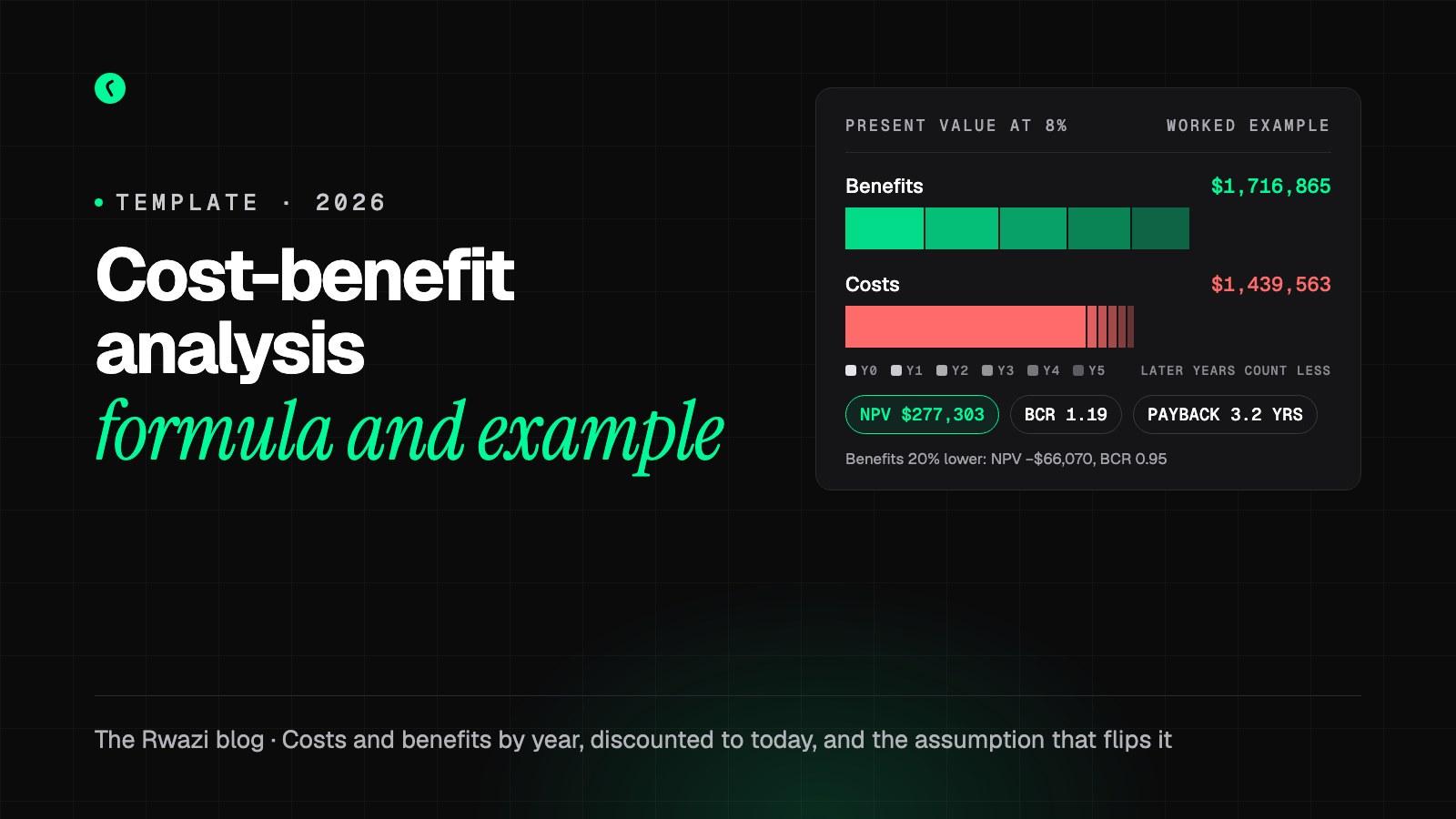
| Cost-benefit and NPV | Whether the benefits, discounted to today, outweigh the costs |
| Scenario planning | Whether a plan holds across a few different futures |
| Real options | What the choice to expand, delay or exit is worth |
| Pre-mortem | Why the plan could fail, assuming it already has |
| Wardley Mapping | How each part of the value chain is evolving, and where to invest |
- When to reach for one: Three to five options and a deadline. The decision matrix gives the fastest defensible answer; scenario planning tests it.
- Run it in Sena: The Decision Maker agent.
Pricing frameworks
| Framework | Use it to decide |
|---|---|
| Van Westendorp | The acceptable price range and the optimal price point |
| Conjoint analysis | What each feature and price level is worth to buyers |
| Segments and lifetime value | Which customer segments are worth the most over time |
- Run it in Sena: The Pricing Agent.
Frameworks for sizing up a market
| Framework | Use it to decide |
|---|---|
| Porter's Five Forces | How the five pressures on industry profit shape a market |
| PESTEL | Which political, economic, social, technological, environmental and legal forces matter |
| Industry lifecycle | Whether an industry is emerging, growing, mature or declining |
| Value chain | Where the company adds value and where costs sit |
| Value net | How customers, suppliers, rivals and complementors interact |
- When to reach for one: Before a market entry, an acquisition or a new category. Five Forces covers the industry; PESTEL covers the forces outside it.
- Run it in Sena: The Market Analyst agent.
Frameworks for where the company stands
| Framework | Use it to decide |
|---|---|
| SWOT | The strengths, weaknesses, opportunities and threats in one view |
| VRIO | Which resources give a lasting edge: valuable, rare, hard to imitate, organized |
| Core competencies | The few capabilities that open many markets |
| McKinsey 7S | Whether strategy, structure, systems, shared values, style, staff and skills fit |
| Business Model Canvas | How the business creates, delivers and captures value |
| Net Promoter Score | How many customers are promoters against detractors, and why |
- Who made them: Jay Barney (VRIO), C.K. Prahalad and Gary Hamel (core competencies), Alexander Osterwalder (Business Model Canvas), Fred Reichheld (Net Promoter Score).
- Run it in Sena: The Positioning Agent.
Frameworks for where to grow and invest
| Framework | Use it to decide |
|---|---|
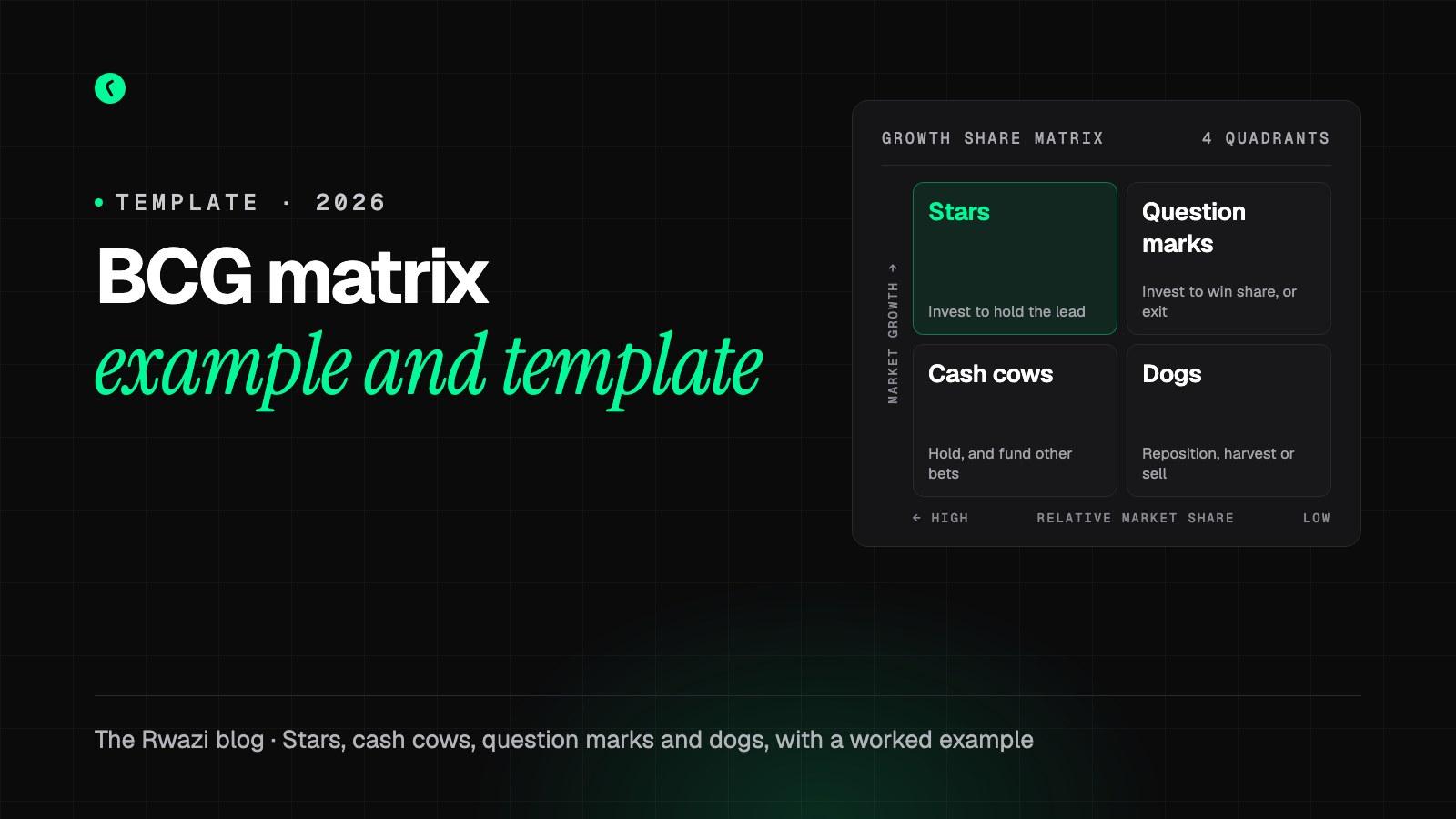
| BCG matrix | Which products are stars, cash cows, question marks or dogs |
| GE-McKinsey nine-box | Which business units to invest in, hold or harvest |
| Ansoff matrix | Which of four growth paths to take, from market penetration to diversification |
| Three Horizons | How to balance the core business, emerging bets and future options |
| Profit pools | Where the profit in an industry sits along the value chain |
- When to reach for one: At budget time. The BCG matrix sorts a portfolio fast; the GE-McKinsey nine-box gives a fuller call for units that sit close together. Portfolio strategy covers the next step.
- Run it in Sena: The Growth Agent.
Frameworks for execution
| Framework | Use it to decide |
|---|---|
| Balanced Scorecard | How strategy turns into measures across four perspectives |
| OKRs | Which ambitious objectives to set and which key results prove them |
| Lean and Six Sigma | Where to take waste and variation out of a process |
| Kotter's 8 steps | How to lead a change from urgency to culture |
| RACI | Who decides, who does the work, who is consulted and who is told |
- Who made them: Robert Kaplan and David Norton (Balanced Scorecard), John Kotter (8 steps).
- Run it in Sena: The Operations Agent.
Problem-solving frameworks
| Framework | Use it to decide |
|---|---|
| Issue tree | How a question breaks into parts that add up to the whole |
| Hypothesis-driven | Which answer to lead with, and what would prove it wrong |
| Pyramid Principle | How to present the answer first, then the arguments |
| Root cause analysis | The cause behind a problem, using the 5 Whys and the fishbone |
| 80/20 analysis | The few causes behind most of the effect |
- Who made them: Barbara Minto (Pyramid Principle). Issue trees and hypothesis-driven work are standard consulting methods.
- Run it in Sena: The Problem Solver agent.
McKinsey frameworks
Several of the 40 come from McKinsey & Company or its alumni:
- **McKinsey 7S:** Tests whether strategy, structure, systems, shared values, style, staff and skills fit together.
- GE-McKinsey nine-box: Places business units by industry attractiveness and business strength.
- Three Horizons: Balances the core business, emerging bets and future options in one view.
- Issue tree and hypothesis-driven work: Break a problem into parts that add up, then lead with the answer and test it.
- Pyramid Principle: Barbara Minto's method for presenting the answer first, developed during her time at McKinsey.
How to choose a strategy framework
- Write the decision. One sentence, with the choice and the deadline.
- Match the question. Use the "which framework for which question" table to pick one framework.
- Add a second only if the first leaves a gap. Five Forces with PESTEL, or the BCG matrix with the GE-McKinsey nine-box.
- Set the inputs. List the data each cell needs before filling any of it.
- Fill it with sources. A date and a source beside every number.
- State the call. End with the decision the framework points to and what would change it.
Where Sena fits: a strategy team prepares a market entry paper
A US consumer goods strategy team has six weeks to recommend whether to enter a second country, and the board will ask why the chosen market beats the others.
- The decision: Which country, if any, gets the entry budget next year.
- What a template shows: A Five Forces grid and a decision matrix filled with the team's own estimates, one framework per slide.
- What Sena reads: The team's own sales and cost files, uploaded or pulled through 250+ integrations, plus purchase, price and shelf data that Rwazi's 5M+ consumer network in 190+ countries captures on request in each shortlisted country.
- Consent: Contributors opt in to each capture, and every purchase and photo carries its location and date.
- What Sena returns: Sena's Market Analyst runs Five Forces and PESTEL per country, and the Decision Maker scores the countries in a decision matrix, each with sources and a confidence level.
The team brings one recommendation to the board, with every cell in both frameworks tied to a source. Market entry strategy covers the decisions after the entry call.
Pick a framework and run it on a real decision
Sena's eight agents run all 40 frameworks and return each cell with its source. Rwazi's consumer network captures the market data behind a decision on request.
Pick a framework in Sena · Start with 500 credits · Request real-world data
Strategy frameworks: the bottom line
- 40 frameworks, eight questions: Compete, choose, price, size the market, position, grow, execute and solve.
- One decision, one framework: Start from the question and add a second framework only when the first leaves a gap.
- Sources make the answer: Each of the 40 holds up in review only when every cell carries a dated source.
Frequently asked questions
What are strategy frameworks?
Strategy frameworks are structured methods for answering one business question at a time, such as where to compete, which option to pick or where to invest. Common examples are SWOT, Porter's Five Forces, PESTEL, the BCG matrix and the Ansoff matrix. Each one organizes the evidence a decision needs.
What are the top frameworks for business strategy?
The most used strategy frameworks are SWOT for where a company stands, Porter's Five Forces and PESTEL for the market, the BCG matrix and Ansoff matrix for where to grow, Porter's Generic Strategies for how to compete, and the decision matrix for choosing between options.
What is the 7S framework in strategic management?
The McKinsey 7S framework tests whether seven parts of an organization fit together: strategy, structure, systems, shared values, style, staff and skills. Teams use it before a reorganization, a merger or a strategy change to find which parts work against the new plan.
What are decision making frameworks?
Decision making frameworks help a team choose between options and commit. The decision matrix scores options against weighted criteria, cost-benefit and NPV compare discounted costs and benefits, scenario planning tests a plan against several futures, and the pre-mortem looks for why a plan could fail before it starts.
What are consulting frameworks?
Consulting frameworks are the structured methods consultants use to break down a client's question and answer it. The issue tree, hypothesis-driven work and the Pyramid Principle structure the problem and the answer; Five Forces, the BCG matrix and the 7S framework analyze the market, the portfolio and the organization.
What are the three levels of strategy?
The three levels of strategy are corporate strategy (which businesses to be in), business strategy (how each business competes) and functional strategy (how each function, such as marketing or operations, supports the plan). The BCG matrix serves the corporate level, Porter's Generic Strategies the business level and OKRs the functional level.
How many strategy frameworks should a team use?
One per decision, and two at most. Each framework answers one kind of question, so a team picks the one that matches its decision and adds a second only when the first leaves a gap, such as PESTEL alongside Five Forces.
Pick a framework in Sena · Start with 500 credits · Request real-world data
About the author: Joseph Rutakangwa is Co-founder and CEO of Rwazi, which builds Sena, the Decision AI with access to real-world data from a 5M+ consumer network across 190+ countries.