Budget forecasting estimates a company's future revenue, costs, and profit from past results, current performance, and the market, and checks whether the budget's targets will be met. A 2027 budget forecast turns next year's sales forecast into spending limits by team, so this guide covers budget vs forecast, the main methods, eight steps to build one, a template, and a worked example with a base, low, and high case.
A budget forecast is a plan with assumptions inside it. The strongest ones name those assumptions and test them before the budget locks. Sena, Rwazi's Decision AI with access to real-world data, runs that test as a simulation and turns the result into a presentation for leadership.
Ask Sena about this article
If 2027 revenue lands 12% below plan, which costs should a snack brand cut first?
How much should a consumer brand budget for marketing to grow US sales 15% in 2027?
What happens to 2027 operating profit if packaging costs rise 8%?
Answers come back with their sources.
Key takeaways
- Budget and forecast do different jobs: The budget sets targets and spending limits for the year. The forecast updates the expected outcome as the year runs.
- Start from revenue drivers: A budget built on outlets, volume, and price holds up better than last year's spend plus a percentage.
- Split fixed and variable costs: Variable costs move with revenue, fixed costs hold, so the low case hits margin harder than the base case suggests.
- Carry a range: A base, low, and high case show how much profit depends on one or two revenue assumptions.
- Stress-test before it locks: Test the pessimistic case and the moves that protect profit before the budget goes to the board.
What is budget forecasting?
Budgeting and forecasting are two halves of one planning cycle. Budget forecasting estimates where revenue, costs, and profit will land, and the budget turns that estimate into targets and spending limits for each team.
What a budget forecast covers
- Revenue: Expected sales by product, channel, and month, usually taken from the sales forecast.
- Cost of goods sold: Materials, production, and freight that rise and fall with volume.
- Operating expenses: Marketing, sales, distribution, and general and administrative costs. Together, these form the operating budget.
- Capital spending: Equipment, systems, and other long-term investments, planned separately in the capital budget.
- Cash: When money comes in and goes out, so the company can pay its bills every month.
Budget vs forecast vs plan
A budget sets the target, a forecast predicts the outcome, and a plan describes how the company will get there. The table shows how each one works in practice.
| Budget | Forecast | Plan | |
|---|---|---|---|
| Question it answers | What can each team spend? | Where will results land? | How will the company get there? |
| Cadence | Set once a year | Updated monthly, quarterly, or rolling | Set for one to three years |
| What changes it | Major shifts, such as a new product or a recession | New actuals and new assumptions | Strategy changes |
| Owner | Finance with each budget holder | Finance, FP&A | Leadership |
| Used for | Spending limits and targets | Early warning of a miss | Priorities and investment |
The budget vs forecast gap is the most useful number in the year. When the forecast drifts below the budget, the team knows months ahead that a target is at risk.
Budget forecasting methods
Budget forecasting methods split into four main types, plus two ways of building the budget. Most teams combine a driver-based forecast with a scenario check.
| Method | How it works | Best for | Where it breaks |
|---|---|---|---|
| Trend (straight-line) | Last year's figures × (1 + growth rate) | Stable costs, such as rent and salaries | New products, new channels, price changes |
| Driver-based | Each line built from its drivers, such as units × cost per unit | Revenue and variable costs | Wrong driver assumptions |
| Regression | Costs or revenue as a function of drivers, from past data | Large companies with years of clean data | Market shifts that break past patterns |
| Scenario | Base, low, and high cases on the assumptions that matter most | Any budget facing uncertainty | Scenarios that stay too close together |
| Top-down vs bottom-up | Leadership sets totals, or teams build up line by line | Top-down for speed, bottom-up for detail | Top-down misses detail; bottom-up runs long |
| Zero-based budgeting | Every cost justified from zero each year | Cost resets and turnarounds | Time-heavy for every line, every year |
How to build a 2027 budget forecast in 8 steps
How to forecast a budget for next year follows the same eight steps for most companies.
- Start from the sales forecast. Take the base, low, and high revenue cases from the 2027 sales forecast.
- Split costs into fixed and variable. Variable costs, such as materials and freight, move with volume. Fixed costs, such as rent and salaries, hold.
- Set the drivers for each line. Cost per unit, headcount by month, media spend by channel, and price changes from suppliers.
- Build the operating budget. Revenue minus cost of goods sold gives gross profit; minus operating expenses gives operating profit.
- Plan capital spending and cash. List investments and their timing, then check that monthly cash stays positive.
- Run three cases. Apply the low and high revenue cases, and see what happens to margin when variable costs flex and fixed costs hold.
- Agree the budget with each owner. Every line gets one owner who signs off on the number and the assumptions behind it.
- Set the forecast rhythm. Re-forecast monthly or quarterly against actuals, and track the gap between budget and forecast.
Budget forecast template
A budget forecast template needs one row per line, the driver behind it, and three cases. Copy the table into Excel or Google Sheets and replace the inputs.
Scroll sideways for all 7 columns →
| Line | 2026 actual | 2027 low | 2027 base | 2027 high | Driver | Owner |
|---|---|---|---|---|---|---|
| Revenue | Outlets × units × price | Sales | ||||
| Cost of goods sold | Units × cost per unit | Operations | ||||
| Gross profit | Revenue − cost of goods sold | Finance | ||||
| Marketing | Plan by channel | Marketing | ||||
| Sales and distribution | % of revenue | Sales | ||||
| General and administrative | Headcount and fixed costs | Finance | ||||
| Operating profit | Gross profit − operating expenses | Finance | ||||
| Capital spending | Project list | Finance |
How to use the template
- Keep drivers in their own cells: A change to cost per unit then flows to all three cases.
- Add a monthly view: Split each line by a seasonal pattern from past years, so cash timing shows up.
- Note the source: Record where each input came from, such as a supplier quote, last year's actuals, or a market report.
Budget forecast example
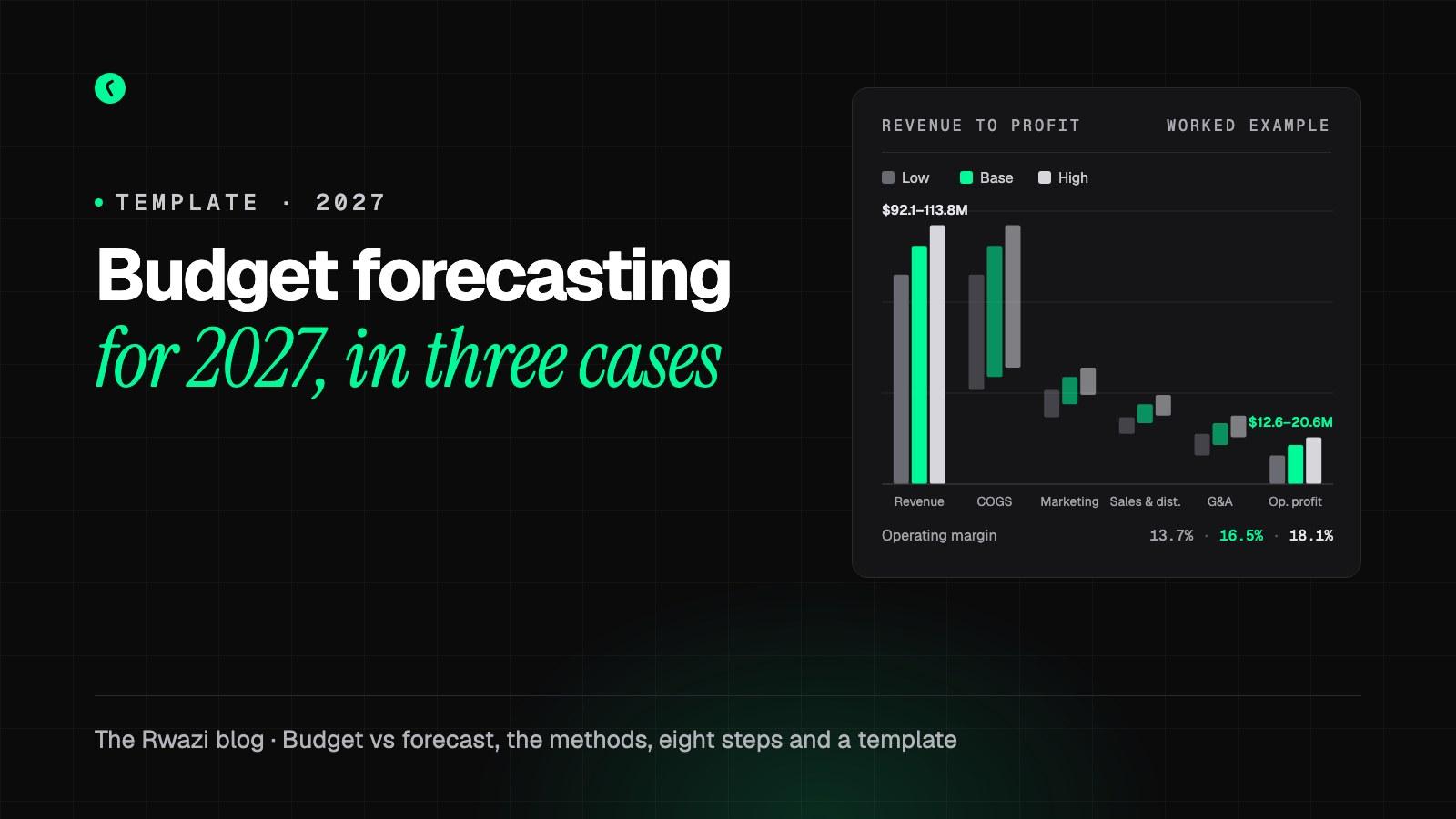
This budget forecast example uses illustrative numbers for a snack brand, carrying the revenue range from the sales forecast into costs and profit.
- Revenue: $92.13M in the low case, $104.73M in the base case, and $113.78M in the high case.
- Cost of goods sold: 55% of revenue in every case, so gross profit runs from $41.46M to $51.20M, with $47.13M in the base case.
- Marketing: Held at $12.0M in every case, a fixed commitment once media is booked.
- Sales and distribution: 8% of revenue, from $7.37M to $9.10M.
- General and administrative: Fixed at $9.5M.
- Operating profit: $12.59M (13.7% margin) in the low case, $17.25M (16.5%) in the base case, and $20.60M (18.1%) in the high case.
Revenue swings 12% between the low and base cases, and operating profit swings 27%, because marketing and overhead stay fixed. That gap is the reason to stress-test the low case before the budget locks: which fixed costs can move, and how fast.
Stress-test the budget before it locks
Open Sena's snack sales simulation: a snack brand tests price, distribution, and marketing moves against category growth and a rival's launch, and sees whether the plan lands on target or short.
Open the snack sales simulation
Rolling forecasts
A rolling forecast extends the forecast by one period every time a period closes, so the company always looks the same distance ahead, such as 12 months or four quarters. The annual budget stays fixed, and the rolling forecast shows where results are heading.
- Why teams use it: Year-end becomes a regular month-end. In March, the forecast already covers the following March.
- What it needs: Clean monthly actuals, a driver-based model, and a short monthly review.
- What it replaces: Re-building the whole budget mid-year when the market moves.
Can ChatGPT do forecasting?
ChatGPT can explain forecasting methods, draft a template, and run simple calculations on numbers it is given. A budget forecast also needs the company's own actuals, supplier prices, and market data, and every assumption traced to a source.
- What it does well: Explaining methods, building a first template, and checking formulas.
- What to check: Any market figure it states, against the original source.
- Sena on the same question: Sena answers with its sources and a confidence level, and runs the forecast as a simulation on the team's own files.
Where Sena fits: the stress test before the budget locks
Sena fits between the draft budget and the board. Sena's Simulation agent turns a decision into a live simulation of what each move would do to the number a team cares about.
- The decision: A snack brand's 2027 base case shows $17.25M in operating profit, and the CFO wants to know how bad the low case gets and what protects it.
- The moves: Hold price, cut marketing in the second half, renegotiate freight, or slow hiring.
- What Sena reads: The team's own sales and cost files, public market data, and consumer activity captured on request through Rwazi's 5M+ consumer network across 190+ countries: what shoppers pay in each store type and what they buy when prices change.
- Consent: Contributors in the network choose to share what they buy, and every answer is zero-party data.
- What Sena returns: A simulation that shows whether the plan lands on target or short, with a confidence range and the sources behind every input. Sena's Presentation agent then builds an editable presentation from the results, shaped for the people who will see it.
The finance team takes one budget and one tested fallback to the board. The Simulations page covers how it works, and the guide to how to make data-driven decisions covers the wider process.
Test the 2027 budget before the board sees it
Open the snack sales simulation to see a target tested against price, distribution, and marketing moves. Then sign up with 500 credits and run the 2027 budget as a simulation, with sources on every input. Rwazi's consumer network captures shelf prices and purchases behind a forecast on request.
Open the snack sales simulation · Sign up with 500 credits · Request real-world data
2027 budget forecast: the bottom line
- Start from drivers: Build revenue and variable costs from volume and price, then add fixed costs.
- Carry three cases: Fixed costs make profit swing harder than revenue, and the low case shows by how much.
- Re-forecast on a rhythm: Monthly or rolling forecasts show the gap to budget months before year-end.
- Stress-test before it locks: Test the moves that protect profit in the pessimistic case before the board signs off.
Frequently asked questions
What is budget forecasting?
Budget forecasting estimates a company's future revenue, costs, and profit from past results, current performance, and market conditions, and checks whether the budget's targets will be met. The budget sets targets and spending limits; the forecast updates the expected outcome as the year runs.
What is the difference between a budget and a forecast?
A budget sets targets and spending limits, usually once a year. A forecast predicts where results will land and is updated monthly, quarterly, or on a rolling basis. The gap between them shows early whether a target is at risk.
What is the difference between planning, budgeting, and forecasting?
Planning sets priorities and how the company will reach them over one to three years. Budgeting turns the plan into targets and spending limits for the coming year. Forecasting predicts where results will land and updates as actuals come in.
What are the four forecasting methods?
The four main forecasting methods are trend or straight-line forecasting from past results, driver-based forecasting from units, prices, and headcount, regression from the relationship between results and their drivers, and scenario forecasting with base, low, and high cases.
How is a budget forecast built?
Start from the sales forecast, split costs into fixed and variable, set the driver for each line, build the operating budget, plan capital spending and cash, run base, low, and high cases, agree each line with its owner, and re-forecast monthly or quarterly against actuals.
What is a rolling forecast?
A rolling forecast extends the forecast by one period every time a period closes, so the company always looks the same distance ahead, such as 12 months. The annual budget stays fixed, and the rolling forecast shows where results are heading.
What is an operating budget?
An operating budget covers the revenue and expenses of running the business for the year: cost of goods sold, marketing, sales, distribution, and general and administrative costs. It ends in operating profit. Long-term investments sit in a separate capital budget.
What is zero-based budgeting?
Zero-based budgeting starts every cost line at zero each year, so each one has to be justified again before it is funded. It suits cost resets and turnarounds, and takes more time than adjusting last year's budget.
Can ChatGPT do forecasting?
ChatGPT can explain forecasting methods, draft a template, and run simple calculations on numbers it is given. A budget forecast also needs the company's own actuals, supplier prices, and market data, with every assumption traced to a source.
Ask Sena a planning question · Request real-world data
About the author: Joseph Rutakangwa is Co-founder and CEO of Rwazi, which builds Sena, the Decision AI with access to real-world data from a 5M+ consumer network across 190+ countries.
Read next: 2027 sales forecast, Sena Simulations, and How to make data-driven decisions