Competitive intelligence tools collect what competitors publish and do, then put it in front of the team that has to respond: sales reps in a live deal, marketers planning a campaign, and strategy leads setting next year's plan. This guide groups 16 tools for competitive intelligence by the job each one does: battlecards and win-loss, website change tracking, news and market monitoring, company research, search and ads, social listening, and online price tracking.
Each group reads a different part of the digital record, so most teams run two or three tools side by side. The alert is half the work. The other half is the response: match a rival's price, hold and promote, or launch a counter offer. Sena, Rwazi's Decision AI with access to real-world data, scores that response with its sources and adds what competitors charge on store shelves when the question needs it.
Ask Sena about this article
Which competitor is gaining share in US dry dog food, and through which retail channel?
How do private label coffee prices compare with branded coffee in UK supermarkets?
Answers come back with their sources.
Key takeaways
- Start from the job: Battlecards for sales, website trackers for competitor pages, news platforms for market moves, research platforms for filings and company data, search tools for competitor keywords and ads, social listening for the conversation, and price trackers for online prices.
- Best competitor intelligence tools by job: Klue, Crayon, and Kompyte for sales; Visualping for website changes; Contify, Valona, and Feedly for news; AlphaSense and CB Insights for company research; Semrush, Similarweb, Ahrefs, and SpyFu for search and ads; Brandwatch and Brand24 for social; Prisync for online prices.
- Published prices: Visualping starts at $14 a month, Prisync at $99, Ahrefs at $129, Semrush at $139, and Brand24 at $249. Sales and enterprise platforms quote per contract.
- Store shelves sit outside the digital record: In-store prices, promotions, and pack sizes come from people in the store, through field audits or a consumer network.
- Decide the response: An alert names the move. A scored decision names the response and the one assumption that would change it.
What are competitive intelligence tools?
Competitive intelligence tools are software that collects information about competitors from public sources, filters it, and shares it with the teams that act on it. Sources include competitor websites, pricing pages, job posts, press releases, news, filings, search rankings, ads, reviews, and social posts. The tools add alerts, summaries, battlecards, and dashboards on top.
What the tools cover
- Collection: Crawlers and feeds watch thousands of sources so analysts check fewer sites by hand.
- Filtering: AI summaries and relevance scoring cut a week of updates to the few that matter.
- Sharing: Battlecards, Slack and Teams alerts, newsletters, and CRM cards put the update where sellers and marketers work.
- Analysis: Search, comparison grids, and AI answers help an analyst explain what a move means.
Competitive intelligence sits inside the wider market intelligence category. The best market intelligence tools guide covers the full category, including B2B contact data and consumer measurement, and the guide to competitive market intelligence covers sources, methods, and ethics.
The 16 competitive intelligence tools at a glance
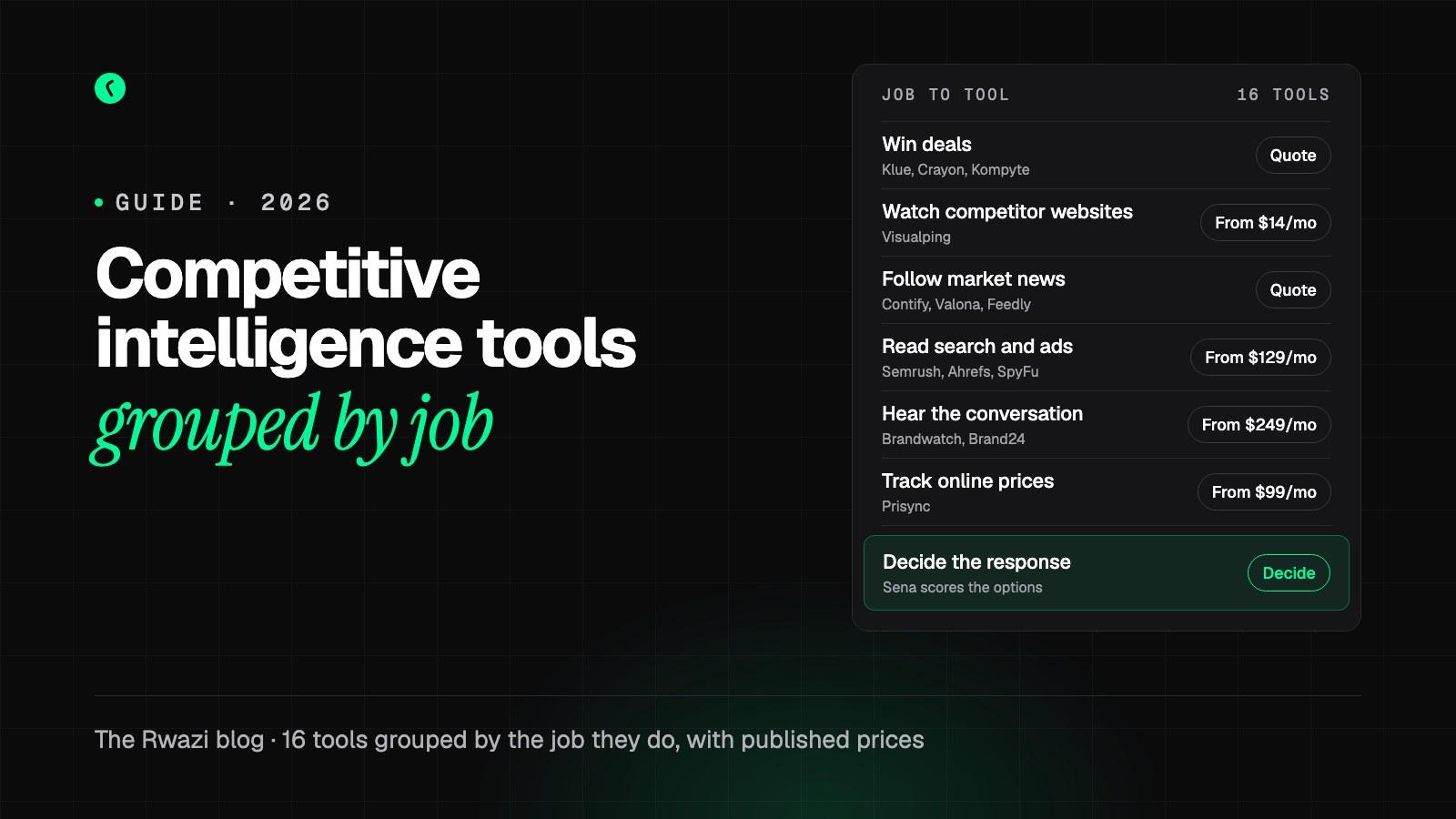
Competitive intelligence platforms split by the job they do. The table groups 16 tools by that job, with the decision each serves and the price on each company's own site on November 23, 2026.
| # | Tool | Job | Decision it serves | Published price |
|---|---|---|---|---|
| 1 | Klue | Battlecards and win-loss | Win a competitive deal | Quote |
| 2 | Crayon | Battlecards and competitor monitoring | Win a competitive deal | Quote |
| 3 | Kompyte | Battlecards and competitor tracking | Win a competitive deal | Quote |
| 4 | Visualping | Website change tracking | Spot a pricing or messaging change | From $14 a month |
| 5 | Contify | News and market monitoring | Brief leaders on market moves | Quote |
| 6 | Valona Intelligence | News and market monitoring | Spot trends and competitor moves early | Quote |
| 7 | Feedly Market Intelligence | News and trend monitoring | Follow a market and its emerging trends | Quote or trial |
| 8 | AlphaSense | Company and market research | Read a competitor's strategy and results | Quote |
| 9 | CB Insights | Company and deal data | Size up private competitors and new entrants | Quote |
| 10 | Semrush | Search and ads | Win competitor keywords and traffic | From $139 a month |
| 11 | Similarweb | Web and app traffic | Benchmark digital market share | Quote |
| 12 | Ahrefs | Search and AI visibility | Win competitor keywords and AI answers | From $129 a month |
| 13 | SpyFu | Search and paid ads | Copy what works in competitor ads | Self-serve plans |
| 14 | Brandwatch | Social listening | Track share of voice against rivals | Quote |
| 15 | Brand24 | Social and media monitoring | Catch competitor mentions fast | From $249 a month |
| 16 | Prisync | Online price tracking | Set online prices against rivals | From $99 a month |
How this guide was researched: The 16 tools are the ones most often named in Google's US AI Overview and top results for "competitive intelligence tools" and in ChatGPT's answer to "best competitive intelligence tools in 2026" on November 23, 2026. Features, coverage figures, and prices come from each company's own website on that date. Every listing is editorial and unpaid.
Turn the next competitor alert into a decision
Sign up for Sena with 500 credits, describe the competitor move and the options on the table, and see which response comes out on top and which assumption would flip it, with sources on every number.
Score the response with 500 credits
Competitive intelligence software for sales: battlecards and win-loss
Competitive intelligence software for sales turns competitor updates into battlecards that sellers open in a live deal, and adds win-loss research that explains why deals close or stall. Klue, Crayon, and Kompyte lead this group. Product marketing teams usually own the tool, and sales enablement measures it by competitive win rate.
- Klue: Competitive intel and win-loss in one platform. A Compete Agent collects and shares competitor updates, and the win-loss suite adds analyst-run interviews, an AI Interviewer for short voice conversations with buyers and sellers, and Blindspots interviews with buyers from evaluations the team sat out.
- Crayon: Competitor monitoring with battlecards, talk tracks, and sales plays generated by Crayon AI. A Salsify case study on Crayon's homepage reports a 22% increase in competitive win rate.
- Kompyte: Battlecards and automated competitor tracking from Semrush. Kompyte tracks competitor updates across hundreds of sources, filters the noise with AI, and adds win-loss reporting through the sales tools reps already use.
When this group fits: Teams with a product marketing or CI owner, a sales team that meets the same three to five rivals in most deals, and a CRM to plug the battlecards into.
Website change tracking tools
Website change tracking tools watch competitor pages and send an alert when a price, plan, headline, or product page changes. Visualping is the best-known standalone option, and Crayon, Kompyte, and Contify include website monitoring inside their platforms.
- Visualping: Used by over 2 million people and teams at 85% of the Fortune 500, per its own site. Plans start at $14 a month for 1,000 checks across 10 pages, and a $0 plan covers 150 checks across 5 pages. Alerts go to email, SMS, Slack, or an API.
When this group fits: Small teams watching a short list of pricing and product pages, and larger teams that want a cheap early warning next to a full platform.
Competitive intelligence platform for news and market monitoring
A competitive intelligence platform for news and market monitoring reads thousands of news sites, trade publications, filings, and blogs, then filters them by competitor, topic, and market. Contify, Valona Intelligence, and Feedly Market Intelligence cover this job. Strategy and CI teams use them for daily briefs and leadership newsletters.
- Contify: Market and competitive intelligence with coverage of competitors, customers, partners, and trends across 117+ languages, plus newsfeeds, website change monitoring, an Athena AI assistant, and intelligence newsletters.
- Valona Intelligence: An AI platform that monitors 200,000+ global sources in 115 languages to spot emerging trends and competitive moves.
- Feedly Market Intelligence: AI Feeds tuned to an industry, an Emerging Trends dashboard, and AI Actions that turn articles into summaries and tables with in-line citations.
When this group fits: Teams briefing leadership on market moves across many competitors, regions, and languages.
Company and market research platforms
Company and market research platforms search filings, earnings calls, broker research, expert interviews, and private company data, so an analyst can read a competitor's strategy and results in depth. AlphaSense and CB Insights cover this job, mostly for strategy, corporate development, and finance teams.
- AlphaSense: AI search across 500M+ documents, including filings, transcripts, and research, plus Tegus expert interviews and a SuperAnalyst agent.
- CB Insights: Data on 13 million companies and 1.5 million deals, with tech market rankings, watchlists, and the ChatCBI assistant, used to size up private competitors and new entrants.
When this group fits: Teams that need a competitor's financials, strategy, investors, and acquisitions, more than its daily website updates.
Competitive analysis tools for search, ads, and web traffic
Competitive analysis tools for search and ads show which keywords competitors rank for, which ads they run, where their traffic comes from, and how visible they are in AI answers. Semrush, Similarweb, Ahrefs, and SpyFu cover this job for marketing and growth teams.
- Semrush: Competitor keyword, backlink, ad, and AI visibility research. Plans start at $139 a month, or $117.33 a month billed annually.
- Similarweb: Digital data on 100M+ websites, 4M+ apps, and 20M+ companies, with 10 years of history, used to benchmark traffic and digital market share against rivals.
- Ahrefs: Competitor search research with a crawler-built index, plus Brand Radar AI for brand visibility across 585 million+ AI prompts. Plans start at $129 a month.
- SpyFu: The SEO and PPC keywords competitors buy and rank for, and every ad they have tested, built for paid search teams.
When this group fits: Teams where search and paid media drive demand, and where a rival's ad test or ranking gain moves revenue the same month.
Social listening and media monitoring tools
Social listening tools track what customers say about a brand and its rivals across social networks, news, blogs, forums, and reviews, and measure share of voice and sentiment over time. Brandwatch and Brand24 cover this job for brand, communications, and consumer research teams.
- Brandwatch: Consumer intelligence and social media management from a Cision company, trusted by half of the Forbes 100, per its own site.
- Brand24: Mentions from 25 million online sources tracked as they appear. Plans start at $249 a month, or $199 a month billed annually.
When this group fits: Teams tracking launches, campaigns, and reputation against rivals. The best brand tracking tools guide covers tracking studies that run next to listening.
Online price tracking tools
Online price tracking tools scrape competitor product pages and marketplaces and report price position, stock, and changes. Prisync covers this job for ecommerce teams, manufacturers, and distributors.
- Prisync: Competitor price and stock tracking with plans from $99 a month for up to 100 products, price updates three times a day, and a dynamic pricing engine on higher plans.
When this group fits: Teams selling the same products as rivals on websites and marketplaces, where a price gap shows up in conversion within days.
What competitive intelligence tools read, and what sits on store shelves
All 16 tools read the digital record: websites, pricing pages, news, filings, search results, ads, social posts, and online product listings. That record covers most of what software and services companies need to know about a rival.
For companies selling through stores, a large share of competitor moves happen on the shelf.
- Shelf prices: A rival's in-store price in a supermarket, pharmacy, or convenience store can differ from its online listing.
- Promotions: Multibuy deals, temporary price cuts, and end-of-aisle displays run store by store.
- Pack sizes and placement: A new value pack or a better shelf position shows up in the store before any press release.
- Traditional trade: In many markets, small independent shops carry most of the volume, and their prices stay offline.
These signals come from people in the store, through field audits or a consumer network that captures prices and promotions on request. The competitive shelf intelligence use case shows how Sena reads modern trade, traditional trade, and convenience across 190+ countries.
How to choose a competitive intelligence tool
Choose a competitive intelligence tool by naming the decision it has to support, then matching the job, the sources, the users, and the budget.
- Name the decision. Winning deals, defending search traffic, setting prices, and briefing leadership each point to a different group.
- Check the sources. Confirm the tool reads the places rivals move: websites, news, search, social, marketplaces, or stores.
- Count the competitors and markets. Five rivals in one country suits a light tool. Fifty rivals in twenty languages needs a platform.
- Name the users. Sellers need battlecards in the CRM. Analysts need search and exports. Leaders need a newsletter.
- Test the noise filter. Run a two-week trial on real competitors and count how many alerts led to an action.
- Check the integrations. Slack, Teams, Salesforce, HubSpot, and an API decide whether updates reach the people who act.
- Compare published prices with quotes. Self-serve tools list prices from $14 to $249 a month. Sales and enterprise platforms quote per contract, so ask for seats, sources, and renewal terms in writing.
- Plan the response step. Decide who turns an alert into a pricing, product, or campaign decision, and how fast.
Which AI tool is best for competitor analysis?
The best AI tool for competitor analysis depends on the job. Most tools in this guide now include an AI assistant: Klue's Compete Agent and Crayon AI write battlecards, AlphaSense's SuperAnalyst and CB Insights' ChatCBI answer research questions, Contify's Athena AI and Feedly's AI Actions summarize news, and Semrush and Ahrefs track AI search visibility.
- General chat assistants: ChatGPT with web search returns a quick shortlist of competitors and links to their sites, which suits a first pass.
- What to check: Prices, plan names, and feature lists change often, so every figure needs a check on the company's own page.
- Sena on the same question: Sena answers with its sources and a confidence level, scores the response to a competitor move, and says plainly when the evidence runs thin. The guide to AI for market research compares more AI options.
Where Sena fits: from the alert to the response
Sena fits after the alert, when a team has to pick a response. A competitor tool names the move. Sena scores the options.
- The move: A team's website tracker flags a rival's new value pack on US grocery retailer sites, priced 15% below the team's own pack per unit (an illustrative figure).
- The options: Match the price, hold the price and fund a promotion, or launch a value pack of its own.
- What Sena reads: The team's own sales and pricing files, public market data, and consumer activity captured on request through Rwazi's 5M+ consumer network across 190+ countries: what the rival's pack sells for on shelves in each store type, which promotions run beside it, and what shoppers buy instead.
- Consent: Contributors in the network choose to share what they buy, and every answer is zero-party data.
- What Sena returns: A weighted decision matrix from Sena's Decision Maker agent that scores each response, names the strongest one and the single assumption that would flip it, such as whether the rival's pack reaches discount chains, with sources and a confidence level.
The team acts on one response and watches one assumption, and its competitor tools keep watching for the next move. The competitive intelligence solution page shows how sales teams use the same answers per market.
Score the response to the next competitor move
Browse Sena's agents to see the frameworks behind each answer. Then sign up with 500 credits and score the response to a live competitor move, with sources on every number. Rwazi's consumer network captures shelf prices and promotions behind a decision on request.
Browse Sena's agents · Sign up with 500 credits · Request real-world data
Competitive intelligence tools: the bottom line
- Match the job first: Battlecards for sales, website trackers for competitor pages, news platforms for market moves, research platforms for company depth, search tools for keywords and ads, social listening for the conversation, and price trackers for online prices.
- Check prices on the company's own page: Self-serve tools list prices from $14 to $249 a month, and sales and enterprise platforms quote per contract.
- Cover the shelf: Companies selling through stores add shelf prices and promotions, which come from people in the store.
- Score the response: An alert is worth the decision it changes, so score the response and name the assumption that would flip it.
Frequently asked questions
What are competitive intelligence tools?
Competitive intelligence tools are software that collects information about competitors from public sources, such as websites, pricing pages, news, filings, search results, ads, and social posts, then filters it and shares it as alerts, battlecards, summaries, and dashboards with the teams that act on it.
What are the best competitive intelligence tools in 2026?
The best competitive intelligence tools in 2026, grouped by job: Klue, Crayon, and Kompyte for battlecards and win-loss; Visualping for website changes; Contify, Valona Intelligence, and Feedly Market Intelligence for news; AlphaSense and CB Insights for company research; Semrush, Similarweb, Ahrefs, and SpyFu for search and ads; Brandwatch and Brand24 for social listening; and Prisync for online price tracking.
How much do competitive intelligence tools cost?
Published prices on November 23, 2026: Visualping from $14 a month, Prisync from $99 a month, Ahrefs from $129 a month, Semrush from $139 a month, and Brand24 from $249 a month. Klue, Crayon, Kompyte, Contify, Valona, AlphaSense, CB Insights, and Brandwatch quote per contract, based on seats, sources, and modules.
What is competitor intelligence?
Competitor intelligence is the part of competitive intelligence that tracks specific rivals: their prices, products, messaging, hires, deals, ads, and results. Competitor intelligence tools collect those signals from public sources and turn them into battlecards, alerts, and briefs for sales, marketing, and strategy teams.
Which AI tool is best for competitor analysis?
It depends on the job. Klue and Crayon use AI to write battlecards, AlphaSense and CB Insights answer research questions about companies, Contify and Feedly summarize news, and Semrush and Ahrefs track competitors in search and AI answers. Sena scores the response to a competitor move, with sources and a confidence level.
What are the 5 steps of a competitive analysis?
A competitive analysis runs in five steps: name the competitors that matter, collect their prices, products, messaging, and channels, compare them with the team's own offer on the same criteria, find the gaps and threats, and decide the response, such as a price change, a product change, or a new campaign.
What is the difference between competitive intelligence and market intelligence tools?
Competitive intelligence tools track specific rivals and their moves. Market intelligence tools cover the wider market, including customers, demand, trends, B2B contact data, and consumer measurement. Several platforms, such as Contify and AlphaSense, cover both.
What is the difference between competitive intelligence tools and competitive intelligence services?
Competitive intelligence tools are software a team runs itself. Competitive intelligence services are analysts or agencies who research competitors on request, through desk research, interviews, and field visits. Klue offers both, with analyst-run win-loss interviews next to its platform.
Can competitive intelligence tools track in-store prices?
Web-based tools track online prices and marketplace listings. In-store prices, promotions, and pack sizes come from people in the store, through field audits or a consumer network. Rwazi's 5M+ consumer network captures shelf prices and promotions on request across 190+ countries.
Ask Sena a competitor question · Request real-world data
About the author: Joseph Rutakangwa is Co-founder and CEO of Rwazi, which builds Sena, the Decision AI with access to real-world data from a 5M+ consumer network across 190+ countries.
Read next: Best market intelligence tools, Competitive market intelligence, and Best brand tracking tools