The McKinsey 7S model is a framework for checking whether an organization's seven internal elements fit together: strategy, structure, systems, shared values, style, staff, and skills. Robert Waterman and Tom Peters developed it while at McKinsey in the early 1980s. This guide covers the seven elements, the hard and soft split, how to apply the 7S framework in six steps, a template, a worked example, and its limits.
The 7S model looks inward. It shows whether the organization can carry a strategy, though it leaves open whether the strategy itself fits the market. Sena, Rwazi's Decision AI with access to real-world data, runs the 7S check and adds market evidence for the strategy at its center.
Ask Sena about this article
After a merger of two beverage companies, where will the cultures clash?
Does a direct-to-consumer launch fit a company built around retail sales teams?
Answers come back with their sources.
Key takeaways
- Seven elements, one fit: Strategy, structure, systems, shared values, style, staff, and skills have to support each other.
- Hard and soft: Strategy, structure, and systems are easier to change; shared values, style, staff, and skills take longer.
- Shared values sit at the center: They connect the other six, so a change there ripples through the rest.
- Score the pairs: The gaps sit between elements, such as a growth strategy paired with an approval-heavy structure.
- Check the market too: The model tests internal fit, so pair it with evidence that the strategy fits the market.
What is the McKinsey 7S model?
The McKinsey 7S framework is an organizational model that maps seven internal elements and checks whether they are aligned. Its main purpose is to diagnose why a strategy is stalling, plan a reorganization or merger, or test whether a company can carry a new strategy before it starts.
The model rests on one idea: the seven elements are connected, so changing one, such as the structure, needs matching changes in the others, such as the systems and skills.
The 7 elements of the 7S model
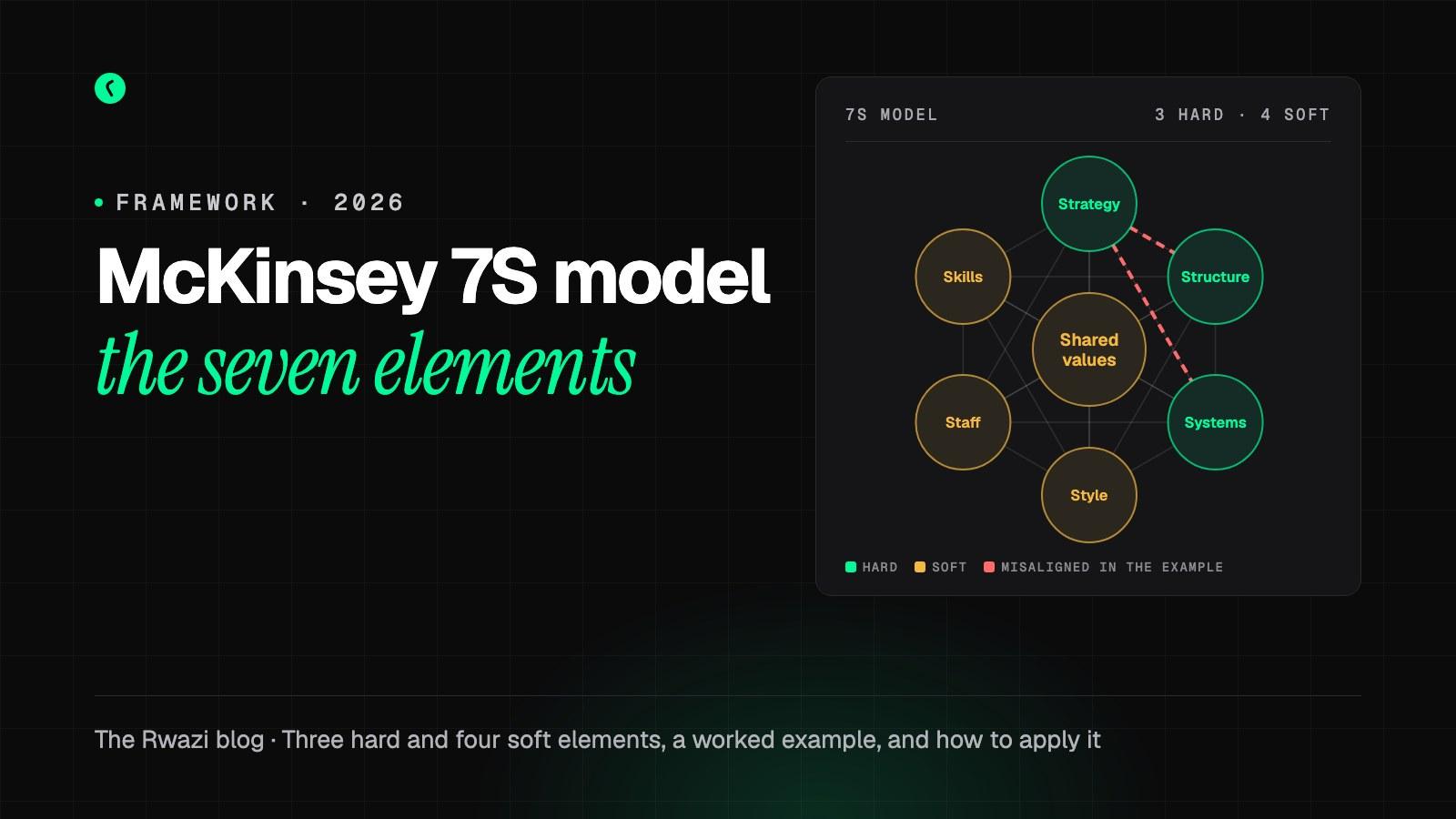
The 7S model splits its elements into three hard elements and four soft elements.
| Element | Type | What it covers | Question to ask |
|---|---|---|---|
| Strategy | Hard | The plan to win against rivals | Is the strategy clear, and does everyone know it? |
| Structure | Hard | How teams are organized and who reports to whom | Does the structure let the strategy move fast enough? |
| Systems | Hard | Processes, tools, and routines that run daily work | Do the systems measure and reward what the strategy needs? |
| Shared values | Soft | The core beliefs and culture at the center | Do people believe in where the company is going? |
| Style | Soft | How leaders lead and decide | Does the way leaders act match the strategy? |
| Staff | Soft | The people, roles, and how they are hired and developed | Are the right people in the right roles? |
| Skills | Soft | What the organization is good at | Does the company have the capabilities the strategy needs? |
Hard elements are easier to define and change from the top: a new strategy, an org chart, or a new system. Soft elements live in culture and habits, change slowly, and often decide whether the hard changes stick.
How to apply the McKinsey 7S framework in 6 steps
How to apply the 7S framework follows six steps, whether the trigger is a new strategy, a merger, or a performance problem.
- Name the change. State the strategy, merger, or problem the analysis serves.
- Map the current state. Describe each of the seven elements today, with evidence.
- Describe the target state. Describe each element as the new strategy needs it.
- Score the fit between pairs. Check every pair of elements for support or conflict, starting with shared values.
- Rank the gaps. Fix the gaps that block the strategy first, and plan for soft elements to take longer.
- Assign owners and review. Give each gap one owner and a date, and re-run the check every quarter.
McKinsey 7S model template
A McKinsey 7S model template needs a current state, a target state, and the gap for each element, plus a check of how the elements fit together.
Scroll sideways for all 6 columns →
| Element | Current state | Target state | Gap | Owner | Priority |
|---|---|---|---|---|---|
| Strategy | |||||
| Structure | |||||
| Systems | |||||
| Shared values | |||||
| Style | |||||
| Staff | |||||
| Skills |
Fit check: Score each pair of elements from 1 (in conflict) to 3 (supporting each other). Seven elements make 21 pairs, and the lowest scores show where the organization works against itself.
McKinsey 7S model example
This McKinsey 7S model example is illustrative: a consumer brand that sells mostly through supermarkets decides to grow in convenience stores.
- Strategy: Win shelf space in convenience stores with smaller packs and faster delivery.
- Structure: Sales teams are organized by supermarket chain, and convenience accounts sit outside every team. This is the first gap.
- Systems: Planning runs on monthly supermarket orders, while convenience stores reorder weekly. Second gap.
- Shared values: The company prides itself on large promotional events, which suit supermarkets more than small stores.
- Style: Leadership signs off every promotion centrally, which slows the fast local deals convenience stores expect.
- Staff: The field team is sized for 40 chain buyers, and convenience means thousands of independent owners.
- Skills: Strong in category management for chains; new to route-to-market for small stores.
What the fit check shows: Strategy conflicts with structure, systems, and style. The order of fixes: name a convenience channel owner (structure), move to weekly planning for that channel (systems), then give regional teams promotion authority up to a set budget (style). Staff and skills follow over two to three quarters.
Check how the organization fits the strategy
Sign up for Sena with 500 credits, describe the strategy and the organization, and run the McKinsey 7S check with Sena's Positioning Agent, with the gaps ranked by what blocks the strategy first.
Run the 7S check with 500 credits
Limitations of the McKinsey 7S model
The 7S model is a diagnostic tool, so it has clear limits.
- Inward-looking: It checks internal fit and leaves customers, competitors, and the market to other tools.
- Qualitative: Scores rest on judgment, so two teams can read the same element differently.
- Static: It shows a snapshot, so the check needs repeating as the change runs.
- Soft elements are slow: The model names them, but changing culture, style, and skills takes months to years.
Frameworks that pair well with it: Kotter's 8 steps for leading the change, a balanced scorecard for measuring it, and SWOT or Porter's Five Forces for the outside view.
Where Sena fits: internal fit and market fit
Sena picks up where the 7S model ends. Sena's Positioning Agent assesses where a company stands and what it is good at, and one of its tools runs the McKinsey 7S check: how strategy, structure, and culture fit.
- The decision: A consumer brand plans to grow in convenience stores and wants to know whether the organization and the market both support it.
- What Sena reads: The team's own sales and organization files, public market data, and consumer activity captured on request through Rwazi's 5M+ consumer network across 190+ countries: what shoppers buy in convenience stores, what they pay, and which brands they choose there.
- Consent: Contributors in the network choose to share what they buy, and every answer is zero-party data.
- What Sena returns: A 7S fit check with the gaps ranked, plus market evidence on whether convenience shoppers buy the category at the planned price, with sources and a confidence level.
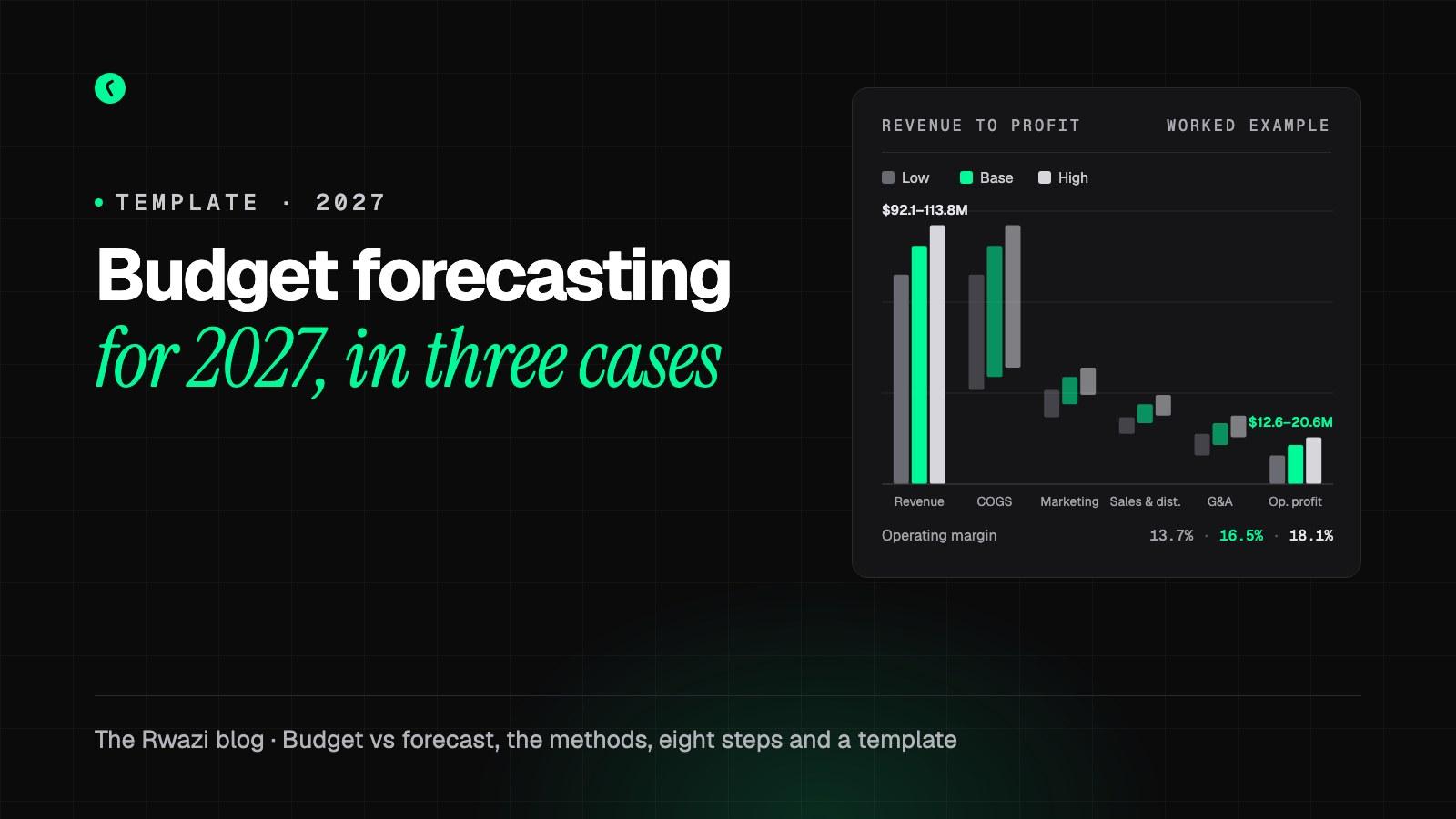
The team fixes the gaps that block the strategy and goes ahead with evidence that the market is there. The guide to how to make data-driven decisions covers the wider process, and the 2027 budget forecast guide covers funding the change.
Test the strategy inside and out
Browse Sena's agents to see the frameworks behind each answer. Then sign up with 500 credits and run the 7S check on a live strategy, with market evidence beside it. Rwazi's consumer network captures what shoppers buy and pay on request.
Browse Sena's agents · Sign up with 500 credits · Request real-world data
McKinsey 7S model: the bottom line
- Fit is the point: The seven elements work only when they support each other.
- Start at the center: Shared values connect the rest, so check them first.
- Score the pairs: The gaps between elements show where the organization works against its strategy.
- Look outside too: Pair the 7S check with market evidence that the strategy fits.
Frequently asked questions
What is the McKinsey 7S model?
The McKinsey 7S model is a framework for checking whether seven internal elements of an organization fit together: strategy, structure, systems, shared values, style, staff, and skills. Robert Waterman and Tom Peters developed it at McKinsey in the early 1980s.
What is the main purpose of the McKinsey 7S framework?
The main purpose is to check whether an organization is aligned to carry its strategy. Teams use it to diagnose why a strategy is stalling, plan a reorganization or merger, or test whether a company can carry a new strategy before it starts.
Which three components are the hard elements in the McKinsey 7S model?
The three hard elements are strategy, structure, and systems. They are easier to define and change from the top, through a new plan, an org chart, or new processes and tools.
What are the soft elements of the McKinsey 7S model?
The four soft elements are shared values, style, staff, and skills. They live in culture and habits, change more slowly than the hard elements, and often decide whether a change sticks. Shared values sit at the center of the model.
How to apply the McKinsey 7S framework?
Name the change the analysis serves, map the current state of all seven elements, describe the target state, score the fit between each pair of elements, rank the gaps, and assign an owner and date to each, then repeat the check every quarter.
What are the limitations of the McKinsey 7S model?
The 7S model looks inward and leaves customers, competitors, and the market to other tools. Its scores rest on judgment, it shows a snapshot, and changing the soft elements takes months to years. Teams pair it with external tools such as SWOT or Porter's Five Forces.
What is a McKinsey 7S model example?
A consumer brand moving from supermarkets into convenience stores finds its strategy clashes with a structure organized by supermarket chain, monthly planning systems, and central sign-off on every promotion. It fixes structure first, then systems, then leadership style.
What are the 7 steps of McKinsey problem solving?
McKinsey's 7-step problem solving is a different method from the 7S model: define the problem, structure it, prioritize the issues, plan the work, analyze, synthesize the results, and communicate the recommendation. The 7S model checks organizational fit; the 7 steps solve a business problem.
Ask Sena a strategy question · Request real-world data
About the author: Joseph Rutakangwa is Co-founder and CEO of Rwazi, which builds Sena, the Decision AI with access to real-world data from a 5M+ consumer network across 190+ countries.
Read next: How to make data-driven decisions and 2027 budget forecast