A route to market (RTM) strategy is the plan for how a product moves from the factory to every outlet worth serving: which channels carry it, which distributors, wholesalers, or sales teams sell and deliver it, and the cost to serve each outlet. It is the part of a go to market plan that puts the product on the shelf.
Sena is the Decision AI from Rwazi with access to real-world data. It reads distributor reports and a team's own sales next to what sits on the shelf in each territory and shows where availability breaks between distributor and shelf, with sources and a confidence level. Sena captures the shelf data through Rwazi's 5M+ consumer network across 190+ countries when a question needs it.
A route to market strategy answers four questions:
- Which outlets: The shops, chains, and kiosks worth serving, and the ones a cheaper route can reach.
- Which channel: Modern trade, traditional trade, wholesale, or e-commerce for each outlet group.
- Who serves each outlet: The team's own sales force, a distributor, a wholesaler, or digital ordering.
- At what cost: Delivery, sales calls, trade terms, and margin for every step.
Ask Sena a route to market question
Put one route to market question to Sena, such as which route fits a household cleaning product in independent shops and kiosks. The answer comes back with its sources and a confidence level.
Key takeaways
- Route to market moves the product; go to market sets the plan: RTM is the part of the plan that reaches each outlet.
- Segment by outlet: A supermarket chain and a corner shop need different routes.
- Cost to serve decides the model: Each outlet earns its route through the margin it returns.
- Check three numbers by territory: Sell-in to distributors, outlet sales, and shelf presence.
- Review the scorecard each quarter: Outlets move between routes each quarter, and the model itself changes every few years.
What is route to market?
"Route to market" means the plan for how a product moves from the factory to every outlet worth serving. It covers four parts:
- Channels: The outlet types that carry the product, such as supermarket chains, independent shops, and online stores.
- Partners: The distributors and wholesalers that buy, store, and deliver the product.
- Sales coverage: The territories, call frequency, and targets for the sales team.
- Commercial terms: Margins, trade terms, credit, and minimum orders at each step.
RTM terms in sales
- Primary sales: Manufacturer to distributor, also called sell-in.
- Secondary sales: Distributor to outlet.
- Tertiary sales: Outlet to shopper, also called sell-out or offtake.
- Beat plan: The fixed outlet route a rep calls on each day.
- Van sales economics: Each van pays its way through drops per day and drop size against the cost of the van, driver, and stock on board.
Route to market vs GTM
| Go to market | Route to market | |
|---|---|---|
| Question it answers | What to sell, to whom, at what price | How the product reaches each outlet |
| Scope | Target buyers, positioning, pricing, launch plan | Channels, partners, sales coverage, delivery |
| Typical owner | Marketing and leadership | Sales, trade marketing, and supply chain |
| How often it changes | At launch and at big repositioning moves | Outlet routes each quarter, the model every few years. |
The GTM strategy page covers the market-by-market sequence that comes before the route.
Route to market in FMCG
In FMCG, a product passes through several hands before it reaches the shelf:
- Manufacturer to distributor: The distributor buys stock for a territory. The manufacturer records this as sell-in.
- Distributor to outlet: The distributor's reps take orders and deliver to shops on their list. These are secondary sales.
- Wholesaler to small outlet: Kiosks and small shops often buy from wholesalers or cash-and-carry markets.
- Outlet to buyer: The product sells off the shelf. This is sell-out.
Supermarket chains usually agree terms directly with the manufacturer's key account team and take delivery at their own warehouse or from a distributor. Independent shops buy through distributors and wholesalers.
The manufacturer sees sell-in clearly. Sell-out and shelf presence sit further down the chain, where reports come from partners. The supply chain visibility page covers what reached each outlet, and the Decision AI for supply chain page covers the wider workflow.
Route to market models
Route to market models fall into three groups: direct routes, indirect routes through distributors and wholesalers, and hybrid routes that mix the two by outlet segment. Digital ordering runs inside any of them.
| Model | How it works | Fits | Trade-off |
|---|---|---|---|
| Direct | The manufacturer's own sales force and trucks serve outlets, including direct store delivery | Key accounts, perishables, dense cities | Full control and data, with the highest fixed cost |
| Distributor | A partner buys stock and serves outlets in a territory through pre-sell orders delivered later or van sales from a stocked truck | Fragmented traditional trade, wide regions | Fast reach, with less control and a distributor margin |
| Wholesale | Outlets buy from wholesalers or cash-and-carry markets | Small, low-volume outlets | Lowest cost to serve, with little view of the shelf |
| Hybrid | Direct for key accounts, partners for the rest | Most consumer goods portfolios | Balances cost and control, with channel overlap to manage |
| Digital ordering and ecommerce | Outlets reorder through ordering apps, and shoppers buy through marketplaces or retailer sites. | Reorders, remote outlets, online-led categories | Lower order cost, with delivery economics to prove |
Route to market strategy steps
Consumer goods teams build a route to market strategy in six decisions:
- Count and segment outlets. Start from an outlet census of every shop in each territory, then group outlets by channel, sales value, growth potential, and service needs.
- Set the role of each channel. Decide where each channel wins, and keep prices and terms consistent across channels that overlap.
- Assign a service model to each segment. Direct, distributor, wholesale, van sales, or digital ordering, matched to the segment's value.
- Choose partners and set the terms. Pick distributors on outlet reach, warehouse and fleet capacity, credit strength, rival products carried, and readiness to share outlet-level sales. Then set margins, trade terms, credit, and minimum orders for each partner and outlet type.
- Model cost to serve per outlet. Compare the full cost of serving each outlet with the margin it returns before scaling the route.
- Set the scorecard and check it each quarter. Read the metrics territory by territory, and move outlets to a different route where the numbers break.
The six decisions double as a route to market strategy template: one row per outlet segment, with channel role, service model, terms, cost to serve, and scorecard as the columns.
Check the scorecard against the shelf
Sign up for Sena with 50 credits, upload a sell-in file and a distributor's outlet sales file, and ask which territories grew sell-in while outlet sales stayed flat. That list shows where to check the shelf first, ahead of the next distributor review.
Route to market metrics
- Outlet reach: The share of relevant outlets that carry the product, with every outlet counting the same.
- Sales-weighted reach: The share of category sales that runs through outlets carrying the product: category sales in those outlets divided by total category sales, times 100.
- Outlet coverage: Outlets served against outlets worth serving by territory.
- On-shelf availability: The share of store checks that find the product on the shelf in outlets that list the product. The on-shelf availability use case covers how to find the cause of each gap.
- Cost to serve per outlet: Delivery, sales calls, trade terms, and partner margin per outlet.
- Strike rate: The share of sales calls that end in an order.
- Distributor stock cover: Days of stock the distributor holds, by product. A rising figure flags sell-in running ahead of outlet orders.
- The three-number check: Sell-in to distributors, outlet sales, and shelf presence, read side by side for each territory.
The manufacturer's own invoices cover sell-in. Distributor reports cover secondary sales, from the distributor to the outlets on its list. Syndicated retail data covers sell-out in the stores it tracks. Shelf presence in each outlet closes the loop. The channel reach and coverage page shows which outlets carry the line, which carry a rival's, and where the overlap sits.
How to read the three numbers
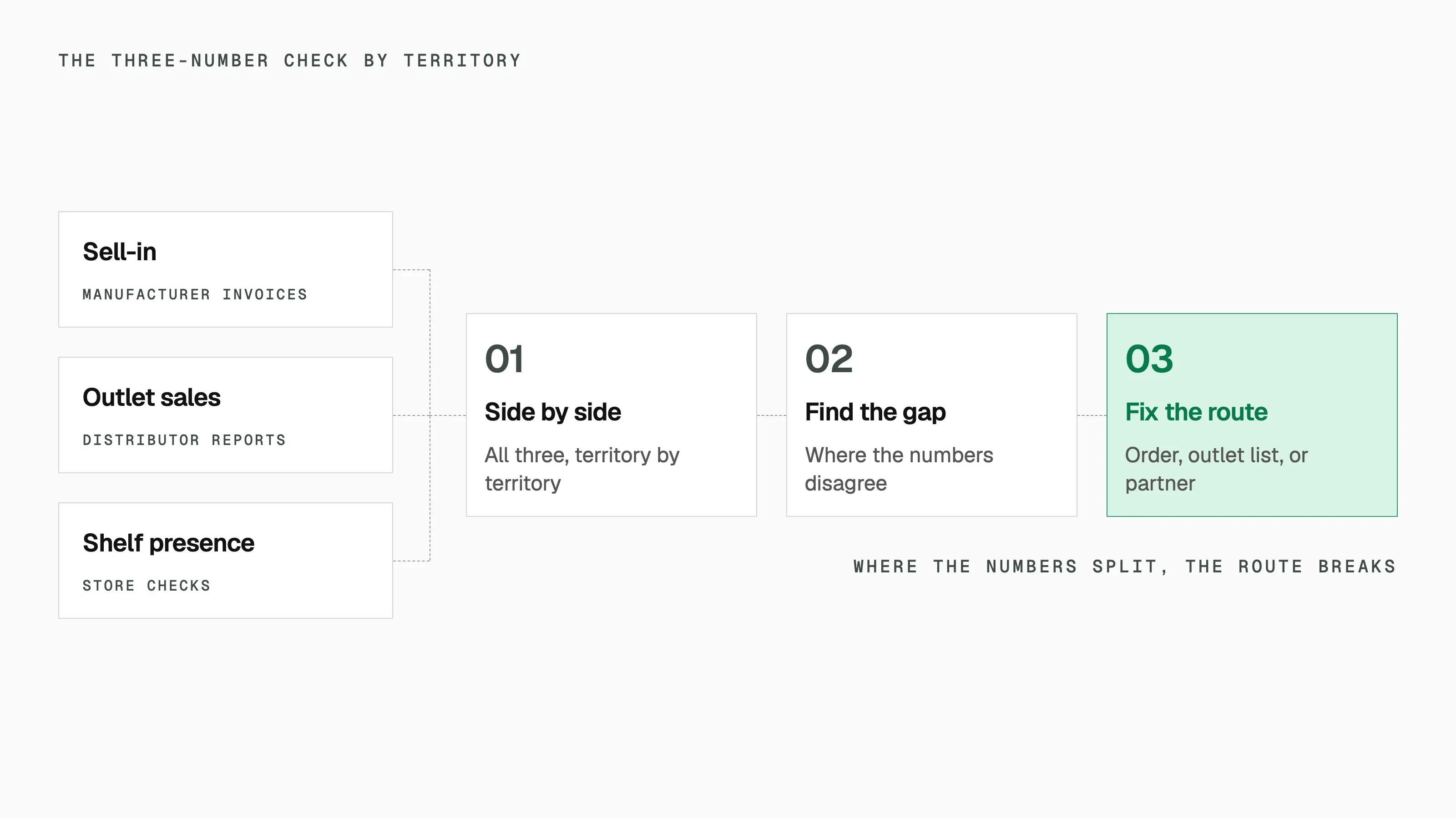
- Sell-in above outlet orders: Stock builds at the distributor. Stock cover shows by how many days.
- Outlet orders above shelf presence: Stock reaches the outlet list, and some shelves stay empty, from closed shops, slow restocking, or a rival in the space.
- All three in line: The route works in that territory, and the next question is cost to serve.
Where route to market breaks
Most route to market plans look sound at the national level. The gaps sit in single territories:
- Sell-in ahead of sell-out: A month-end push loads the distributor with stock to hit a sell-in target, and the stock sits in the distributor's warehouse while outlets run empty.
- Channel conflict: A wholesaler sells into the same shops below the distributor's price, or stock bought for one territory turns up in another, and the distributor's outlet sales fall.
- Outlet lists that drift: Shops on the distributor's list have closed, changed owners, or dropped the product.
- Listed products off the shelf: The outlet carries the product on paper, and the shelf shows a rival in its place.
- Territory averages: A strong city hides a weak rural area inside the same territory total.
- Cost to serve creep: Small outlets keep a direct route long after their volume fell below the cost of serving them.
The store coverage and retail execution use case shows how teams check coverage claims store by store.
Which route to market fits
| Situation | Typical route |
|---|---|
| Short shelf life or fast-moving products (bread, dairy, soft drinks, salty snacks) | Direct store delivery, by the manufacturer or a bottler, for freshness, rotation, and shelf upkeep |
| Slower-moving shelf-stable products (personal care, household goods, pantry staples) | Retailer warehouses for chains, distributors and wholesalers for independent shops |
| Modern trade (supermarket and convenience chains) | Direct key account management |
| Traditional trade (independent shops and kiosks) | Distributor networks with van sales |
| Small budget or low-volume outlets | Wholesale and digital ordering |
| Many markets with different trade structures | Hybrid, set territory by territory |
Route to market examples
- Modern trade: A beverage maker serves national supermarket chains directly through key account managers, checks shelf presence store by store before each promotion, and holds promotion spend in stores where the product is missing until stock lands.
- Traditional trade: A snack maker reaches independent shops through regional distributors with van sales and adds a second van route where the distributor's outlet list misses rural shops.
- Wholesale for small outlets: A personal care maker moves its smallest outlets from direct delivery to wholesale and keeps direct calls for the outlets whose margin covers them.
- Digital ordering: A household goods maker adds app-based reordering for remote shops and keeps the distributor for delivery.
The sales territory analysis use case shows how a team finds why the same product sells differently by territory.
Where Sena fits: a distributor renewal
- The decision: Which distributors to renew in three territories where sell-in rose and outlet sales stayed flat, with the contract review due next month.
- What the distributor report shows: Orders delivered to the outlets on the distributor's list. The review also needs to know which of those outlets carries the product on the shelf this month.
- What Sena reads: The team's sell-in file, the distributor's outlet sales report and outlet list, plus store photos that contributors in Rwazi's 5M+ consumer network share when the question needs them. Sena's computer vision reads which products sit on each shelf, at what price, and which have run out.
- Consent: Contributors in the network choose to share each store photo, and every photo comes from a store open to the public.
- What Sena returns: Which territories and outlets carry the product on the shelf, where sell-in and shelf presence disagree, and the volume at stake in each gap, with sources and a confidence level on the answer.
The team renews the distributor in the territories where shelf presence matches sell-in. Where the two disagree, it trims the next sell-in order to match outlet sales and moves the empty-shelf outlets to a second distributor ahead of the renewal. The Decision AI for sales page covers the wider sales workflow, and the CPG industry page covers the category view.
Test a route to market question in Sena
Ask Sena a route to market question in chat, or sign up with 50 credits and upload a sell-in file.
Ask Sena a route to market question · Sign up with 50 credits
Frequently asked questions
What is a route to market?
A route to market is the plan for how a product moves from the factory to every outlet worth serving. It sets which channels carry the product, who sells and delivers it, the commercial terms at each step, and the cost to serve each outlet, so the product reaches the shelf where buyers shop.
What does RTM mean in sales?
In sales, RTM means route to market: the coverage plan behind the sales team. It sets which outlets each territory serves, how often reps call on them, which distributor or wholesaler supplies them, and the targets for each call, such as orders taken and products listed.
What is route to market vs go to market?
Go to market sets the target buyers, positioning, pricing and launch plan for a product. Route to market is the part of that plan that moves the product to buyers: the channels, distributors, sales coverage and delivery behind each outlet. Go to market decides what to sell and to whom, and route to market decides how it gets there.
What is route to market in FMCG?
In FMCG, route to market is the path a product takes from the manufacturer to thousands of outlets. Supermarket chains usually agree terms direct with the manufacturer, while independent shops buy through distributors or wholesalers. The test of an FMCG route to market is whether the product sits on the shelf in the outlets the plan counts.
What are the main route to market models?
The main models are direct, where the manufacturer's own sales force and trucks serve outlets; distributor, where a partner buys and serves outlets in a territory; wholesale, where outlets buy from wholesalers or cash-and-carry markets; hybrid, which mixes these by outlet segment; and digital ordering or ecommerce.
What is an RTM in marketing?
In marketing, RTM stands for route to market: the channels, partners and sales coverage that carry a product from the manufacturer to each outlet and buyer. Marketing sets the positioning, price and promotion, and the RTM plan sets which outlets stock the product, who supplies them and how often each one gets a sales call.
What metrics measure route to market performance?
The core metrics are outlet reach, sales-weighted reach, outlet coverage, on-shelf availability, cost to serve per outlet and strike rate. The most telling check compares three numbers by territory: what the manufacturer ships to distributors, what outlets sell, and what sits on the shelf. A wide gap shows where the route breaks.
What is the difference between outlet reach and sales-weighted reach?
Outlet reach is the share of relevant outlets that carry a product, with every outlet counting the same. Sales-weighted reach is the share of category sales that runs through those outlets. A product in a few large supermarkets can show low outlet reach and high sales-weighted reach, so teams read both before adding outlets.
What is cost to serve in route to market?
Cost to serve is the full cost of supplying one outlet or segment: delivery, sales calls, trade terms, partner margin, returns and credit. Teams compare it with the margin each outlet returns, then move low-volume outlets to a cheaper route, such as a wholesaler or digital ordering, and keep them supplied.
What is an example of a route to market strategy?
A snack maker serves supermarket chains direct through key account managers, independent shops through regional distributors with van sales, and small kiosks through wholesalers. Each quarter it checks shelf presence by territory and moves outlets to a different route where sell-in and shelf presence disagree.
Ask Sena a route to market question · Sign up with 50 credits
Read next: Sales territory analysis and What is syndicated data?