
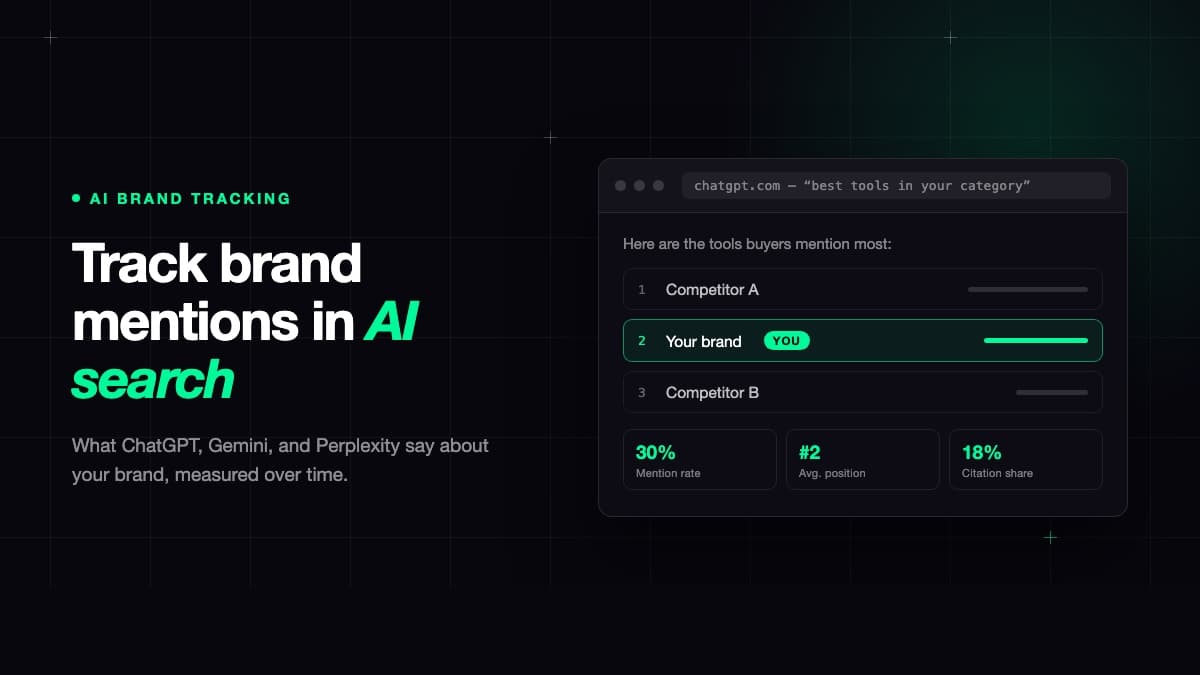
Ask ChatGPT for the best tool in your category. Does it name you or your competitor? More buyers start their search there every month. In fact, 51% of B2B software buyers now open an AI chatbot before Google. If the model skips you, the loss stays hidden.
AI brand tracking fixes that blind spot. It shows how ChatGPT, Gemini, and Perplexity describe your brand over time. You see where you rank, how you are framed, and which sources shape the answer.
Ahead, you'll learn what to measure and how to set it up for each assistant. You'll also see the tools that help and how to improve what the models say.
Key takeaways
- AI brand tracking shows how ChatGPT, Gemini, and Perplexity describe your brand over time.
- The stakes are high. 69% of buyers picked a different vendor based on AI and guidance, and 33% bought from a new brand.
- Track five metrics: mention rate, share of voice, citation share, average position, and sentiment.
- The method is simple. Pick your assistants, run buyer questions on a schedule, then log the results.
What is AI brand tracking?
AI brand tracking measures how often your brand appears in AI answers. It also tracks how accurately the models describe you. It is the AI-era version of share of voice. Traditional brand tracking reads periodic studies and social posts. AI brand tracking reads the answers themselves. Those are the recommendations and comparisons that ChatGPT, Gemini, and Perplexity give a buyer.
An AI brand tracker runs your questions against these assistants on a schedule. It scores each answer for three things:
- Presence is whether your brand shows up at all.
- Position is where it lands against competitors.
- Accuracy is whether the description matches reality.
Together they show if the models recommend you, skip you, or get you wrong.
Why brand perception in AI answers matters now
Buyers ask an assistant before they open a search tab. They type "best brand tracking software for a mid-market team" into ChatGPT. Then they read the shortlist it returns. Sit on that shortlist, described well, and you enter the deal. Get skipped or mislabeled, and you lose the buyer in silence.
The shift is already at scale:
The business impact should land with any leadership team:
69% of buyers picked a different vendor based on AI guidance. One in three bought from a brand new to them.
This is the quiet part of the shift. A drop in AI visibility looks like a slow quarter. You see fewer inbound conversations and a softer pipeline. The cause stays hidden. The buyer who asked the assistant stays invisible to your analytics. Tracking the answers turns that blind spot into a signal.
What AI brand tracking measures: 5 metrics
Strong AI brand tracking turns the answers into five numbers. Together they show whether you appear and how you are framed.
- Mention rate: The share of test prompts where your brand appears. The formula is simple: appearances divided by total prompts, times 100. Appear in 12 of 40 questions, and your mention rate is 30%.
- Share of voice: Your mentions against your competitors across the same prompts. It shows who owns the category in the model's eyes.
- Citation share: How often your own pages get cited behind an answer. These pages shape the model's view, and you can earn more of them.
- Average position: Where your brand lands in a ranked list. The first six reads are very different from the last.
- Sentiment and accuracy: Whether the framing is positive, neutral, or critical. And whether the facts are right. A confident, wrong description costs you more than silence.
How to track your brand in AI answers?
The method is the same for every assistant. The specifics vary by platform, as shown below.
- Choose your assistants: Start with the ones your buyers use. For most B2B teams, that means ChatGPT, Gemini, and Perplexity. ChatGPT leads B2B software research at 63% of buyers.
- Build a prompt set: Write 25-40 questions a real buyer would ask. Cover three types. Category questions, like "best tools for X." Comparison questions, like "X vs Y," and direct brand questions, like "What is [your brand]." Keep the wording fixed so results stay comparable.
- Run the prompts and log the answers: For each one, record whether your brand appears. Note its position, the sources cited, and how it reads. A simple sheet works to start.
- Repeat on a schedule: Run the same set weekly or monthly. The value is in the movement. A brand can slip from first to fifth after a model update. That is the change you want to catch early.
- Score and compare: Turn the log into a few numbers you track over time. Use the mention rate and average position. Benchmark them against two or three competitors.
A dedicated AI brand tracker handles the running and logging. It runs the prompts on schedule and alerts you when your visibility shifts.
a. ChatGPT
Run your category and comparison prompts. Then log how ChatGPT handles your brand.
- Score each answer for whether your brand is named, ranked, and described correctly.
- Watch the source mode. Web browsing returns different results than training data.
- Automate it. A ChatGPT brand tracker runs these prompts on a schedule. It flags the changes for you.
b. Gemini
Use the same prompt set. Watch the Google link, since AI Overviews now show on 48% of Google searches.
- Brands that rank in Google organic results often surface in Gemini too.
- Log presence, position, and sources. Then compare them against your ChatGPT results.
c. Perplexity
Perplexity shows its sources inline. That makes it the clearest place to see which pages shape the answer.
- Log the cited domains for each prompt. Note where your own pages appear.
- Earn citations on the sources Perplexity already trusts. That is the most direct way to lift your presence.
Common AI brand tracking mistakes
A few patterns trip up most teams. Avoid them and your data stays useful.
- Tracking only ChatGPT: Buyers also ask Gemini and Perplexity. Your position often differs. Cover all three.
- Running the prompts once: A single snapshot misses the trend. Answers shift with model updates. Run on a fixed schedule.
- Leaving outdated pages live: Old pages feed wrong answers. Update or redirect the sources the models cite.
- Treating position as fixed: A model update can move you overnight, and you can recheck after major releases.
AI brand tracking tools compared
You can start free. A spreadsheet and manual prompt runs cover the basics. One native tool adds real data. Bing Webmaster Tools has an AI performance view. It shows how often Copilot-style answers cite your site and which queries drive them.
As your prompt set and competitor list grow, a purpose-built AI brand tracker saves time. It also keeps the data consistent. The features that matter most:
- Multi-assistant coverage: Track ChatGPT, Gemini, and Perplexity together, not one by one.
- Scheduled, automated runs: Consistency is the whole point, and manual runs drift.
- Sentiment and accuracy scoring: Presence alone hides whether the framing helps or hurts.
- Citation-level detail: It shows which sources the model trusts, so you know where to earn a mention.
- Competitor benchmarking: Your numbers mean more when you're up against two or three rivals.
Here is how the leading AI brand tracking tools compare in 2026. Pricing moves fast, so confirm the current plan before you buy.
| Tool | Best for | Assistants tracked | Starting price | Free trial |
|---|---|---|---|---|
| Profound | Enterprise teams that need the most depth | 10+ models incl. ChatGPT, Perplexity, Google AI | From $499/mo | Demo only |
| Otterly.AI | Small teams and the lowest entry cost | ChatGPT, Perplexity, Google AI Overviews | From $29/mo | 14 days |
| Peec AI | Mid-level marketing teams | ChatGPT, Perplexity, Gemini | From €89/mo | 7 days |
| Semrush AI Visibility Toolkit | AI coverage across ChatGPT, Gemini and others. | Major assistants plus AI Overviews | From $99/mo | With Semrush trial |
| Scrunch AI | Broadest platform coverage plus GA4 attribution | ChatGPT, Claude, Perplexity, Gemini, Meta AI, Google AI Mode and Overviews | From $250/mo | Demo |
| Nightwatch | Teams combining SEO rank tracking with AI | Multiple assistants plus organic search | AI add-on from $99/mo | 14 days |
Most of these tools answer the same question well. Did the answer move, and how do you compare to rivals? The harder question is why. What is true in the real world behind the answer? The next section covers that.
How to improve your AI brand presence?
Tracking earns its keep when it changes what you do next. Use the gaps you logged to drive four moves. People call this generative engine optimization. It means giving the models better, more consistent sources to read.
- Earn a place in the sources the model trusts: When the model skips your brand, trace the pages it cites. If it leans on review sites like G2 or Capterra, build your profile there. If it cites comparison guides, earn a mention or publish your own.
- Fix inconsistent brand information: Models stay cautious when your details conflict across the web. Keep your description, category, and core facts consistent everywhere.
- Correct hallucinations at the source: When the model gets you wrong, trace the claim to its page. If an old post says you lack a feature, update or redirect it.
- Strengthen third-party validation: AI leans on third-party consensus. Reviews, press, and mentions on trusted sites move you more than your own copy.
Two more reads close the loop. When a competitor climbs, study the citations behind their rise. When your position slips after a model update, treat it as an early warning.
How does Sena fit?
Every tracker in the table answers the same two questions. Did the answer move, and how do you rank against rivals? Sena, the Decision AI built by Rwazi, answers the question that decides your next move: why it moved and what is true in the real world behind it.
Here is what that adds to the five metrics you just tracked:
- It reads the cause behind the number. Sena reads your presence in AI answers alongside real-world signals from a 5M+ consumer network across 190+ countries. So when your mention rate slips or your sentiment turns, you see what drove it.
- It traces every answer back to its source. The same move this guide asks of you, it runs for you. Sena surfaces the pages the model trusts and flags the ones that describe you wrong, so you fix them where they live.
- It shows you where effort pays off. Sena connects the sources shaping the answer to how buyers behave in the real world, so your next move lands where it changes the result.
Presence tells you the model skipped you, but Sena tells you why and where to fix it. That context is what most trackers leave out.
Conclusion
AI answers are the new front door to your category. Buyers read them before they reach your site. AI brand tracking shows what those answers say about you. Pick your assistants, run a fixed set of prompts, and track the five metrics. Then fix the gaps you find at the source. Start now, while the AI search results are still forming.
Frequently asked questions
What is AI brand tracking?
AI brand tracking measures how often your brand appears in AI answers. It also tracks how accurately the models describe you. It works across ChatGPT, Gemini, and Perplexity. It is the AI-era version of share of voice.
How do I track brand mentions in AI search?
Pick the assistants your buyers use. Run a consistent set of category questions. Record whether your brand appears, where it ranks, and how it reads. Repeat on a schedule so you see the trend. A dedicated tracker can automate the prompts for you.
Can you track brand mentions in ChatGPT?
Yes. Run the prompts your buyers would ask. Then log whether ChatGPT correctly names, ranks, and describes your brand. Do this on a schedule to see trends across model updates. A ChatGPT brand tracker can run the prompts for you.
What is an AI brand tracker?
An AI brand tracker is a tool that runs your questions against AI assistants on a schedule. It scores each answer for presence, position, and accuracy. It saves the manual work and keeps your data consistent.
How is AI brand tracking different from traditional brand tracking?
Traditional brand tracking reads periodic studies, social posts, and news. AI brand tracking reads the answers AI assistants give directly. That is where many buyers form their first impression. The strongest approach combines both, plus real-world signals.
How often should I run an AI brand tracker?
Weekly or monthly works for most teams. Answers shift as models update and as new sources get indexed. A fixed schedule catches movement that a one-time check misses. High-stakes categories benefit from weekly runs.
Which AI assistants should I track?
Start with the assistants your buyers use for most B2B teams; that means ChatGPT, Gemini, and Perplexity. ChatGPT leads B2B software research at 63% of buyers. Add others, like Microsoft Copilot, as you learn where buyers ask.